Official game
Play Shardbreakers
This game is hosted by Steam. Continue to the official page to play or download it.
Wishlist on SteamOverview
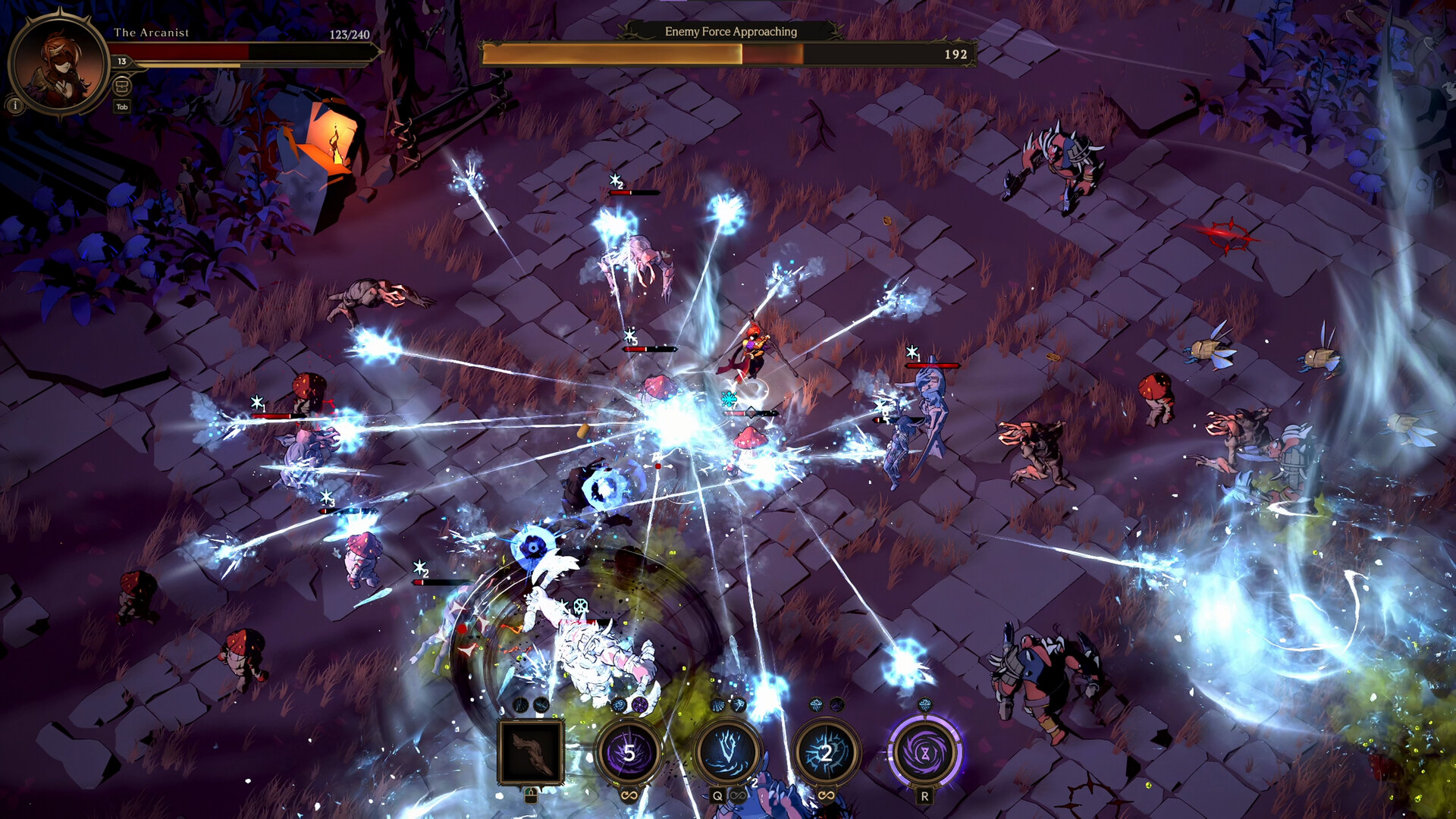
Shardbreakers is an isometric bullet-hell action roguelite from Embercore, and it hangs the entire experience on one idea you do not find combos, you design them. Every attack comes from Shards: socketed fragments of the First Light that you combine in lanes on a spell engine board. Skill Shards define what a spell does, Modifier Shards define how it behaves, and Condition Shards decide when it fires. Your weapon attacks on its own, lighter spells trigger themselves, and the biggest nukes wait on your input. The result plays like a twin-stick bullet hell crossed with the socket puzzle from Path of Exile.
The fiction gives the system its name. The Breakers shattered the First Light, the origin of creation, and stole its Shards to fuel their rule. You play one of three heroes descending through hand-crafted biomes swallowed by darkness, reclaiming raw Shards and bending them into increasingly absurd spell engines. Runs use hand-crafted biomes with procedurally generated layouts, permadeath ends the run, and permanent upgrades, skill trees, and unlockable heroes carry over between descents.
The game targets January 2027 on Steam. Embercore has been iterating hard: the demo was pulled for a major rework, a playtest ran through September 2026 with the Fusion system replaced by the new Resonance system, and a public demo was slated for October ahead of Steam Next Fest. That matters for this guide. Numbers and specific shard names below come from the 2026 playtest and demo builds, and Embercore has already reworked core systems once, so expect tuning passes before launch.
| Fact | Detail |
|---|---|
| Developer / Publisher | Embercore |
| Genre | Isometric bullet-hell twin-stick action roguelite |
| Platform | Windows (Steam), full controller support, Family Sharing |
| Release | January 2027; public demo planned October 2026 |
| Heroes | Hunter (Ranger), Arcanist (Mage), Knight |
| Shard types | Skill, Modifier, Condition |
| Skill elements | Fire, Ice (frost), Lightning (shock), Arcane, Physical |
| Run structure | Hand-crafted biomes, procedural layouts, permadeath |
| Meta progression | Blessing tree, unlockable heroes and weapons, blueprints |
| Price | Not announced |
Who it is for: players who liked Path of Exile's socket puzzle and wished it fired in real time, Noita fans who want spell-combination depth without pixel physics, and horde-slayer players who want their build to be the damage source rather than a random upgrade pool.
Who it is not for: players who want the game to pilot itself. Early builds leaned auto, but the 2026 rework deliberately moved toward manual aiming and steering your engine. If you want passive Vampire Survivors progression, this asks more of you.
Getting Started
Wishlist the game and grab the public demo when it drops. Access to past tests came through the Steam playtest request button, and Embercore approved batches of requests manually, so requesting early mattered. Demo progress does not carry to the full game.
Your first 30 minutes
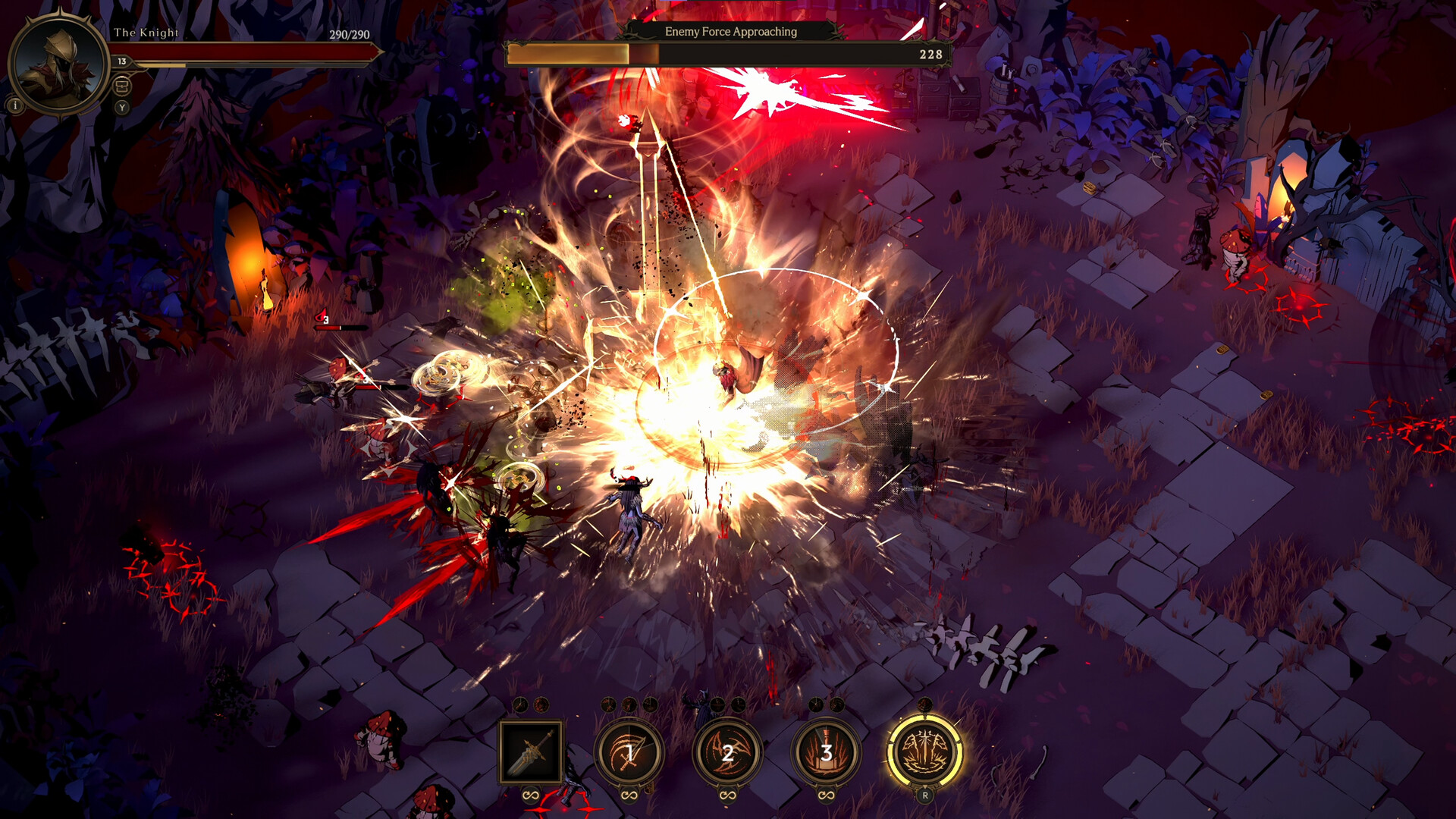
- Start on the Knight. The demo community converged on this fast: the Knight's passive fills a bar as you land basic hits, and spending it grants shields plus on-hit healing. Tab over to your character portrait to read the perk. Built-in mitigation and healing cover the instant-damage instances that kill new players, which makes the Knight the most forgiving hero while you learn room layouts and boss tells. Once you understand the dodge rhythm, the Hunter and Arcanist open up.
- Socket one lane, then test it before adding more. The board shows what a shard combination does before you commit. New players stack five shards, trigger nothing, and die confused. One skill plus one modifier gives you a readable result you can iterate on.
- Read the trigger order left to right. The 2026 rework made placement matter: moving one shard can change the whole chain. If a cascade whiffs, the culprit is usually ordering, not power.
- Spend your manual slots last. Weapon fire and light spells run themselves. Hold your decisive casts for elite packs and boss vulnerability windows.
- Treat death as data. Permadeath ends the run, but the blessing tree, unlocks, and blueprints persist. Push a dumb build into a biome you cannot clear and watch which interaction carries furthest. Failure is build data.
Beginner mistakes to avoid
- Ignoring Condition Shards. They look passive, but conditions turn two skills into a combo. A skill that fires on freeze paired with an ice skill doubles output without touching damage numbers.
- Hoarding shards for a perfect combo. A clean three-shard engine beats a messy six-shard board where nothing fires in order. Socket the working part, upgrade it, then branch.
- Standing in the open during cascades. The board does the damage; you do the dodging. Chained spells clear screens only if you survive long enough for the chain to resolve.
- Chasing slow weapons. Community testing in the demo found attack speed and cooldown reduction outperform raw damage on nearly every weapon. The unlockable crossbows and fire staff hit harder per shot but fire so slowly that sustained DPS lags the base kit. Fast weapons also feed the Knight's bar and on-hit conditions faster.
- Skipping the map preview. Room steps can preview what they offer (new skill, modifier, HP increase). Planning two rooms ahead around your build's needs beats grabbing whatever appears.
Core Mechanics
The spell engine: lanes, slots, and Resonance
Each lane is a row of slots. Skill Shards define what a spell does across five elements. Modifier Shards change projectile count, spread, travel speed, or behavior. Condition Shards decide when things fire: on kill, on freeze, on crit, on hit streak.
The original demo used a Fusion system where combining specific recipes produced new spells. The September 2026 playtest replaced Fusion with Resonance: you socket shards together into chains and rearrange them to change how the engine works, and position within the chain matters. Embercore's framing: where you place your shards now matters, and moving just one can change the whole chain. Spell leveling still works through merging duplicates; most spells stop at level 2 before you combine them, but pushing a single fire spell to level 6 is the unlock condition for the Knight's last sword.
Authority splits three ways. Your weapon fires automatically. Lighter socketed spells trigger on their own. Your most decisive spells stay manual. That split is the design core: the game plays the bottom end so you can spend attention on the decisions that matter, and the 2026 combat rework added manual aiming so you steer the engine rather than watch it.
The five elements and what they enable
Fire burns and spreads. Ice controls, freezing and setting up shatter interactions. Lightning chains between targets. Arcane bends the rules of the other four. Physical anchors builds with reliable, positional damage. The demo does not publish exact numbers, but behavioral identity holds across builds, and conditions keyed to states (frozen, burning, shocked) are where the elements start talking to each other.
Combat density is fuel. Every chain condition reads enemy states, so hordes feed your engine. The counterintuitive skill is standing in the right pocket, letting density trigger cascades, and dodging only the patterns that actually threaten you. Elites and bosses drop rare materials on top of standard loot, so hunting them mid-run compounds your economy.
The run loop: rooms, doors, and choices
Runs descend through hand-crafted biomes. The demo-era maps included the Forsaken Encampment, the Twisted Forest, and the Crystalvein Cavern, with the announcement teasing more to come. Room flow mixes:
- Combat rooms with authored enemy compositions and environmental hazards like spike traps
- Loot goblins that flee with your drops; catching them pays, but they pull you into danger
- Merchant stops where gold buys shards, including run-defining pieces like the healing-on-damage shard
- Door choices between a gold door, a skill upgrade, and a shard door
- Heart rooms and potion pickups for sustain
- Campfires that signal events and heals; the tell can be easy to miss, so watch for the exclamation cue when it is patched in
- Elites and bosses gating biome exits, dropping blueprints on defeat
Blueprints are the meta key: beating bosses drops them, and blueprints unlock entirely new shards and weapons outside the run. Character unlocks draw on them too, and the tracker counts specific conditions (blueprints required for the third hero, spell upgrades for the Knight's last weapon). Note the demo-era quirk: the counter could read 0/5 despite unlocked blueprints until you met the exact condition, and relics found during runs did not always register in the codex. Both are the kind of rough edge the October demo should smooth.
Heroes change the foundation
| Hero | Playstyle | Passive and tempo | Best engines |
|---|---|---|---|
| Knight | Melee anchor, durable | Bar fills on basic hits, spends into shields and on-hit healing; scales fast | Proximity conditions, fire melee, physical anchoring, attack-speed stacking |
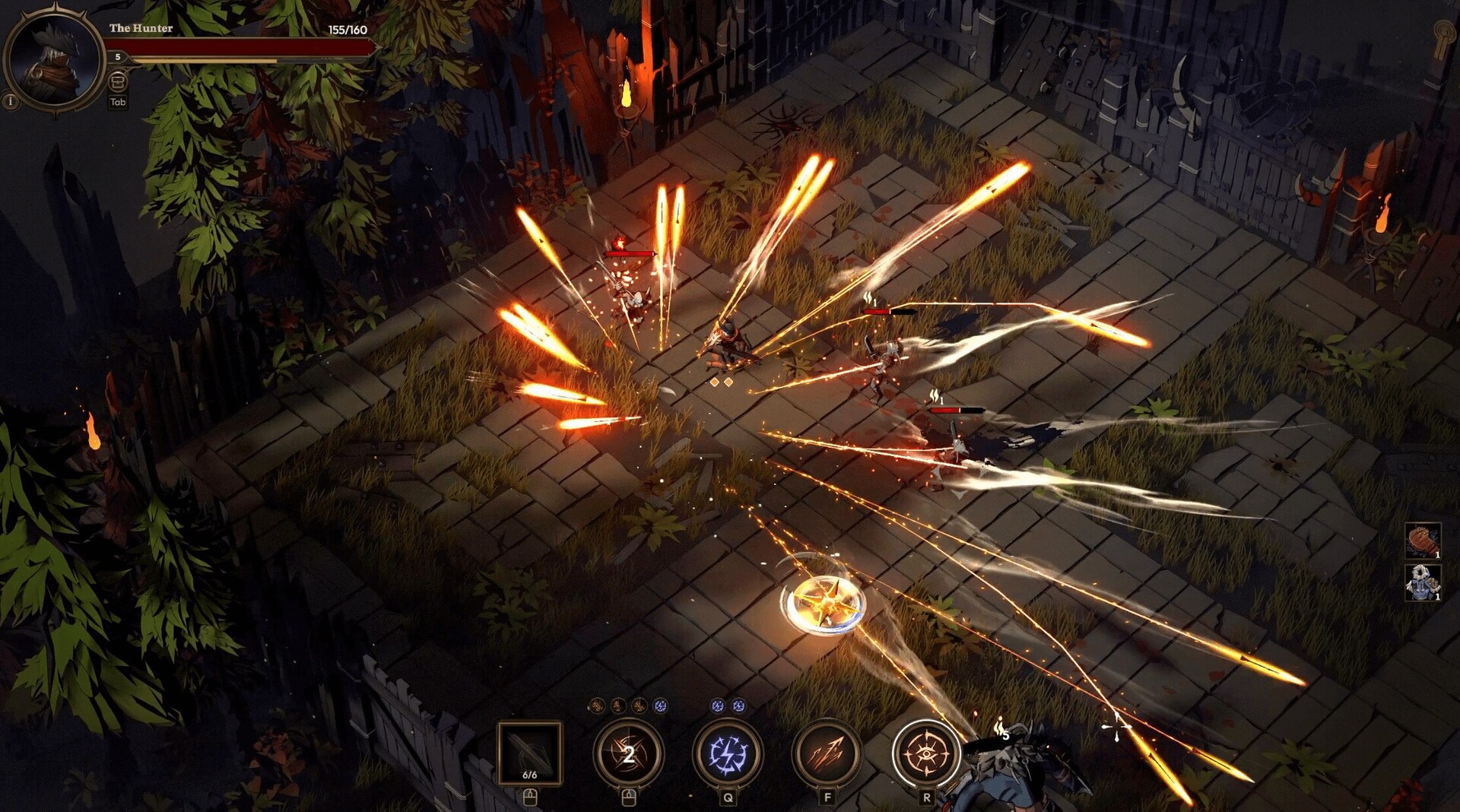
| Hunter (Ranger) | Ranged tempo, mobile | Fastest base movement; repositioning-friendly | Instant mobile triggers, ricochet projectiles, grenade and nova combos |
| Arcanist (Mage) | Caster, synergy density | Leans into raw spell output and condition stacking | Cascading chains, blizzard and blade-vortex uptime, arcane-doubled casts |
The Knight is the easiest win because the passive answers the game's biggest threat (burst damage). The Hunter plays fastest and rewards aggressive repositioning. The Arcanist has the highest build ceiling once conditions compound. Unlocking all three matters because each changes how the same shard pool behaves.
Combat pacing and difficulty
Biome three is where the demo's difficulty spike lived: enemy HP and density jump, and a build that cruised through map two can stall. Elites hit hard enough that unmitigated builds die in two to three hits. The rebalanced October demo targets more consistent build identity early in a run, which should soften the mid-run power gap, but expect late-biome walls to demand completed engines, not half-built ones.
Progression Strategy
Within a run
- First three rooms: build identity. Take the first skill shard that matches a lane concept, then its first modifier. Do not diversify yet; a single working interaction outdamages three half-ones.
- Prioritize cooldown and attack speed on the blacksmith and forge upgrades. Forge and blacksmith stops appear between biomes. Cooldown reduction compounds with every chained skill; raw damage does not.
- Buy the healing-on-damage shard when the merchant stocks it. It is the strongest survivability pickup for Hunter and Arcanist runs, stronger than the dedicated healing skill, which needs heavy leveling before it pays off.
- Gold door vs. shard door. Early, take shards: your engine is the bottleneck. Once your engine works, gold compounds through merchants into more shards than the door would have granted.
- Save manual casts for elites. An elite room with a loaded manual nuke is a 20-second fight. Without it, you trade HP you will miss in the boss room.
- Level one spell past the merge cap deliberately. Merging stops most spells at level 2, but a single spell pushed to level 6 unlocks hero weapon quests. Plan one power-level target per run if a weapon unlock is close.
Between runs (meta progression)
- Bank blessings into sustain first. The blessing tree includes things that should have been baseline, like banishing rewards during a run. Sustain and reroll-adjacent nodes stretch every future run further than raw damage nodes.
- Chase blueprints by beating biome bosses, not by grinding shards. Blueprints unlock new shard types and weapons that re-open build space. Each boss kill is a permanent power gain even on failed runs.
- Unlock the third hero once conditions allow, then rotate. Playing all three teaches which engines each hero accelerates, and it feeds weapon unlock quests across the roster.
- Elites drop rare meta materials in newer builds. If your clears are safe, detour for elite rooms; the rare materials fund unlocks faster than standard room grinding.
Builds and Tier List
The Resonance rework moved power from named recipes to chain structure, but the 2026 playtest surfaced clear archetype tiers. Treat this as launch-demo guidance; numbers will move.
| Tier | Archetype | Core chain | Why it wins |
|---|---|---|---|
| S | Homing Frostbolt Ricochet | Frost bolt + homing + ricochet + on-hit conditions | Self-aiming projectiles chain across packs, feed conditions, and let you kite. The default recommendation for a first deep run. |
| S | Fire Nova on Kill | Fire nova + on-kill trigger + area scaling | Every pack death detonates the next. Clears hordes faster than any manual play once online. |
| A | Blade Vortex + Blizzard Uptime (Arcanist) | Blade vortex + blizzard + cooldown reduction | 100% uptime on both turns the screen into a kill zone; demands cooldown stacking to come online. |
| A | Glaive Lawnmower (Knight) | Glaive + return/boomerang modifier + orbital conditions | The glaive line walks with you; stacking copies turns your body into a mower. Cyclone Glaive fusion capped it in demo-era builds. |
| A | Temporal Orb Vortex (Knight) | Temporal orb + orb-speed + cooldown on hit | Orbits shred melee ranges and feed cooldown refunds; pairs with lightning fury for boss nukes. |
| B | Arcane Needle + Fire Nova | Needle + nova pairing + elemental conditions | Strong single-target into the mushroom boss and hordes; needs protective positioning. |
| B | Grenade Spell Explosions | Grenade skill + elemental payloads | Fun, screen-shaking, scales with grenade count; heavier cooldown demands. |
| B | Glacial Hammer | Hammer + freeze + slow support shards | Freeze-lock bosses was a real strategy in demo builds and a known balance sore spot; expect tuning. |
| C | Slow weapons (crossbows, fire staff) | Raw damage lines | Big per-hit numbers, poor sustained DPS, weak condition feeding. Take only with attack-speed support. |
Legendary crafting: certain legendary skills (the lightning tornado is the famous example) required stacking the same support shard repeatedly, with odds around 1% per attempt in demo builds. Chase legendaries only after your core engine is complete; they are finishers, not foundations.
Best-in-slot shard priorities by element:
| Element | Priority skill | Priority condition | Priority modifier |
|---|---|---|---|
| Ice | Frost bolt (homing) | On freeze | Ricochet / bounce |
| Fire | Fire nova | On kill | Area up |
| Lightning | Lightning fury / chain skills | On shock | Chain count |
| Arcane | Arcane needle | On crit | Duplicate cast (slot a copy of your skill) |
| Physical | Glaive / hammer line | On hit streak | Attack speed |
Step-by-Step Strategy
Sequence 1: The Knight safety-net run (first full clear attempt)
- Pick the Knight and the base weapon; read your passive on the portrait screen.
- Rooms 1 to 3: take one ice or fire skill, one modifier for it, and nothing else.
- First elite: hold your manual cast until the elite commits to an attack, then dump it.
- First merchant: buy the healing-on-damage shard if stocked; otherwise a second modifier for your main skill.
- Stack attack speed at the forge. Skip damage nodes.
- Boss room: circle-strafe at melee range, let the passive bar feed shields, and spend manual casts only when the boss shows a recovery tell.
- After the boss, spend blueprints at the hub before the next run, not mid-session.
Sequence 2: Hunter horde-farmer
- Pick Hunter. First skill: frost bolt. First modifier: homing.
- Room 4 to 6: add ricochet, then an on-hit condition.
- Buy gold-door rewards early to fund merchant shards; the Hunter's speed makes loot goblins nearly free money.
- By map two, your bolts chain three or more bounces; stand in the pack's edge, not the center, and let the engine clear.
- Hold manual casts for elite packs. Kite in a wide loop; the homing chain does the work.
Sequence 3: Arcanist blizzard engine
- Pick the Arcanist. Take blizzard first, blade vortex second.
- Stack cooldown reduction from every forge stop. This build is offline until cooldowns collapse.
- Add a condition that triggers blizzard on your vortex hits to fuse the two skills.
- Play body-blocker: stand in your own blizzard, vortex spinning, shields from the Knight not available so use the healing-on-damage shard from the merchant.
- Late biomes: add arcane duplicate-cast on the vortex to double uptime.
Sequence 4: Boss-killing routine (works all biomes)
- Enter the boss room with a full manual cast and a full Knight bar if applicable.
- Phase 1: dodge only the telegraphed slams; everything else is recoverable with sustain.
- When the boss enters a vulnerability or recovery window, dump your manual nuke plus any on-window conditions.
- Never chase damage during bullet phases; your engine kills passively while you move.
- For the mushroom boss and the 24,000 HP late-run boss, prioritize single-target conditions (on crit, arcane needle) over area conditions; area scaling does nothing to a single target.
Sequence 5: Weapon unlock sprint (Knight's last sword)
- Run the Knight with one dedicated fire skill in a fixed lane.
- Take every skill upgrade door for that fire skill; merging stops at level 2, so push a single copy through upgrade doors instead.
- Avoid merging your target spell; merges cap it.
- Hit level 6 on that single fire spell. The unlock reads "Upgrade spell Fire" and counts a single spell's levels, not total fire casts.
- Check the character screen between runs; the weapon appears in the Knight's loadout once the tracker completes.
Sequence 6: Blueprint farming loop
- Run biome one fast (five to eight rooms, minimal detours) with a lean engine.
- Take the elite room whenever offered; newer builds drop rare meta materials from elites.
- Kill the biome boss for the blueprint drop.
- Reset and repeat. Three boss kills fund more permanent power than one deep, failed run.
Advanced Tips
Order your chain like a sentence. A condition that checks for burning works one lane after your fire application, not beside it. If a cascade whiffs, read the board left to right and match it against what happened on screen. Move one shard. The rework made single-slot moves game-changing.
Slot a duplicate of your skill to double cast. The engine accepts skill copies as modifiers on themselves. It is one of the highest-value transformations available and costs a duplicate you were about to merge.
Clockwork Soldiers are aggro batteries. The minion skill draws fire and can be conditioned to cast another skill shard on its hits, effectively giving your build a second, walking caster. Point them at elites and cast through the distraction.
Duplicate modifier shards merge for levels. Combining copies of a modifier (including slot-expanders) levels them. Do not sell duplicates of a modifier you are building around.
Break the bosses' scripts carefully. Demo-era builds could freeze-lock Ashroot and skip its ground sequence, occasionally locking the fight. Fast boss kills are legitimate, but if the boss stops acting entirely, you have tripped a threshold; ease off burst and let the phase script play.
Cooldown reduction is the real damage stat. Every chained skill scales with how often it fires. The community consensus after the demo: attack speed and cooldown beat flat damage on nearly every weapon and node.
Map planning beats greed. Room steps can preview rewards. If two biome bosses stand between you and a blueprint, route for them instead of detouring for a mid-value shard.
Log your engines. Embercore rebalances between tests and reworked Fusion into Resonance wholesale. Keep a note of your two best chains and their slot order, so a patch that shifts trigger behavior costs you minutes of retesting instead of an hour of rediscovery.
A full room is fuel, not just danger. On-kill and on-hit-streak conditions convert horde pressure into engine output. The skill ceiling is standing in the pocket where density feeds your chains while only dodging the patterns that actually threaten you.
Known Issues and Open Questions
- Post-rework balance is unsettled. The playtest that closed September 30, 2026 (extended two days by popular demand) ran on the Resonance build; the October public demo is the first wide look at the rebalanced combat and build identity. Specific numbers above may shift.
- Demo-era bugs the rework targeted: trigger-order confusion, unclear spell interactions, weak early-run build identity, a Knight-bar with no explanation (it is the passive; hover the portrait), blueprint counters that read 0 despite unlocks, and relics not registering in the codex.
- Hunter feels weaker than the Knight. Multiple testers and Embercore's own replies acknowledged the Hunter needs enhancement; the Knight's mitigation and healing carry harder. Expect Hunter tuning before launch.
- Controller skill triggers dropped inputs for some players; reported and acknowledged by the team.
- No multiplayer. Embercore says co-op is on their mind but the current focus is the single-player core.
- Boss design is the weakest pillar. Enemy and boss implementation drew consistent criticism; biome three's spike reads as a wall rather than a test.
Steam Deck and Platform Notes
Steam lists Windows only, with full controller support and Family Sharing. No Steam Deck verification and no ProtonDB reports exist for the playtest build. Twin-stick controls with a manual-cast layer map naturally to a pad, so Deck compatibility is plausible but unverified; treat it as unknown until Embercore confirms.
System Requirements
| Tier | Minimum | Recommended |
|---|---|---|
| OS | Windows 10 64-bit | Windows 10 64-bit |
| CPU | Intel Core i5-4670K / AMD Ryzen 5 1500X | Intel Core i7-6700K / AMD Ryzen 5 3600 |
| RAM | 16 GB | 16 GB |
| GPU | GTX 1650 4 GB / Radeon RX 570 4 GB | GTX 1060 6 GB / Radeon RX 580 8 GB |
| DirectX | Version 11 | Version 11 |
| Storage | 6 GB | 6 GB |
Monetization and Pricing
Standard premium Steam release, no price announced. No microtransactions visible in any store material. Free public demo planned for October 2026.
Roadmap and Where the Game Stands
- Announcement: mid-2025 trailer, free demo promised.
- Closed beta: August 2025 sign-ups.
- Demo v1: June 2026 launch, two quick updates (elite meta-currency drops, boss fixes, Hunter weapon rebalance, spike-trap visibility, high-FPS dash fix).
- Rework: demo pulled for a major combat and spellcrafting rebuild.
- Playtest: September 18 to 30, 2026. Fusion replaced by Resonance; manual aiming emphasized; combat reworked toward steering your build.
- Next: public demo in October 2026 ahead of Steam Next Fest; full release January 2027.
Embercore's cadence is slow, deliberate patching with public replies in Steam discussions, and they have asked players directly to keep the shard system's depth intact. The studio reads feedback in public and has already shaped patches from it, so wishlist-plus-playtest is the highest-leverage way to influence the launch build.
Comparison With Similar Games
| Game | Shared DNA | Where Shardbreakers differs |
|---|---|---|
| Path of Exile | Socket-driven skill linking, condition chains | Real-time twin-stick combat; the board is a character sheet you rewire mid-run |
| Noita | Spell combination depth, emergent chaos | Isometric bullet hell, no pixel simulation; interactions are readable, not physics-driven |
| Magicraft | Spell-modifying wand building | Shardbreakers keys on conditions that decide when skills activate, not wand arrangement |
| Halls of Torment / Death Must Die | Horde pressure, run loops | Build authority sits in your hands, not a random per-level pool |
| Vampire Survivors | Screen-filling barrages | Outcomes depend on how good your build is, not on passive collection |
FAQ
Is Shardbreakers out? No. It targets January 2027, with a public demo planned for October 2026 ahead of Steam Next Fest.
Is there a demo right now? The September playtest closed September 30, 2026. Embercore approved all pending playtest requests before closing, and a public demo follows in October.
How much will it cost? Not announced.
Is it multiplayer? No. Single-player only; co-op is under consideration but not promised.
What is Resonance? The system that replaced Fusion in the 2026 rework. You socket shards into chains and rearrange them; placement changes how the whole engine fires.
Which hero should I start with? The Knight. Its passive (shields and on-hit healing from basic hits) covers the game's biggest threat while you learn. Move to Hunter for tempo and Arcanist for ceiling.
How do I unlock the Knight's last sword? Level a single fire spell to 6. Merges cap at 2, so feed that one spell upgrade doors instead of merging it.
How do blueprints work? Beat biome bosses. Blueprints drop from bosses and unlock new shards and weapons at the hub. Some hero unlocks need a blueprint count.
Is it on Steam Deck? Unconfirmed. Windows is the only announced platform.
Is this just Vampire Survivors with extra steps? No. It shares horde DNA, but the shard system makes it a deliberate build-crafting game, and the 2026 rework pushed combat toward manual steering.
Quick Reference Card
| System | What to know |
|---|---|
| Skill Shards | Fire, Ice, Lightning, Arcane, Physical |
| Modifier Shards | Projectile count, spread, speed, duplicates |
| Condition Shards | On kill, freeze, crit, hit streak; order matters |
| Resonance | Rearrange chains; one slot move can rewire the engine |
| Heroes | Knight (safe), Hunter (tempo), Arcanist (ceiling) |
| Best first builds | Homing frost bolt ricochet; fire nova on kill |
| Stat priority | Cooldown and attack speed over flat damage |
| Merchant must-buy | Healing-on-damage shard |
| Blueprints | From biome bosses; unlock shards, weapons, heroes |
| Legendary crafts | Late-run finishers; roughly 1% odds per attempt |
| Demo | Public demo October 2026 |
| Launch | January 2027 |
Screenshots