Official game
Play Susanoo: Typing Action
This game is hosted by Steam. Continue to the official page to play or download it.
View on SteamOverview
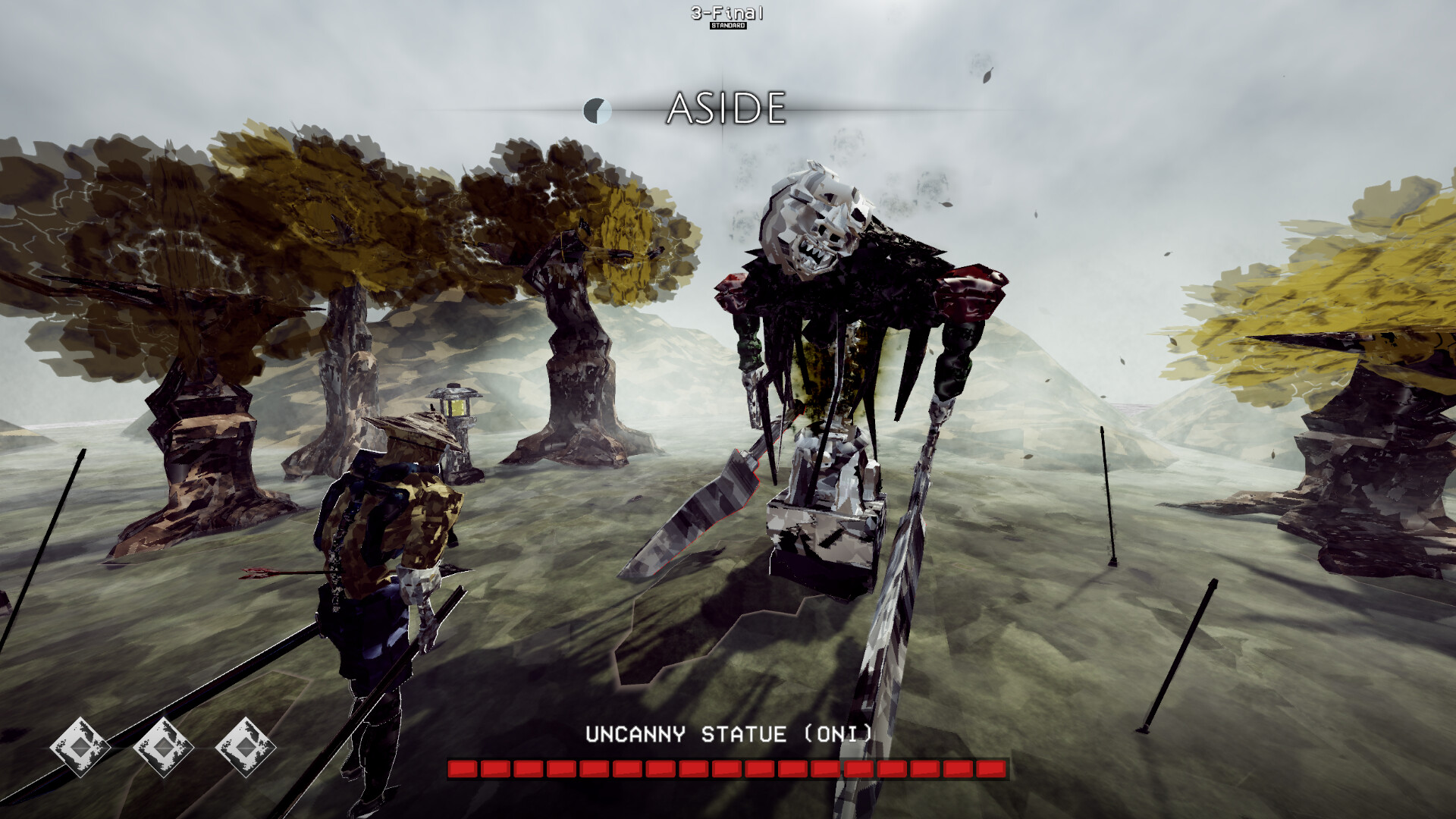
Susanoo: Typing Action is a duel game that happens to run on a keyboard. You play a sword-wielding storm god fighting through waves of yokai and samurai, except your sword swings when you type words and your block is a single well-timed press of the Space bar. The developer, Vincent Dgoat, calls it a Sekiro-like typing game and credits two influences: Sekiro's deflect rhythm and Glyphica's typing combat. Both parents are visible the moment you start playing.
The structure is deliberately short. The full game takes two to three hours, the developer says so on the store page, and the design treats that as a feature rather than an apology. You get a complete arc: learning the verbs, escalating enemy patterns, boss fights that demand both fluent typing and honest parry timing, and a redemption story that frames the whole thing. Released October 29, 2026 on Steam for Windows, published by the developer himself.
| Fact | Detail |
|---|---|
| Developer / Publisher | Vincent Dgoat (solo) |
| Genre | Typing action, Souls-like duel pacing |
| Release | October 29, 2026 |
| Length | 2-3 hours, single campaign |
| Platform | Windows, keyboard required |
| Core loop | Type words to attack, Space to parry |
| Difficulty | Listed under "Difficult" and "Souls-like" tags |
| Languages | English interface, Japanese full audio |
| Extras | Steam Achievements, Family Sharing, demo available |
The popularity of this niche is small but loyal. Typing games sell on the strength of one idea executed cleanly, and the Souls-like framing gives this one a skill ceiling most typing games never bother to build. If you finished the campaign and want more, the game's own achievements and your own parry consistency are the replay hooks.
Who this guide is for: players starting the demo or the full game who want the parry system explained properly, typists who want to convert raw WPM into actual damage, and anyone stuck on a boss because they keep eating hits mid-word.
Getting Started
Before you touch the keyboard
Three setup decisions matter more in this game than in almost any other genre:
- Use the same keyboard for the demo and the full game. Parry timing is muscle memory tied to key travel. A mechanical switch with 2mm actuation trains a different rhythm than a membrane keyboard with 4mm. If you calibrate your Space timing on one and switch to the other, expect a rough first hour.
- Turn off anything that eats keystrokes. Keyboard macros, remappers, and some IME language predictors add input lag or swallow presses. This game reads raw letters; give it raw letters.
- Sit at typing height. Sounds trivial until a boss fight demands eight consecutive clean words while you hunch after your sixth death. Your error rate climbs with shoulder tension. This is a posture game in every sense.
Your first 30 minutes
- Play the tutorial without rushing it. The game introduces typing attacks first, then the parry. Do not skip to the first duel hoping to learn mid-fight; the tutorial's parry window is generous, and that generosity is where you should build the timing base.
- Die once on purpose to a big attack. Watch the wind-up. Every enemy telegraphs heavy strikes with an animation that starts before the word prompt or parry flash appears. You need one death where you watch the animation instead of the prompt to internalize this.
- Find your parry count. Most players naturally parry either just after the wind-up ends or at the flash. Try both deliberately. One of them will feel like luck; the other is your real timing.
- Finish words, all the way through. A half-typed word deals nothing. If you typo a short word, push through the remaining letters instead of hammering backspace. Backspace resets your rhythm; a one-letter slip costs less.
- Stop looking at your hands by minute twenty. If you still glance down, run five minutes of home-row drills before continuing. Splitting attention between prompt, enemy, and hands fails at the third input.
Beginner mistakes
- Chasing speed over accuracy. A clean 55 WPM beats a sloppy 80. Typos break your combo and leave you exposed mid-swing animation.
- Parrying on sound alone. Audio cues exist, but the wind-up animation is the reliable trigger. Laptop speakers lag, and some strikes share sound profiles.
- Treating every fight like a typing test. Words appear one at a time in combat pacing. Type-test habits like reading ahead three words do not exist here; the skill is reading one word as a single shape.
- Panicking backspace on long words. For 6+ letter words, a single wrong letter is cheaper to fix by retyping forward from the error in most implementations than by clearing the whole buffer. Learn which one the game uses in the demo and commit to it.
Core Mechanics Explained
Typing as your attack string
Every offensive action routes through a word prompt. Type it correctly and Susanoo commits a swing, with the animation synced to your completion. Three properties of this system matter in practice:
- Prompts are sequential, not parallel. You face one word per exchange. The pacing mimics a duel's exchange rhythm rather than a typing test's constant stream.
- Accuracy chains into momentum. Consecutive clean words keep your offense rolling. A typo breaks the chain and, in the Souls-like framing, hands the initiative back to the enemy. In Sekiro terms: you stopped attacking, so the enemy attacks.
- Word length telegraphs threat. Longer prompts tend to arrive alongside bigger enemy actions. A six-letter word landing while a samurai winds up means the game is asking you to trade: finish the word or break off and prepare to parry. Reading prompt length as combat information, not just text, is the single biggest skill jump in the game.
The Space-bar parry
Defense is one key with an active window, and this is the purest Sekiro inheritance. In Sekiro, pressing the deflect input opens a fixed window of frames; a strike landing inside it counts as a perfect deflect, a strike landing just after becomes a normal block, and a strike landing much later damages you. Community frame analysis of Sekiro puts the deflect window at roughly 30 frames, about half a second, with the following ten-ish frames converting to a block instead. Susanoo adapts that philosophy to a single key:
Space pressed ──► active parry window opens
Strike lands inside window  ──► perfect deflect, enemy staggered
Strike lands just after     ──► blocked, posture pressure on you
Strike lands well after     ──► full damage taken
Two consequences follow from this design:
- Parries are predictive, not reactive. By the time you see the strike's impact frame, you are already too late. You press Space because the wind-up animation told you the strike is coming, the way rhythm-game players hit notes on approach rather than on arrival.
- The window size is your difficulty dial. You cannot change it, but you can change your consistency. That is what the demo is for: ten minutes of deliberate parry practice tells you whether your hardware and reflexes produce honest deflects.
The attention economy
The real mechanic underneath both systems is alternation. Attack phase: eyes on the word. Defense phase: eyes on the enemy animation. The game's difficulty comes almost entirely from how quickly it forces you to switch between the two. Bosses shorten the gaps. By the final duels you are reading a word's shape, typing it in one motion, and snapping your eyes back to the enemy before the last keystroke lands. Players who try to watch both at once miss both. Players who type in bursts, word by word, control the pace.
Posture logic and why pure offense fails
The Sekiro template Susanoo borrows does not use health bars as the primary win condition; it uses posture. Aggression that ignores defense builds unearned confidence, and the enemy punishes it with attacks you have never practiced deflecting. The same logic applies here in duels where an enemy's poise lets them power through your combo if your input chain broke earlier. The pattern to learn: attack until the enemy signals a strike, win the parry exchange, resume attacking. Rhythm, not pressure.
Enemy design and escalation
Fights escalate by teaching new pattern types rather than inflating numbers. Basic enemies telegraph slowly and use common words. Later enemies layer feints, delayed strikes, and prompt interruptions that force you to abandon a half-finished word. Bosses combine all of it with multi-phase exchanges. Because the campaign is two to three hours, the game cannot rely on grinding you into competence; every fight is a lesson, and the curriculum is dense.
The story frame does mechanical work
You play Susanoo, the Shinto storm god, cursed for arrogance and seeking redemption by protecting every soul he meets before the curse consumes him. The redemption arc explains the game's mercy on the player: duels are winnable, learning is expected, and the difficulty tag means "demands attention," not "unfair." The mythology also gives the word pool a consistent flavor. This is a game about a god learning humility, and it plays best when you type carefully instead of mashing. Thematically consistent, mechanically instructive.
Progression Strategy
The campaign is short and linear, so progression is about skill ordering, not unlock trees.
Phase 1: Verbs (first hour)
- Priority: typing fluency on the game's word shapes. Play the opening duels twice if the demo allows; repetition here is cheap and pays off for the whole runtime.
- Do not optimize parries yet beyond "survive." Your goal in hour one is zero typos at comfortable speed.
Phase 2: The parry (second hour)
- Priority: converting parries from reaction to prediction. Deliberately enter fights planning to parry the first strike of every exchange, even at the cost of taking hits.
- Milestone: you can name, after each death, whether your failed parry was early or late. If you cannot, you are not paying attention to the right signal.
Phase 3: Integration (final third)
- Priority: attention switching under pressure. Practice the eye pattern: word → type → enemy → parry → word. Bosses will interrupt mid-word; learn which interruptions are parry-safe and which demand finishing the word.
- The final boss is an exam on all three skills. There is no build to grind, so go in rested and warm.
What "unlocking" means here
Steam achievements are the progression meta-layer. For a two-to-three-hour game, the realistic completion targets are finishing the story and then cleaning up no-death or full-parry runs if the achievement list supports them. Treat the game as a skill artifact: your typing accuracy and parry consistency carry to whatever you play next, which is more than most games can say.
The Word Duel Playbook: 6 Step-by-Step Strategies
1. The calibration routine (before any session)
1. Type the alphabet once, eyes closed. Note stumbles.
2. Ten parry attempts in the demo/tutorial area.
3. Count how many felt "on time." Below 7/10, run 10 more.
4. Only enter the campaign when the count stabilizes.
This five-minute ritual is the difference between a clean boss attempt and eight warm-up deaths. Parry consistency drifts day to day; calibrate, don't assume.
2. The word-shape read
Before typing any prompt, read the whole word as one object. Vowel positions and double letters are where mid-word typos live. Type the word in one continuous motion at 90 percent of your max speed. The 10 percent you give up buys near-perfect accuracy, and accuracy chains into damage. Players who type letter-by-letter lose duels that word-shape typists win.
3. The trade decision
When a long prompt appears during an enemy wind-up, decide immediately: commit or break. The rule of thumb:
- Enemy wind-up still early, word is 5+ letters → commit to typing; you finish before the strike.
- Wind-up nearly complete → break off, hands to Space, win the parry, then attack.
- Word is short (3-4 letters) → always commit. The swing beats the strike.
Practicing this single decision tree converts the game's hardest moments from coin flips into reads.
4. The parry-first drill
Pick any fight you can survive comfortably. Clear it once parrying every strikeable attack, accepting extra fight length. This drill feels wrong for the first three attempts and transformative by the fifth. It fixes the most common intermediate stall: players who can type but cannot win exchanges because they only block or eat hits.
5. The death audit
After every death, answer two questions out loud before retrying: "What killed me?" and "Was my mistake early or late?" Deaths without answers are wasted deaths. Two to three hours is too short for grinding, so every attempt must deposit information. This habit alone is most of what people call being "good at Souls-likes."
6. The boss checkpoint plan
For each boss:
- First attempt: pure reconnaissance. Do not try to win. Watch every animation, note which strikes are parryable (fast flash) versus dodged or tanked (slow, no flash).
- Second attempt: win the first phase cleanly, even if you die in phase two.
- Third attempt onward: full push. Your body knows the patterns now; let it.
Bosses in short games are tuned to fall on attempt four to six for engaged players. If you are past attempt ten, stop, run the calibration routine, come back in ten minutes. Tilt is the actual final boss.
Advanced Tips
Actuation point is your parry latency. Light-touch keyboards reward slightly early presses because registration is fast. Heavy switches reward pressing on the impact frame. Once you know which keyboard you own, adjust your mental trigger: light keys, press at wind-up end; heavy keys, press at flash.
Warm up WPM separately from parry timing. They are different motor systems. Ten minutes of a typing trainer followed by ten demo parries beats twenty minutes of either alone.
Learn the vocabulary's rhythm. Word pools in themed typing games skew toward their theme. Mythology words here mean lots of multisyllabic nouns, which reward even, rolling typing over sprint bursts. Feel the cadence of common long words and pre-time your fingers.
Use your peripheral vision for prompts. Late-game encounters place word prompts and enemy animation in different screen areas. Skilled players keep focal attention on the enemy and read the prompt peripherally, typing from the word's shape captured in one glance. Practice by deliberately focusing past the prompt in safe fights.
Audio is a confirmation channel, not a trigger channel. Let the wind-up animation trigger your press, and let the sound confirm whether your timing was honest. Reversing these makes you fragile on any setup where audio lags.
Type through fear. When a boss reaches its final phase, most players' accuracy collapses from adrenaline. The counter is mechanical: slow to 80 percent speed and prioritize zero typos. A calm 60 beats a panicked 85, and the boss does not scale to your heart rate.
FAQ
Is fast typing required? Moderate accuracy at moderate speed is enough. The game's difficulty is timing and attention, not raw WPM gates. If you type 45+ WPM with decent accuracy, nothing in the campaign is closed to you.
How hard is the parry timing? It follows Sekiro's learnable-window philosophy: telegraphed strikes, a fixed active window, and consequences that escalate from block to damage as your timing degrades. Most players convert parries from luck to skill inside the demo's ten minutes.
Is the demo representative of the full game? The demo covers the opening duels and both core verbs. Enemy patterns escalate beyond it, but the word pacing and parry feel are identical. Calibrating in the demo transfers directly.
Does controller or mouse work? No. The Steam category is Keyboard Only Option, and the design means it. Letters plus Space, nothing else.
What happens after the two to three hours? Achievements, replay for cleaner runs, and the transferable skill argument: you leave the game a measurably better, calmer typist. There is no post-game content announced.
Why no difficulty settings? The design philosophy treats the campaign as one tuned curve. The parry window is the difficulty. The demo exists precisely so you can test whether that window is fair on your hardware before buying.
Is it worth it if I am not a "typing game person"? If you like Sekiro's duel rhythm more than its exploration, this is the cheapest way to practice that rhythm, and the typing layer replaces the movement game rather than replacing the timing game.
Mac or Linux support? The store listing is Windows only. The minimal system requirements (GTX 560-class GPU, 4GB RAM) mean almost any desktop from the last decade runs it.
Quick Reference Card
| Situation | Action |
|---|---|
| Word prompt appears | Read whole word, type in one motion at 90% speed |
| Enemy wind-up begins | Eyes off prompt, onto animation |
| Strike flashes | Space, once, no mashing |
| Long word + late wind-up | Break off, parry first |
| Short word + any wind-up | Commit the swing |
| Death | Name the mistake: early or late |
| Boss attempt 1 | Reconnaissance, do not try to win |
| Tilt after 5+ deaths | Calibration routine, 10-minute break |
| Spec | Requirement |
|---|---|
| Minimum | Win 10, 2.4GHz dual core, 4GB RAM, GTX 560, 500MB |
| Recommended | Win 11, 3.1GHz quad, 8GB RAM, GTX 970, 4GB |
| Input | Keyboard only (letters + Space) |
| Languages | EN interface/subs, JA full audio |
The whole game fits in a weekend evening and a single page of strategy. That is the point. Learn the two verbs, respect the alternation, and the storm god's redemption arc is yours in one sitting.
Last reviewed by Game How To Editorial. We play each game, verify mechanics against official sources, and update guides when the game changes.
Screenshots