Official game
Play Vaewolf
This game is hosted by Steam. Continue to the official page to play or download it.
Wishlist on SteamOverview
Vaewolf is a 2D hand-drawn hack and slash from Liverpool studio Milky Tea, published by Megabit Publishing (part of Aonic UK), launching Early 2027 on Steam, Epic Games Store, PlayStation, Xbox, and Switch 2. You play a young elf whose family is massacred by a dark Viking clan. Survival wakes something in you: the Vaewolf, a hybrid of werewolf and vampire, and the game's entire combat design flows from that one premise. Shapeshift at will, combine skills across forms into brutal takedowns, and stay on the offensive through a revenge campaign set in a hand-drawn Lake District, from Cumbrian mountains down to Underworld ruins.
The release window is now official. The Steam announcement pinned Early 2027, the story trailer premiered at PC Gaming Show Tokyo Direct 2026, and the game appeared on PlayStation and ID@Xbox channels in the same window, which tells you the platform deal structure is locked. The store page is live with wishlists open, seven languages confirmed (English, French, German, Spanish, Japanese, plus Simplified and Traditional Chinese), and the community hub is active with developer answers to the most common pre-launch questions.
This guide covers everything a day-one player needs: how the three forms actually divide combat labor, the cross-form takedown system, what the gameplay footage reveals about the HUD and economy, ability awakening and build planning, zone-by-zone expectations, the accessibility options that change how the game plays, and a pre-launch checklist for getting the most out of your first weekend.
Confirmed Facts
| Field | Detail |
|---|---|
| Developer | Milky Tea (Liverpool, ~30 staff, founded 2005) |
| Publisher | Megabit Publishing (Aonic UK) |
| Genre | 2D hack and slash, dark fantasy power fantasy |
| Release | Early 2027 (official), final date TBC |
| Platforms | PC (Steam + Epic), PlayStation, Xbox, Switch 2 |
| Price | Not announced |
| Players | Single-player |
| Controller | Full support, custom volume controls, playable without timed input |
| Achievements | Steam Achievements confirmed, count TBA |
| Cloud saves | Steam Cloud + Family Sharing |
| Languages | 7 at launch including both Chinese scripts |
| Setting | Ancient English North, Lake District-inspired, plus the Underworld |
| Art direction | Hand-drawn, Hergé line clarity with Mike Mignola shadow language |
System Requirements (Official)
| Component | Minimum | Recommended |
|---|---|---|
| OS | Windows 10 64-bit | Windows 10/11 64-bit |
| CPU | 2.4 GHz quad-core | 2.5+ GHz quad-core |
| RAM | 8 GB | 16 GB |
| GPU | GTX 960 / R9 280 | RTX 2070 / RX 5700 XT |
| DirectX | Version 11 | Version 11 |
| Storage | 8 GB | 8 GB |
The spec spread is unusual: a 960 minimum with a 2070 recommended suggests the hand-drawn effects layers (the purple magic VFX, particle-heavy form swaps) scale hard. 2D games rarely ask for 16 GB, so the recommended tier is about headroom for those effects, not base performance. Minimum-spec players will be fine; max-effects streaming rigs want the recommended tier.
How to Play: The Three Forms and What Each Is For
Every encounter in Vaewolf is a question about which body you should be wearing. The three forms are not stances you park in; each is a tool with a job, and the skill ceiling lives in the switching.
Elf Form: The Ranged Answer
The elf is precision at distance. Opening fights, plucking archers and throwers off the back line before they volley, and damaging targets whose defense is built around melee trades. The form's value is tempo: while you are in elf, the fight happens at your range and on your terms. Gameplay footage shows the elf's shots carrying real stagger, enough to interrupt wind-ups, which makes it a defensive tool as much as a damage one.
Werewolf Form: The Defense Breaker
The werewolf is raw fury, and the store's specific phrase is tearing defences to shreds. Shielded Vikings, entrenched formations, anything that plants itself: werewolf food. The damage profile rewards committing to a target and staying on it until the guard breaks. Footage shows the werewolf's charged swings producing the largest damage numbers in the current build (50+ on elite-grade enemies versus high 20s for standard hits), so the payoff for the commitment is real.
Vampire Form: The Crowd Controller
Dark magic rules the battlefield. In a 2D brawler that means area denial, pulls, and sustained pressure across space. When the screen fills, vampire is the answer, and it is the natural finisher form for groups the other two softened. The screenshot evidence shows vampire-form AoE rings clearing multiple hit indicators in one pulse, the highest per-action hit count of any form.
The Form Matchup Table
| Fight situation | Form to wear | Why |
|---|---|---|
| Enemies bunched at range | Elf first | Clear the backline before it touches you |
| Shield wall or heavy guard | Werewolf | Defense shredding is this form's entire job |
| Six or more on screen | Vampire | Dark magic rules space, not single targets |
| Boss with a shield phase | Werewolf into vampire | Break the guard, then punish the window |
| Boss with a summon phase | Vampire into elf | Control the adds, snipe the source |
| Archer lines behind melee | Elf opener, then werewolf | Kill the volley source before it trades with you |
Shapeshifting as a Combo Verb
The ceiling is not inside any single form. It is at the seams. Takedowns that combine skills across forms hit harder than anything one body does alone, and switching mid-string keeps enemies from settling against your damage type. The practical pattern: open with elf precision, switch to werewolf as the gap closes so the lunge itself becomes part of the string, exit through vampire magic if reinforcements arrive. The transformation animation is part of the move, not a pause between moves. Players coming from Dead Cells will recognize the weapon-swap rhythm; here the swap is the weapon.
What the Gameplay Footage Reveals
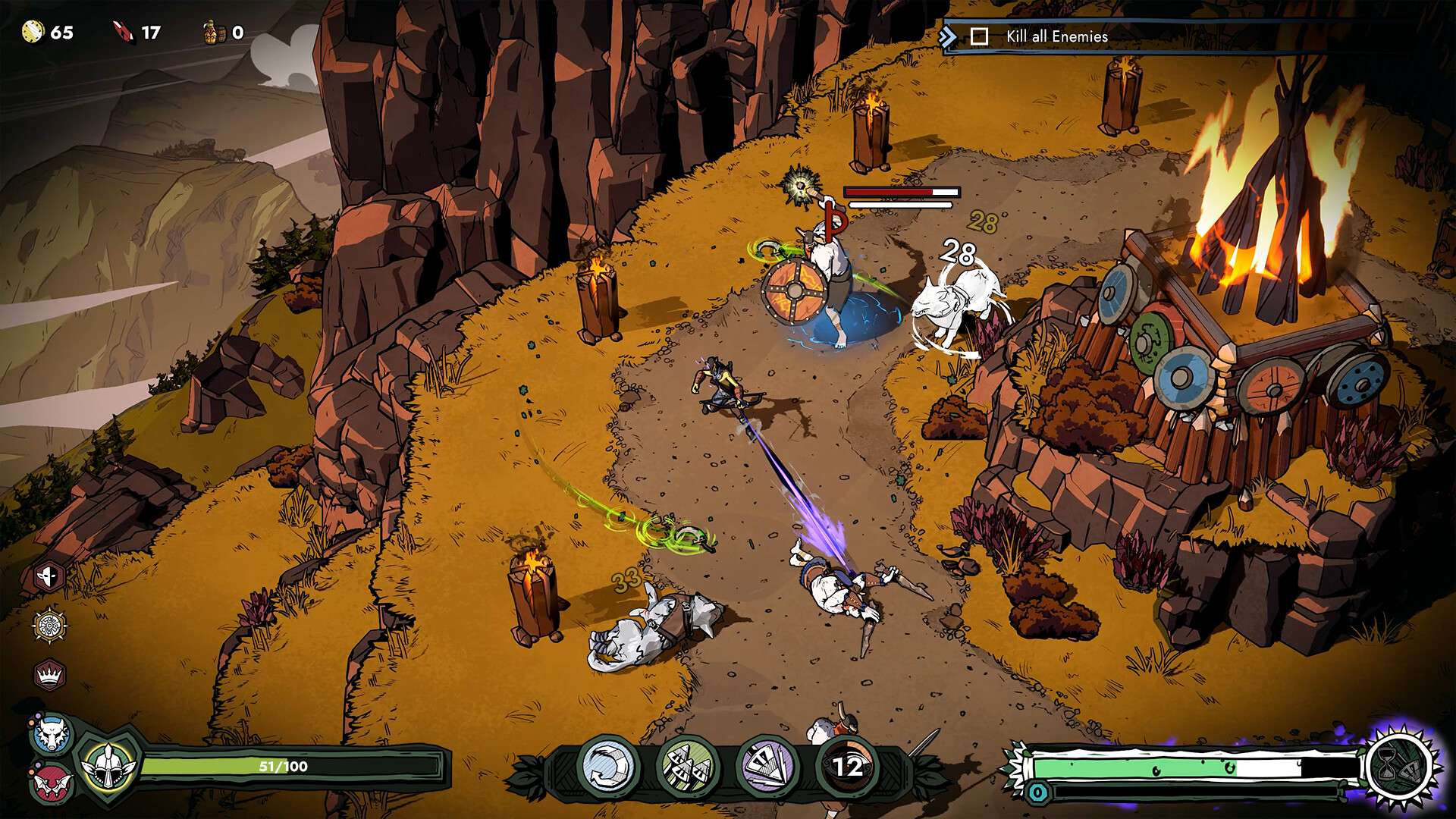
A first-look gameplay capture (35 minutes, fighting through to the Witch boss) plus the seven store screenshots tell you more about day-one play than any preview. The readable systems:
The HUD has three resource counters, not one. Gold-coin currency, a red blood-like resource, and a green material count, all live in the top-left. This is a spend economy layered over the combat: expect shops, altars, or awakening costs drawing on different pools. The blood resource is almost certainly vampire-form fuel, so the economy and the forms are linked by design.
Ability loadout is three slots plus a counter. Three circular ability icons with cooldown rings sit bottom-center, with a numeric counter beside them (consumables or charge stacks). This is a compact kit, not a skill-tree-in-combat. Your awakened abilities live in a rotation small enough to memorize, which pushes build planning toward choosing the right three rather than managing ten.
Form portraits sit beside the health bar. The bottom-left shows your current form's portrait with red (vampire) and white wolf (werewolf) icons adjacent. Health readouts run 60/60 and 100/100 in different captures, so expect max-HP upgrades through progression. The form-swap UI being on the health bar means switching is a constant, mid-fight action, not a menu.
Objectives are wave-based and explicit. The "Kill all Enemies" banner with a checkmark appears in multiple captures. Arenas gate progression on clears. Counter: 65 gold, then 110, then 230 across captures, so clears pay directly into the economy.
Damage numbers are on and meaningful. 28, 22, 35, 50 across captures. The numbers track with form roles: elf chip shots low, werewolf charged swings at the top. If you are optimizing, the number tells you which form is actually carrying the fight.
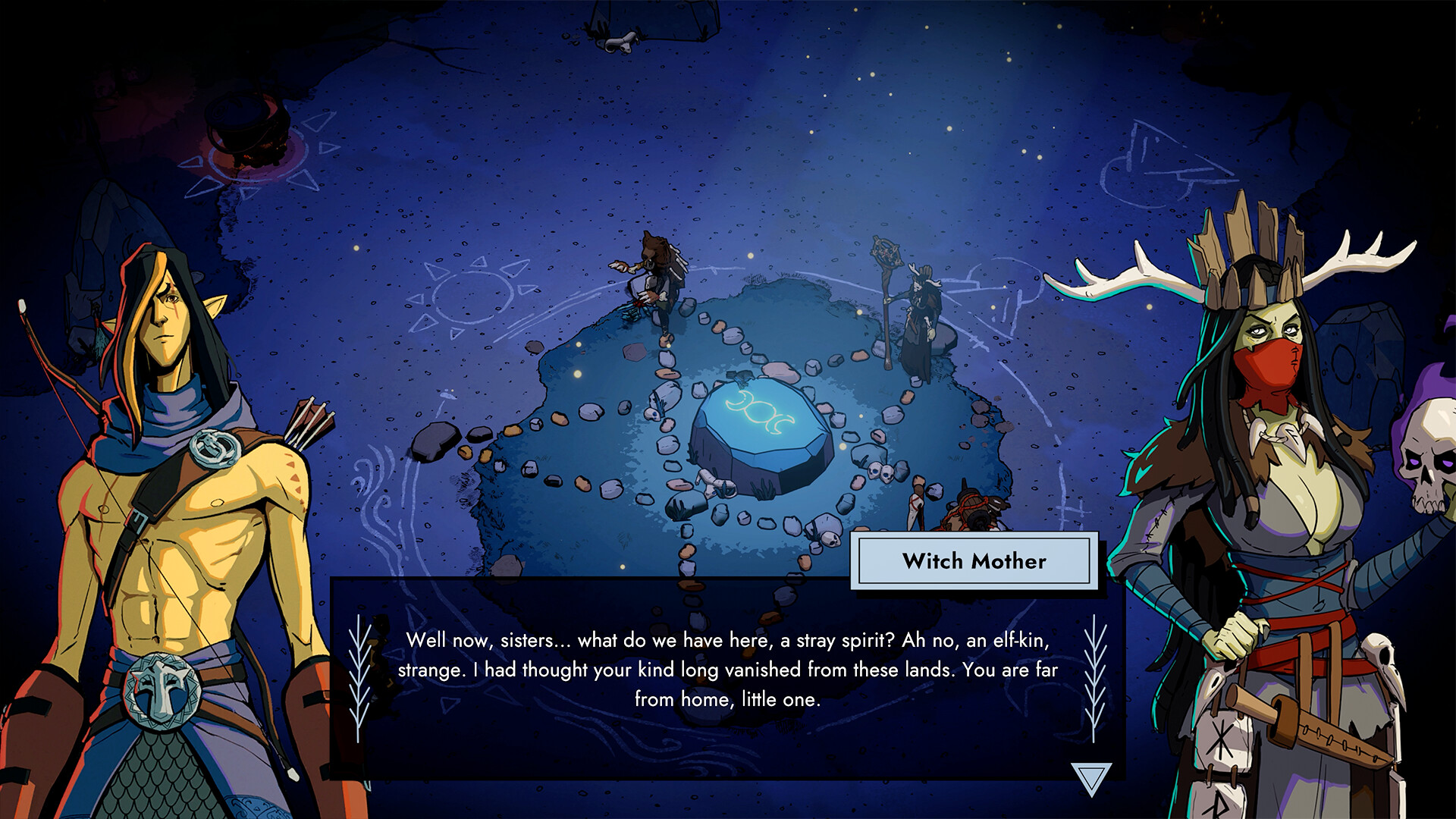
The enemy roster already spans archetypes. Pale melee raiders with shields, blue brutes (troll-grade elites), a green serpent creature, a mounted red knight, and a named Witch boss with her own health bar. Viking clan + creature bestiary + boss tier is the full hack-and-slash stack, and the Witch fight footage confirms multi-phase boss structure.
Environment interaction exists. Bonfires with mounted shields, totems, glowing rune circles, and shrines appear in backgrounds. Expect checkpoint-adjacent interactables and possibly form-gated exploration (a rune circle that only responds to vampire magic is the obvious design).
Ability Awakening and the Revenge Loop
Progression runs on awakening new abilities as you hunt the clan. The store frames the cycle as hunt, awaken, ravage, repeat. Plan around two implications:
- New abilities change old routes. A traversal or combat skill awakened mid-campaign will recontextualize earlier zones. The revenge path is built to reward a second pass through familiar territory with new tools. Assume backtracking is content, not padding.
- Your awakened picks are building a signature finisher. Because skills combine into takedowns, every ability choice is really a choice about which three-slot rotation you want to pilot. Pick abilities that chain into each other rather than collecting unrelated power. A vampire pull that feeds into a werewolf execute is worth more than two strong orphan skills.
The zone list from official materials: raw Cumbrian mountains and lakes, then forbidding Underworld caverns and ruins. The Underworld arc is the difficulty signature, so budget your strongest awakened rotation for it rather than spreading upgrades evenly.
Step-by-Step Strategies for Launch Weekend
1. The First-Hour Form Drill
Before chasing the story, spend ten minutes in the first arena deliberately looping all three forms: elf kill, werewolf kill, vampire kill, then one full cross-form string. The game rewards fluency, and muscle memory built cheaply here pays for every arena after. Learn which button the swap lives on first; everything else in this game is timing off that swap.
2. The Opener Discipline
Every fight opens with a read: count the enemy types before committing. Archers alive? Elf opener. Shields up front? Werewolf opener. Mass of bodies? Vampire opener. The opener matters because the first three seconds of a wave decide whether you fight at your range or theirs, and Vaewolf's aggression tuning (brutal, ceaseless, per the store) punishes fighting at the enemy's range.
3. The Guard-Break Pivot
Shield enemies are the gate to everything else. The pattern: werewolf swings until the guard cracks (watch for the stagger pose), then vampire magic into the stunned cluster. Chaining the break into the punish is the single highest-value skill loop in the game, because shield walls are what stop momentum, and momentum is the whole power fantasy.
4. The Elite Takedown Routine
Blue brutes and elites hit hard and eat standard strings. Route: elf precision shots to whittle from range while closing, werewolf charge for the guard break, then your combined takedown for the burst. Do not stay in werewolf for the whole fight; its defense shredding is for the window, not the war of attrition. Elites are where the cross-form takedown multiplier actually shows up in the damage numbers.
5. The Boss Three-Read
The Witch footage confirms multi-phase bosses. Generic counter-play that will hold across the roster: phase one, learn the tells with elf-range safety; phase two, werewolf the armor/shield window when it appears; phase three (the speed-up), vampire for space control because dodging through crowds at rage speed is where runs die. Keep one ability slot reserved for the phase-three panic button, whatever your build.
6. The Economy Rule
Three currencies will tempt you to spend everywhere. Rule of thumb until the shop structure is documented: gold coins for capability (abilities, upgrades), blood for combat fuel (vampire resources), green materials for consumables. Never spend capability currency on consumables; the awakening system is the actual power curve, and the cooldown counter on the ability bar tells you how tightly your rotation depends on those awakened picks.
Build Planning
The game is unreleased, so treat these as day-one hypotheses grounded in the confirmed systems:
Build 1: Takedown Artist
Awakenings: Pull (vampire), gap-closer (werewolf), finisher multiplier (any form). Rotation: Elf chip, werewolf break, pull, execute. Three slots fully committed to the string. Who it's for: Players who want the montage. Highest ceiling, most inputs, weakest if you misread an opener because the whole build lives in the combo.
Build 2: Battlefield Warden
Awakenings: Vampire AoE upgrades, health upgrades, one panic button. Rotation: Vampire-first against every wave, werewolf only for shield walls, elf almost never. Who it's for: Players who want control. Slower clears, near-zero death risk, ideal first run while learning enemy patterns.
Build 3: Precision Duelist
Awakenings: Elf shot upgrades, movement, werewolf charge as the single melee answer. Rotation: Elf-dominant, swapping to werewolf only for guard breaks and elites. Who it's for: Players coming from ranged action games. Safest against the roster's melee-heavy composition, hardest against summon phases.
Comparison
| Build | Clear speed | Death risk | Boss fit | Skill floor |
|---|---|---|---|---|
| Takedown Artist | Fastest | Highest | Best burst windows | High |
| Battlefield Warden | Moderate | Lowest | Good (space control) | Low |
| Precision Duelist | Slow-moderate | Low | Weak vs summons | Medium |
Advanced Tips (Pre-Launch, Evidence-Based)
- Swap on contact, not on cooldown. The werewolf lunge lands harder if the transformation begins while the gap is closing. Standing swaps waste the animation's i-frames, if the footage's dash trails are any guide.
- Shields are form instructions, not walls. The game literally tells you which tool to use: defenses shred under werewolf. A shield phase is a switch prompt.
- Save vampire for the crowd, not the duelist. Dark magic spent on a single guard is tempo given away; the blood resource makes waste expensive twice.
- Watch the third resource counter. Green materials at 17, then 33 across captures, tracking with progression depth. If consumables craft from them, hoard until the crafting system reveals itself.
- Treat the three-slot bar as a puzzle. The counter next to your abilities suggests charges, not infinite casts. Builds that rotate efficiently through three slots will out-sustain builds that spam.
- Read damage numbers as form feedback. If your werewolf numbers are low, you are not committing long enough for the charge payoff. The game displays exactly which form is pulling weight.
- Wishlist and claim launch-week visibility. Wishlist numbers drive store placement, and for a studio's most ambitious original IP, launch-week momentum determines how much post-launch support the game gets. If you plan to buy, the wishlist is the cheapest way to help.
- Wait for the demo signal. Milky Tea has run playable builds at events before. A Next Fest demo before Early 2027 is plausible; it would let you test the shapeshift rhythm before committing, and every trailer's comments section is asking for one.
Mistakes That Will Cost You (Based on the Confirmed Systems)
| Mistake | Cost | Fix |
|---|---|---|
| Parking in werewolf | Ranged enemies volley freely | Rotate to elf the moment pressure breaks |
| Transforming while standing | Dead frames mid-fight | Transform during gap-closing |
| Fighting crowds in elf | Slow clears, chip damage | Vampire rules space; swap early |
| Skipping side routes | Missed awakenings | The revenge loop rewards re-traversal |
| Treating shields as block puzzles | Stalled fights | Shield is a werewolf prompt by design |
| Spending all three currencies equally | Starved awakening curve | Gold = capability, blood = fuel, green = consumables |
Developer Background
Milky Tea started in 2005 over a cup of tea between two designer-artists and now runs about 30 people, fully remote across the UK and EU from a Liverpool base at Baltic Creative Campus. The studio's resume runs through licensed and motorsport work (Coffin Dodgers, Hyperbrawl Tournament) and, most relevantly, Grit and Valor: 1949, its recent diesel-punk RTS published in the same Aonic ecosystem. Awards shelf: BAFTA, EMMY, Banff, and TIGA nominations, plus a Creative England top-50 shortlist. Vaewolf is its most ambitious original project and the first under the Megabit indie label, which is part of Aonic UK.
Two facts matter for players. First, the studio ships multi-platform (Unity-based, per its own capability page), which is why day-one PS/Xbox/Switch 2 parity was credible. Second, the art direction namechecks are real: the store copy credits Hergé's line clarity and Mike Mignola's shadow mythology, and the seven screenshots back the claim, clean silhouettes carrying heavy black crowds and fog over real Lake District geography.
Comparison With Similar Games
| Game | What it shares with Vaewolf | Where Vaewolf differs |
|---|---|---|
| Dead Cells | 2D combat fluency, rapid swap rhythm | Linear revenge campaign, not a roguelite loop |
| Katana ZERO | Hand-crafted 2D violence, one-hit-read combat | Shapeshifting as a core verb plus ranged play |
| Skul: The Hero Slayer | Mid-fight transformation swapping | Forms are one hero's bodies, each with a role |
| Blasphemous | Dark mythic 2D setting, ceremonial violence | Faster and combo-forward, less methodical |
| Viewtiful Joe lineage | Style-first 2D brawler presentation | Modern accessibility layer (no-timed-input mode) |
Accessibility Notes
The Steam feature flags deserve attention because they are rare in this genre: playable without timed input (relaxes combo timing for players who need it) and custom volume controls (per-channel mixing, useful for music/sfx balance). Full controller support is locked for all platforms including Switch 2. If timed inputs have kept you out of character-action games, this flag plus a three-slot ability bar (small rotations are learnable) makes Vaewolf one of the more accessible entries in the genre on paper. Verify the no-timed-input mode's scope at launch; the flag confirms existence, not depth.
Pre-Launch Checklist
- Wishlist on your platform of choice. Steam, Epic, PS, Xbox, and Switch 2 pages are live or coming; wishlists get you the launch-date alert the moment it drops.
- Join the Discord (discord.gg/megabit). The developers have committed to regular development updates between now and Early 2027, and the hub is where demo news lands first.
- Watch the story trailer once for plot, once for combat. The Tokyo Direct premiere cut shows the three forms in actual chains; it is the best available preview of the switching rhythm.
- Clear disk space (8 GB) and check your GPU against the recommended tier if you care about the effects stack; the hand-drawn VFX is the game's visual identity and the recommended spec is what runs it clean.
- Decide your day-one build hypothesis now (Takedown Artist, Warden, or Duelist), then let the first two hours of play falsify it. Going in with a plan beats going in with a wiki.
FAQ: Every Question the Community Is Asking
When does Vaewolf release? Early 2027, officially. The exact date is TBC; the developers have said regular updates will run between now and launch, so the date will surface through the Steam news feed and the Megabit Discord first.
How much will it cost? Unannounced. Megabit's indie catalog typically prices in the mid-teens, but wait for the official number.
Is Vaewolf a roguelike? No. This was the first question in the community hub, and the campaign structure is a linear revenge story with ability awakening, not a run-based loop. Death handling is TBC, but nothing in the official materials describes procedural generation or permadeath.
Is Vaewolf on consoles or Steam Deck? Consoles: yes, day one on PlayStation, Xbox, and Switch 2, plus PC via Steam and Epic. Steam Deck: the store page carries no verification status, but a stylized 2D Unity title at GTX 960 minimum spec is about as Deck-friendly as releases get; expect it to run, wait for the official badge.
Is there a demo? Nothing confirmed. Milky Tea has history with event builds, and a Next Fest demo before Early 2027 is the community's standing request. Watch the Discord.
How hard is it? Unrated pre-release. The store language emphasizes relentless aggression, which usually signals a mid-to-high difficulty curve, and the playable-without-timed-input mode exists specifically to soften the execution ceiling for players who want the fantasy without the dexterity tax.
What languages does it support? English, French, German, Spanish (Spain), Japanese, Simplified Chinese, and Traditional Chinese at launch. Interface and subtitles for all; full audio in English.
Is the story important? The revenge plot is the structure (elf survivor, Viking clan, awakening powers), and the community's early read is that lore delivery leans on environments and the Underworld arc. If story matters to you, the trailer is the tone-setter; if not, the combat systems stand alone.
Quick Reference Card
| Topic | Answer |
|---|---|
| Genre | 2D hack and slash, dark fantasy |
| Developer | Milky Tea (Liverpool, since 2005) |
| Publisher | Megabit Publishing (Aonic UK) |
| Release | Early 2027, date TBC |
| Platforms | Steam, Epic, PS, Xbox, Switch 2 |
| Price | TBA |
| Forms | Elf (ranged), Werewolf (defense break), Vampire (crowd control) |
| Core verb | Mid-combo shapeshifting into cross-form takedowns |
| Ability slots | Three plus a charge counter |
| Currencies | Gold (capability), blood (fuel), green material (consumables) |
| Setting | Lake District-inspired English North + Underworld |
| Art | Hand-drawn, Hergé/Mignola influence |
| Accessibility | Full controller + no-timed-input mode + custom volume |
| Languages | 7 at launch, both Chinese scripts |
Vaewolf's bet is that three bodies beat one toolkit. The Early 2027 window is now official, the platform list is the widest a Milky Tea game has ever had, and every piece of footage shows the same core loop holding up: read the fight, wear the right body, and make the switch itself part of the kill. Wishlist it, watch for the demo, and practice switching mid-swing.
Screenshots