Daily Pick
One deeply researched guide worth reading today.
A practical route through the systems that matter most, written to help new players make confident decisions quickly.
Overview
Travelling At Night is a choices-matter, combat-free CRPG from Weather Factory, the studio behind Cultist Simulator, Book of Hours, Sunless Sea, and Fallen London. The Steam storefront sums the whole pitch up in three words: CONJURE. CONFESS. DISAPPEAR. It is the third game in the Secret Histories series, set in a myth-scarred 1948 Europe. You play Spencer Hobson, a man who was hollowed out by the Worms from under the world in a deep Cracow winter twelve years ago. He disappeared for a decade. Now he is back, and his past is long, and it is not done with him yet.
The design lineage is explicit: the developers name Planescape: Torment, Shadowrun, Disco Elysium, and Fallout 1+2 as the isometric greats they are building in the tradition of. There is no combat, no initiative order, no damage numbers. "After six years of war, there's been enough of that for now." What replaces combat is a dialogue engine dense enough to carry the whole game: skill checks, footnotes, Passions, Memories and Signs, a reworked crafting system for occult items, an outfit system that changes how the world treats you, and a travelling circus whose performances are themselves multi-act skill challenges.
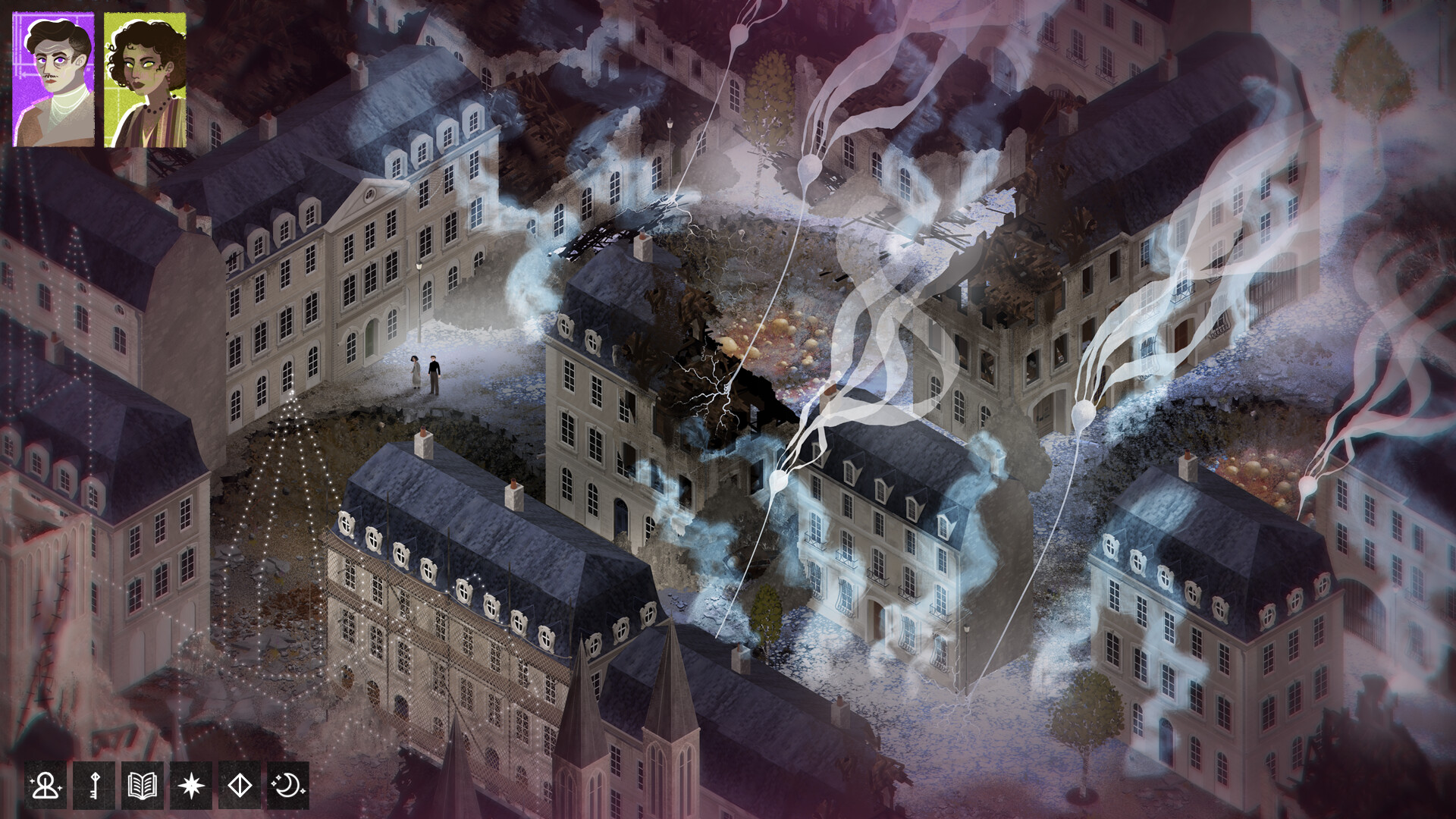
The setting: the golden Incorporates of the USA wage a cold war against the star-touched Ministries of the USSR. France has holes in it through which you can see the stars. Chitinous cities embrace the Change, or struggle against plagues of leaf and amber. The rain does not always fall the right way. You start in Antibes, a war-torn French coastal town under the thumb of a State whose motto is not Liberté, Égalité, Fraternité but Travail, Famille, Patrie.
The demo has been out since August 10, 2026, and its numbers tell you this is one of the year's indie stories. Weather Factory reported 30,000 installs, about 20,000 actual players, a concurrent peak of 563 (Book of Hours' demo topped at 229), and half of all players passing the one-hour mark. The studio processed 1,200 bug reports in the launch fortnight and shipped patches most days since. The response was strong enough that the developers called it "the most positive I've seen to the preview version of any game I've ever worked on."
Target audience: players who loved Disco Elysium's dialogue-as-gameplay, Planescape: Torment's philosophical weight, and Weather Factory's dense prose. Not for you if you need action, combat builds, or fast pacing. This is a slow, prose-heavy experience about motives and consequences, built for replays: one beta tester made 1,544 distinct choices in a single play session.
Quick Facts
| Attribute | Detail |
|---|---|
| Developer | Weather Factory (Lottie Bevan & Alexis Kennedy) |
| Publisher | Weather Factory |
| Genre | Choices-matter combat-free CRPG |
| Platforms | Windows, macOS, Linux (Steam + GOG) |
| Release | To be announced (demo out since Aug 10, 2026) |
| Demo length | 4 to 8 hours, roughly Cultist Simulator's whole launch word count |
| Full game scope | 40+ hours, a dozen-plus locations, multiple endings |
| Difficulty | Medium (puzzle-adjacent, no combat, dense systems) |
| Music | J. Willgoose, Esq. of Public Service Broadcasting |
| Price | To be announced (demo free) |
Getting Started
Before You Launch
- Set expectations: no combat. You will talk, investigate, craft, and choose. Death exists, but it comes from consequences, bad bargains, broken oaths, and the Worms, not from hit points.
- Read the footnotes. There is no codex by design. Highlighted words open lore infoboxes when clicked, and those infoboxes contain more highlighted words. The footnote web is how newcomers absorb ten years of Secret Histories context. You can also set footnotes to "Importunate" mode in options if you want already-read ones to keep showing, and open them directly with T or a middle-click.
- Know the save system. Autosave is on, and you can keep up to 99 manual saves. Save before any conversation with a named NPC. Choices lock in.
- Pick your dialogue speed. The demo now offers three speeds: CALM, QUICK, and CRISP. CRISP has no typewriter effect at all. If text crawl annoys you, set CRISP before anything else; it also removed the stutter complaints that dominated the first week.
- Mac and laptop users: press T to focus tooltips. This shipped as a launch-day patch note; it is the intended way to read item and skill tooltips, and it now works on non-Latin keyboard layouts too.
- Expect the interface to punish fast clicking. The game waits a quarter-second after text completes before accepting a selection, and it will not select the first option unless you press an arrow key, so hammering space is safe. Down arrow advances text. Read before you click anyway.
Your First 30 Minutes
The demo opens as you step off the train at the Gare d'Antibes into a dark, rainy perma-gloom. You have four things to do in the opening beat, and none of them involve a weapon.
- Choose your Career. Four options: Exorcist (driven by Sorrow), Stage Magician (feeding your Appetite), Physician (can't resist Curiosity), and Writer (Sophistication is "useful, somehow"). The demo's career screen generates a portrait, a little backstory, your Sign, and your starting Aspect Pool. You can also raise a skill to 9 at character generation.
- Choose your Passion. The career gates which three Passions you are offered; you pick one to start, and can hold up to three as the game goes on. New Passions unlock through dialogue choices and play style, and the Passions screen now shows your current potential Passions and lets you reject them.
- Put points into skills. Career determines which skills you can invest in at creation. You cannot respec the starting allocation, so read the skill descriptions.
- Talk to everyone in Antibes. The town has about as many words in it as all of Cultist Simulator at launch. NPCs are your main source of Memories, Signs, and side content. Skip a conversation and you miss character growth.
Beginner Mistakes
| Mistake | Why It Hurts | Fix |
|---|---|---|
| Spending Memories immediately | The matching Sign is often one conversation away; paired spending is worth far more | Sweep a whole region before spending anything |
| Ignoring footnotes | Footnote choices grant flavoured experience and seed Passions; skipping them forfeits the cheapest XP in the game | Click every highlighted word; set Importunate mode |
| Talking back to Léon early | The State's servant can get you imprisoned within minutes; it is the demo's most common death-by-consequence | Save before testing authority figures |
| Wearing the wrong outfit | Weather and social reactions apply real penalties on checks | Keep rain gear, respectable wear, and summer clothes in rotation |
| Maxing one skill at creation | The demo's checks spread across social, occult, and survival situations | Build a spread: one social, one utility, one career skill |
| Playing with untrained skills | An untrained skill used ahead of a trained one is a trap the patch notes had to fix | Assume trained beats big-numbered |
| Re-crafting the same item | The re-craft loop was patched out; hoarding copies does nothing now | Craft what you need for the current chapter |
Core Mechanics Explained
The Character System: Careers, Skills, Passions, Signs
Character creation runs Career → Passion → skill points, and produces a starting Aspect Pool plus a Sign. There are roughly 108 distinct starting Spencers, so two playthroughs can feel like different games from minute one.
Careers define your dialogue toolbox and which skills you can seed at creation:
- Exorcist : Sorrow-driven, Suppression Bureau and Légion du Seuil background. Strong occult knowledge (Skolekosophy) and authority over the supernatural. Best for players who want the lore-first experience.
- Stage Magician : Appetite-driven, performance and misdirection. Legerdemain and Charm leanings. The smoothest first run: the demo's social checks bend toward performance skills.
- Physician : Curiosity-driven, medical authority. Dignity is essential "for physicians who need to be taken seriously." Strong with respectable NPCs like Strathcoyne.
- Writer : Sophistication, "useful, somehow." Excellent for persuasion and high society, weak for survival. Pair with Spivvery or Dignity early or you become the most articulate starving person in Europe.
Skills (16 total) are the building blocks. Named examples:
| Skill | Use Case |
|---|---|
| Dignity | Authority, being taken seriously, respectable company |
| Spivvery | Black market, hot meals, alternative routes past guards |
| Sophistication | Persuasion, reading between lines, opera and high society |
| Skolekosophy | The study of things that shouldn't be studied |
| Legerdemain | Theft, sleight of hand, stagecraft |
| Nyctodromy | Night travel, spying, the book the game is named after |
| Charm | Social warmth, seduction, disarming hostility |
| Eloquence | Song, speech, public performance |
| Birdsong | Communication with birds, who have their own agendas |
An untrained skill should never be used ahead of a very-low-value trained skill. The game tracks training carefully; the patch notes fixed an edge case where untrained skills could be rolled ahead of trained ones. Assume trained beats big-numbered.
Passions are your moral-emotional alignment, and they evolve. The full suite includes Sorrow, Appetite, Curiosity, Melancholy, Whimsy, Ambition, and Compassion, with more. You start with one and can hold three. The system is designed so you are not forced into a good/evil binary: one day whimsical, the next angry. Your Passions gate which dialogue options appear and how the world responds.
Your Sign is allocated last, at the end of character creation. It connects to your origin story, commedia dell'arte, and a recurring Rosa Mundi activity that matters at significant moments throughout the game. It is the most mysterious thing on your sheet; keep notes on when it triggers.
Memories, Signs, and the Experiences Economy
Memories and Signs are your growth currency. You find them in the ruins as you roam, or glean them from conversations. You spend them to grow Skills and Passions "along the lines that run shining into the dark."
- Memories are what you carry from experiences: a conversation, a discovery, a loss.
- Signs are the world's marks: something you found, something that found you.
- The pairing matters. A Memory spent alone grows you a little. A Memory spent against a matching Sign grows you a lot.
Two economy fixes reshaped the demo's math. First, you can now mix Experiences rather than needing all of one type to increase (not evolve) a Skill or Passion, which unclogs progression enormously. Second, skill increase costs up to 10 have been halved for both career and non-career skills. The developers say the numbers are not final, but the demo is now far more generous than at launch. Spend earlier and more often than launch-era advice told you.
The Footnotes System
Footnotes are Weather Factory's answer to the CRPG codex. Highlighted words open infoboxes; those infoboxes contain more highlighted words. But they are not pure reference. Like Book of Hours, some footnotes force a choice about interpretations of History or personal preference, "like a personality quiz that gives you flavoured experience points." That means reading footnotes is not flavor, it is progression. Explored footnotes stop appearing in text (searchable if you need them, and the search now includes tutorial messages you have seen), and you can switch the mode from Subtle to Importunate if you want them to keep showing.
The Item Rework: Equipped vs. Occult Operations
The September "Cantilevered Into Light" patch rebuilt the item system, and understanding it changes how you play. The old version had two confusing categories of skill-modifying items. The new version is clean:
- Permanent items you equip for passive bonuses.
- One-use items you do not equip. You choose one to help with "the little magics you do in dialogue," the occult-operation choices.
The critical change: occult-operation Aspects (Bewitch, Entwine, Expel, Unveil) are no longer hard locks. They are always open. Without a proper crafted item, you fall back on improvised materials and take a hefty penalty on the attached skill check. With high enough skill, or a full Aspect Pool, you can succeed anyway.
The design intent is explicit in the patch notes: Spencer cannot throw fireballs. Like a character in a Tim Powers or Susanna Clarke novel, he needs his kit of useful things, or he falls back on bits of fluff and chalked sun-crosses. Practitioners of the Arts Unconsidered can get by with cat-fluff and table salt. Bright Arts types really need their pure and fancy gubbins. Night Arts fall in between. One-use items carry a little red marker so you never burn an equipped item by accident again.
The Outfit System
Outfits are complete sets, not piecemeal gear. The demo has six; the full game has nineteen. They matter three ways:
- Skill modifiers. What you wear changes your rolls.
- Social reaction. People respond to how you dress. Strathcoyne prefers Respectable clothing.
- Weather. A trenchcoat is good for rain, bad for the Riviera sun. Antibes has both, sometimes in the same hour.
The system exists to kill the MMO-outfit problem where you wear mismatched stat gear and look like you woke up in a bin. Spencer is the best-dressed man in the Suppression Bureau; the game keeps it that way. Swap outfits deliberately, not habitually.
Crafting at Thin Places
Crafting is a core mechanic. Spencer uses a lifetime of occultery to craft items at certain locations: "places where the skin of the world is thin." You will know them when you see them. The Sanitarium Aujourd'hui's upstairs has Verdant and Holy workstations, with at least one more hidden. Known recipes from the demo's tooltip lore:
- A Midnight Mark : taints the dreams of a victim. Aggressive, occult, useful for the darker routes.
- The Rite of the Ascending Sun : manages your own Dread. A survival tool, not a weapon.
The September rework also differentiated recipe tiers: alchemy items now grant refreshments, level 15 items give Trouble reductions on use, and top-tier items are mostly permanent skill bonuses. The demo only exposes the alchemy tier, but the full game's crafting is "Cultist Simulator Lite": materials, recipes, and consequences. The crafting UI has been the developers' most-admitted weak point, now on its third or fourth iteration of a planned five or six, so expect it to keep improving.
The Rosa Mundi Circus
The itinerant occult circus at the heart of the game. Its troupe includes Spencer, Vincent, Lalla Chaima, Nina (Witch of Lagasse), Medea, Floris, Lazare, Sidonie, Bronek, and Monica Medina, among others. Nina and Medea will never be present at the same time. Each member plays a stock role: Lazare always plays Pierrot, Nina always plays Élise.
Performances are multi-act skill challenges. You choose a five-act play, then choose your role. Different roles demand different skill checks in each act. Succeed through the acts and the performance is exceptional; fail and it is merely acceptable. Rewards scale with how far you carry it: cash, Influences, Experiences, and Troubles.
Example: for "The Player and the Peacock," play the scoundrel Scapin or the romantic lead Valère. As Scapin in Act I, steal jewels with Legerdemain or spy on the court with Nyctodromy. As Valère, Charm the palace inhabitants or use Eloquence to sing a love-song to the Peacock. Later acts open more options. Plays are repeatable but variable, and not all plays are equal in all places: "The King Stag" plays well in forest-haunted Mimata, while Ministry authorities read "The Player and the Peacock" as counter-revolutionary and ban it outright.
The development blog confirms performances will form "a heartbeat for the game": you gain experience from them, cast yourself in roles, and unlock increasingly challenging plays and new lore as you go. The performance loop is the last big mechanical piece still in build-out, so expect it to be the centerpiece system of the full release.
The Faction Web
The political structure is the game's main antagonist. Three factions pull at you:
| Faction | Who They Are | What They Offer |
|---|---|---|
| The Incorporates | Golden, USA-aligned corporate powers | Resources and legitimacy |
| The Ministries | Star-touched USSR-aligned powers | Secrets and occult power |
| The Remortals | The old order, beings who died and returned | Perspective and danger |
You can conspire with or betray all of them. Sell the power you unearth, keep it for yourself, or surrender it to something new. Your choice of alliance, consequence, and destination produces multiple endings.
Progression Strategy
What to Prioritize First
- Social coverage over stats. The demo is a town full of named NPCs and skill checks. A balanced spread of Charm, Dignity, and Spivvery opens more content than maxing one combat-adjacent stat that doesn't exist.
- Spivvery early. In a war-scarred Europe, food and shelter are real problems. Spivvery is the only way to ensure a hot meal in a cold world. It unlocks black-market options, alternative routes past checkpoints, and NPC reactions a Dignity-heavy physician will never see.
- Hold your Memories. Do a full sweep of a region's conversations and interactables before spending anything. The Sign that matches a Memory you have held since the previous region is often sitting in the next conversation.
- Follow the footnote XP. Each footnote chain that ends in a choice grants flavoured experience. Antibes is packed with them. Clicking every highlighted word is the single most reliable XP farm in the demo.
- Buy or find the second outfit early. Weather swings in Antibes. Owning rain gear and respectable wear means you never take a weather penalty on a critical check.
Unlock Order for the Demo
- Complete character creation with a Passion you actually want to roleplay. Do not pick for stats alone.
- Clear the Gare d'Antibes and the streets both sides of town. Talk to everyone twice if the game lets you.
- Visit the four anchor locations: Librairie des Heures (Andrée), the Church of St Reparata (Father Jaume), Janvier et Fils (Janvier's photos), and Chez Felix (Linou, Pompon, the fridge).
- Corner the black market with the local bookseller before the State's attention lands on you.
- Enter the Sanitarium Aujourd'hui through the main door or the harder route via Léon.
- Clear the Sanitarium's residents: Dr Aubiere, Mathis, Vincent, Bessy Bloom, Rodia, Fraser Strathcoyne, Khione.
- Craft at the upstairs workstations. Make the Rite of the Ascending Sun early if Dread is climbing.
- Set your alarm for the middle of the night and sneak the upper floor for secrets.
- Recruit Vincent before the train. He follows you to the ends of the earth.
- Step on the train to Mimata. Demo ends; save carries nothing forward, so do everything first.
Full-Game Roadmap
The demo is deliberately limited to the first area. The full game opens to more than a dozen locations: Mimata, Kerisham, Paris, Berlin east (one of the weirdest places you will go), Cracow (the king of weird), amber-cloaked Mahaggony, and the isometric post-war version of Brancrug. Where you pitch the circus is a branching storyline of its own. Plan your full-game route around which plays you want to run and which factions you want to court.
Mimata, the second town, is the best-documented destination ahead of release. Development updates describe a town under an eerie transformation: nature is not as it was in Antibes, and the inhabitants display "eccentricities." Confirmed locations include Isabeau's post office (with her beloved doll and pristine telephone), the murky Auberge du Chêne (where a weary detective waits), Boucherie Goupil (the only place in town not under floral siege), a convent called the Convent Raveline sitting at the top of Mimata's hill, and a bachelor's lodge in a broken tower belonging to Eustache the convent handyman. The woods outside town hold "Things in the Wood." The demo ends exactly where this content begins, which is the developers' way of telling you what you are buying.
Builds and Tier Lists
Career Tier List (First Playthrough)
| Tier | Career | Reasoning |
|---|---|---|
| S | Stage Magician | Appetite fits the demo's social-heavy Antibes; Legerdemain covers the Rosa Mundi Scapin role and theft checks; no early-game weaknesses |
| A | Physician | Dignity opens respectable doors (Strathcoyne path) and authority checks; Curiosity suits completionists |
| B | Exorcist | Skolekosophy unlocks the occult route and the deepest lore, but early beta had known issues; the occult payoff lands later |
| C | Writer | Sophistication is real but situational; survival skills suffer. Only pick if you commit to Spivvery as your second skill |
Passion Tier List (Demo)
| Tier | Passion | Reasoning |
|---|---|---|
| S | Curiosity | Drives exploration, matches the Physician's skill set, feeds completionist play |
| A | Ambition | Keeps every faction option open; best for multi-ending runs |
| A | Appetite | The Magician's engine; strong in social scenes |
| B | Sorrow | Exorcist-flavored, deep but narrow |
| B | Compassion | Reliable for the "nice Spencer" route, closes some ruthless options |
| C | Whimsy / Melancholy | Flavor-first; take them on a second run, not your first |
Skill Priority Matrix
| Situation | Priority Skills |
|---|---|
| First hour in Antibes | Charm, Dignity, Spivvery |
| Black market route | Spivvery, Legerdemain |
| Sanitarium social | Dignity, Charm, Sophistication |
| Rosa Mundi performance | Legerdemain or Eloquence (role dependent) |
| Occult route | Skolekosophy, Nyctodromy |
| Survival pressure | Spivvery, Rite of the Ascending Sun (crafted) |
Companion Priority
| Companion | When | Notes |
|---|---|---|
| Vincent Chraibi | Demo, first recruitable | Old Légion comrade, irrepressibly cheerful, follows Spencer everywhere |
| Lalla Chaima | Full game | Vincent's ex, knife-throwing Rosa Mundi performer, Moroccan theatrical wardrobe |
| Corso Reverte | Full game | Third companion, perfect hair, drawn by Adrien |
Vincent and Chaima are exes with an "extremely balanced and healthy" relationship, so expect friction if you run both.
Step-by-Step Strategy
Sequence 1: The Antibes Social Sweep
- Step off the train at Gare d'Antibes. Do not run anywhere yet.
- Talk to every NPC on the street. Note who gives Memories versus Signs.
- Enter the Librairie des Heures and talk to Andrée. She is the anchor for the black market chain.
- Visit the Church of St Reparata and meet Father Jaume. His beach quest is a warm-up for the town's weather mechanics.
- Drop by Janvier et Fils. Janvier has photos to show you; you no longer have to go outside to look at the third one.
- End at Chez Felix. Talk to Linou, annoy or befriend the cat Pompon, and open the fridge (you do have to go into the kitchen).
- Sweep back. By now you should hold several Memories. Check every new conversation for Signs before you spend anything.
Sequence 2: The Black Market
- Raise Spivvery at character creation or via Memories.
- Ask around the Librairie about the local bookseller's other stock.
- Bring cash or trade goods. The black market wants either.
- Buy the items that enable the darker crafting routes (the Midnight Mark line).
- Leave before Léon notices. If you get flagged by the State, the prison detour costs your first hour.
Sequence 3: Entering the Sanitarium
- Choose your door. The main entrance is the respectable route; a difficult conversation with Léon unlocks the harder path.
- Meet Dr Aubiere. He has "a particular interest in people like you." Be careful what you admit.
- Clear the ground floor: Mathis (orderly's whites, hidden past), Bessy Bloom (jazz singer turned cook), Rodia (Greek singer-patriot, Plague of Leaves, greenery everywhere).
- Meet Fraser Strathcoyne. Former Librarian of Hush House, philanthropist, collector, newly Cross-natured. Wear Respectable clothing around him.
- Find Vincent. He is your old comrade from the Légion days; recruit him before the train.
- Note the two semi-secret characters the developers planted in the demo. Finding them is its own reward.
Sequence 4: The Night Sneak
- Clear the daytime Sanitarium content first.
- Set your alarm for the middle of the night.
- Creep the upstairs: the wardrobe, the workstations, the bedrooms.
- Check Rodia's room, then Strathcoyne's (the largest, plushest room, bottom right, because of course it is).
- Grab the hidden crafting opportunity the Suppression Bureau censored from the map.
- Return to bed before dawn. Some residents do not sleep, and some are worse awake.
Sequence 5: Crafting Your First Items
- Locate a thin place. The Sanitarium upstairs has Verdant and Holy workstations.
- Read recipes before touching materials. The game warns you directly: crafting is intimidating.
- Craft the Rite of the Ascending Sun first if Dread is climbing. It manages your own Dread.
- Craft a Midnight Mark only when you have a target and a dark route in mind.
- Remember the new rules: one-use items stay in your inventory until you deliberately spend them on an occult operation. Nothing burns by accident anymore.
Sequence 6: The Train to Mimata
- Finish every side chain before the station. The demo ends when you board.
- Confirm Vincent is recruited and following.
- Save twice. Different slots.
- Board the train and watch the demo's ending. The developers reworked it based on beta feedback, so it lands properly now.
- Note which choices you made and which routes you left open. The full game will not carry the save, but your memory of the demo's branching will make the full release faster.
Advanced Tips
The Double-Source Memory Strategy
Never spend a Memory the moment you get it. When you enter a new region, sweep conversations and interactables first, then spend. The Sign that matches a Memory you have been holding since the previous region is often one conversation away. This is the single highest-leverage habit in the game.
The Career-Completionist Route
Each career has its own dialogue tree and starting Passions. Do not replay the whole demo four times. Run the demo once with a career whose opening you want to see, then start the full release with a different one. The demo's early game is short enough to sample two careers comfortably before launch.
Footnote Farming
Set footnotes to Importunate if you want every chain visible. Follow chains to their choice points. The flavoured experience points from footnote choices add up faster than any other repeatable source in the demo, and the choices seed your Passions. Treat footnotes as a second dialogue tree running under the first.
The Improvisation Rule
With the September rework, every occult-operation choice is always available. The math changed: attempting an occult operation with improvised materials (cat-fluff, chalked sun-crosses, table salt) takes a heavy penalty, but succeeds if your skill is high or your Aspect Pool is full. Before you spend a rare one-use item, ask whether a trained skill or a full Aspect Pool carries the check anyway. Save the good gubbins for the checks that matter. Bright Arts operations are the strictest about materials; Arts Unconsidered practically run on table salt.
The Outfit Rotation
Keep three outfits in rotation: rain gear for the perma-gloom streets, respectable wear for Strathcoyne and the Sanitarium, and light summer wear for sunny scenes. Check the weather before every major conversation. A trenchcoat in the Riviera sun is a penalty you can avoid by opening your wardrobe.
The Vincent Factor
Vincent follows Spencer now, directly, with less teleporting through doors. He is a companion with his own reactions, his own outfits (Sanitarium uniform and casual wear), and his own history with Chaima. Recruit him early and keep him around for the Légion-flavored dialogue options. If you leave him watching Sinombre at the Sanitarium and go to the circus without him, that is a choice with consequences.
Read the Patch Notes as Lore
Weather Factory's open development means the patch notes are canon-adjacent. Builds are named after in-world routes: "LAST TRAIN OUT OF MILAN," "NIGHT TRAIN TO ANTIBES," "TRISKAIDEKOPHOBIA." Following the news feed gives advance warning of systems being rebalanced (Fascination, Vincent's AI, skill edge cases) before they hit the full game. The "NIGHT TRAIN TO ANTIBES" beta build invalidated all earlier saves; treat beta saves as disposable.
The Rosa Mundi Meta
For performances, know your role before you pick your play. Scapin wants Legerdemain or Nyctodromy; Valère wants Charm or Eloquence. Match your strongest skill to the role, not the play's prestige. And remember the geography of censorship: a play that is a triumph in Mimata can be banned outright in Ministry territory. Build your skill spread around the plays you actually want to run.
FAQ / Common Mistakes
Is Travelling At Night a combat game? No. It is explicitly combat-free. "After six years of war, there's been enough of that for now." Death exists, but through consequences rather than combat.
What platforms does it support? Windows, macOS, and Linux, on Steam and GOG. The demo launched on Steam first; GOG follows once stable. Steam Deck day-1 support is targeted.
Is there a demo? Yes. The first public demo launched August 10, 2026 on Steam. It covers all of Antibes and the Sanitarium Aujourd'hui and ends when you board the train to Mimata. It has been patched almost daily since launch.
Do I need to have played Cultist Simulator or Book of Hours? No. The game is designed to ease newcomers into the Secret Histories; the footnotes carry the context. Long-time fans catch references (Spencer Hobson's debut, Hush House visitors, the title's namesake book and the Nyctodromy skill), but nothing requires prior play.
How long is the game? The studio promises forty-plus hours of "notably replayable noir-myth narrative." One beta tester made 1,544 distinct choices in a single session, which tells you how much branching is under the hood.
Is it single-player only? Yes, single-player, with Steam Achievements and Family Sharing confirmed.
Will there be localization? English at launch. The studio expects post-launch localization "as usual," since their prior games were translated after release. The demo's discussion forums show strong demand for translations and fan-translation support.
How many endings are there? Multiple. The game concludes with "your choice of alliance, consequence, destination," and decisions made from different motives produce different outcomes across playthroughs.
Is there crafting? Yes, and the game warns you it is intimidating. Crafting happens at thin places, and known recipes include the Midnight Mark (taint dreams) and the Rite of the Ascending Sun (manage Dread). The September rework made occult-operation choices permanently available, with crafted items as one-use assist items instead of keys.
Why did I get imprisoned five minutes in? Because you talked back to Léon, servant of the State. It is the demo's most common first death-by-consequence. Save before testing authority figures, and remember the State's motto: Travail, Famille, Patrie.
Is there voice acting? Not fully. The demo is text-first, with ambient sound and music from J. Willgoose, Esq. The community has flagged the lack of narration and voices as a wishlist item, but a game with this much dialogue would be prohibitively expensive to voice at launch.
Can I play it on a low-end PC? Yes. Minimum specs are modest: Intel Core 2 Duo, 2 GB RAM, DirectX 11 compatible video card with 512 MB memory, 10 GB storage.
What do the dialogue speed options do? CALM, QUICK, and CRISP control the typewriter effect. CRISP prints text instantly with no animation. Set it in options; it also eliminated the stutter issues from the first demo week.
Designer Notes
Travelling At Night is a deliberate break for its makers. Weather Factory is Lottie Bevan and Alexis Kennedy plus an orbiting cadre of freelancers; Alexis designed and led the writing on Fallen London and Sunless Sea, and did guest writing for BioWare, Paradox, and Telltale in an earlier era. He has made resource-based narrative games for fifteen years, but this is his first true isometric CRPG, a form he describes in the announcement like a composer finally attempting an opera. The whole thing is being built in the open, as a micro-indie that does not need stealth mode or share prices, so the patch notes and news feed double as canon-adjacent lore.
Two decisions explain most of how the game plays. First, the game drops the intentionally inchoate player-cipher of Cultist Simulator and Book of Hours for a concrete named protagonist, Spencer Hobson, which the writers say is a name "some of you will recall from Cultist and Book." Second, one of the keywords on the design whiteboard is "hope." The setting is post-war ruin, but the game is not a catalogue of misery; it wants you to travel through the dark and find something worth carrying. That intent is why the Passion system refuses a good/evil binary and why the footnote choices read like a personality quiz. Plan a run that explores motive, not just outcomes.
Final Verdict
Travelling At Night is a rare pre-release game where the developers' own writing is the best marketing. The demo proves the combat-free CRPG formula works when the prose is this good and the systems underneath it are this dense. The footnote web, the Passion system, the reworked occult-operation economy, the Rosa Mundi performances, and the outfit rotation all give you levers to pull that have nothing to do with damage numbers.
Who should buy it: narrative CRPG fans, Weather Factory devotees, anyone who thinks a game without combat can still be tense.
Who should skip it: players who need action or build-crafting combat. There is no combat here, and the pace is deliberately slow.
Rating: 4.5/5 (demo-based estimate) : a must-watch for narrative game fans; the final score depends on how the full campaign holds the thread across forty-plus hours.
Last reviewed by Game How To Editorial. We play each game, verify controls against official sources, and update guides when game mechanics change.