Official game
Play Webs of Reverie
This game is hosted by Steam. Continue to the official page to play or download it.
Play Free on SteamOverview
Webs of Reverie is a free first-person survival horror game from Mouse Byte Studios, released on Steam October 9, 2026 for Windows. You wake up in Ironveil Psychiatric Hospital with no memory of who you are. The job is to explore the wards, solve document-driven puzzles, pick or bypass locks, and keep out of the path of Nurse Bloodwell while your sanity drains and the hospital slowly stops making sense.
The design is pure avoidance horror. There is no weapon, no combat, no way to fight back. Two entities patrol the halls and both end your progress on contact. Your tools are routing, patience, and a limited pill supply that restores sanity. The game is small (750 MB), demanding for its size (GTX 1660 Ti minimum, DirectX 12), and built around one loop: plan an expedition out of a safe zone, execute it, get back before the sanity bill comes due.
The user review count sits at exactly one (positive) in launch week, with community discussion still forming. This guide compiles everything knowable about the systems: the sanity economy with hard thresholds, the dual lock-and-archive route structure, Bloodwell's patrol logic, the wing-by-wing progression path, the known launch bugs and how to route around them, and the settings that matter on this engine.
Game Facts
| Field | Detail |
|---|---|
| Genre | First-person survival horror, puzzle, stealth routing |
| Developer/Publisher | Mouse Byte Studios |
| Price | Free |
| Platform | Windows 10 only (no Mac/Linux) |
| Release | October 9, 2026 (store shows 9-10 Oct depending on region) |
| Storage | 750 MB |
| Engine requirements | DirectX 12, GTX 1660 Ti / RX 5600 minimum, 4 GB RAM |
| Controller | None. Keyboard and mouse only |
| VR | Not supported |
| Family Sharing | Supported |
| Achievements | None at launch |
| Language | English (interface, full audio, subtitles) |
Tags on the store lean Singleplayer, Survival Horror, Story Rich, Puzzle, Horror. The RPG genre flag is an artifact; nothing here levels or builds.
The mature content disclosure matters for who this game is for: themes of mental illness and paranoia, medication as a core mechanic, one uncensored monster design, two hunting entities, and characters who smoke. If any of that is a hard line, this is not your game.
System Requirements
| Component | Minimum |
|---|---|
| OS | Windows 10 |
| CPU | 10th Gen Intel i5 or Ryzen 5 5600 |
| RAM | 4 GB |
| GPU | GTX 1660 Ti or RX 5600 |
| DirectX | Version 12 |
| Storage | 750 MB |
That GPU floor is the story here. A 1660 Ti minimum for a 750 MB indie horror means real-time lighting and the sanity distortion effects are genuinely expensive. If you are below the floor, the archive areas (fog plus stacked light sources) are where you will feel it first.
Getting Started — Your First Hour
The Menu, Before the Game
Launch-week feedback flags quality-of-life issues at the shell level, and knowing them upfront saves frustration:
- The main menu animation is slow and unskippable. You will see it every time you return to the menu. Plan sessions around fewer, longer expeditions rather than constant restarts.
- The intro cutscene is not skippable. On a fresh install, budget a few minutes before you have control.
- ESC opens the Escape (pause) menu but does not close it. The menu's "Continue" button re-enters gameplay; mis-clicks near it have cost players their run by accidentally starting a new game, and a new game inherits the quest log state of the old one (launch players report starting fresh and seeing Quest 2 already active).
- The quest popup auto-dismisses quickly. If a quest text matters, open the quest log in the Escape menu and read it there.
- "Options" on the main menu does not highlight on hover, but it works.
None of this is difficulty, but all of it is friction. The practical protocol: finish a session by saving and quitting to desktop rather than idling in menus.
Learn the Sanity Curve Before You Optimize Anything
Sanity is the only real health bar, and it drives the entire game. Three things drain it: witnessing disturbing imagery, proximity to Bloodwell, and time inside distorted zones. As it drops, the environment visibly warps and the game's threat pressure rises.
The three-band model that makes routing decisions simple:
| Sanity band | World state | What you should be doing |
|---|---|---|
| Above 70% | Reads normally | All puzzle work, document reading, lock-picking. This is your work window. |
| 40-70% | Mild distortion, navigation gets unreliable | Transition back toward a safe room. Finish anything already in progress; start nothing new. |
| Below 40% | Aggressive threat escalation, environment lies | Emergency mode. Straight line to the nearest known safe zone or pill cache. No detours. |
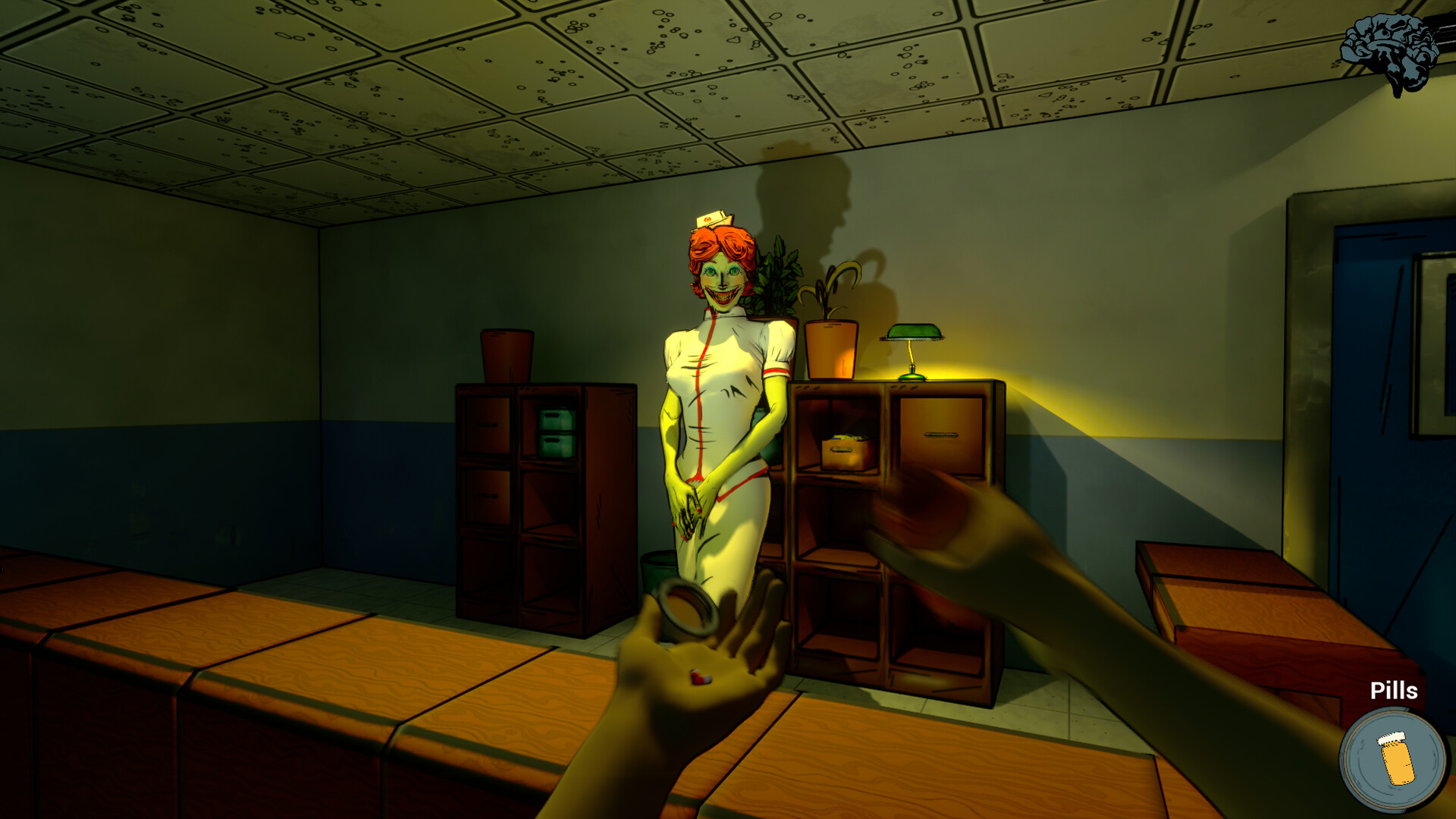
Pills restore sanity and do not respawn. The map holds a fixed supply, so a full playthrough is a closed economy. The discipline: a pill taken when the wobble starts is a pill not available when the game turns hostile. Take pills at the 40% line, not at first distortion. The wobble is information, not a timer.
The Two Doors Rule
Every locked area in Ironveil has two ways in, and every expedition should know both before entering:
- Lock-picking is the controlled route. It takes time (which is sanity time), consumes picks on failure, but you choose when and where.
- Archive entrances are the fast, dangerous route. They skip puzzle chains entirely and connect distant wings, but they dump you into exposed locations.
Lock-picking itself is one rhythm. The timing pattern is consistent across every lock in the game, so the skill investment is front-loaded: overlearn it on the first low-stakes doors, because the worst place to learn is a corridor with footsteps in it. Failed picks are consumed, so brute force is a resource leak on top of a time leak.
Core Mechanics Explained
The Pill Economy
Think of pills as a budget across the whole campaign, not per-area pickups. The math that matters:
- The total supply is fixed at map generation. Nothing restocks.
- Distorted zones drain sanity continuously while inside them. Standing still in one costs sanity for nothing.
- Sanity below the 40% line multiplies threat pressure, which costs more sanity, which accelerates the spiral. The death spiral is real and fast.
The practical budget: enter each expedition with enough pills to survive one bad encounter plus one distortion detour. If an expedition would need more than that, it is two expeditions.
Nurse Bloodwell's Patrol Logic
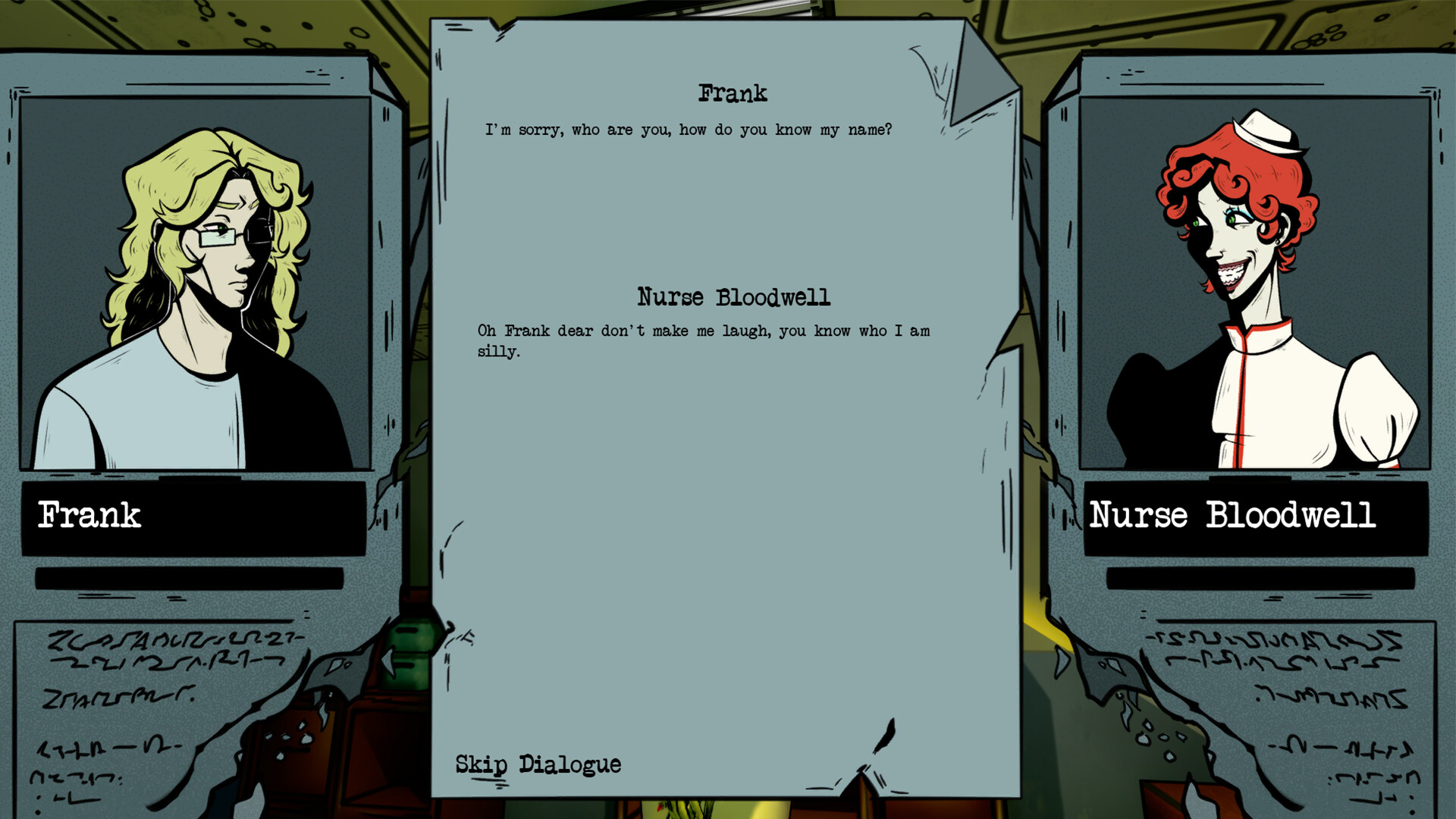
Bloodwell is not an AI that hunts you. She walks scripted routes through the halls. Every capture in this game traces back to a player decision made before she appeared: entering a room with one exit, crossing a corridor without listening first, breaking line of sight too late.
Her rules, distilled from the patrol design:
- Her audio carries further than her visual. Listen at every corner before you commit. Headphones are mandatory for this game; the low-frequency footfall cue is the difference between a clean crossing and a restart.
- She does not lose interest. There is no distraction mechanic, no throwables, no noise maker. Once she is between you and your exit, the only fix is the exit behind you.
- Line of sight is binary and persistent. Hiding behind a gurney mid-corridor does nothing if she watched you enter the corridor. Distance without cover is not stealth.
- Her routes repeat. Watch a full cycle from cover before crossing her zone. Thirty seconds of observation saves entire runs.
The Second Entity
The store copy confirms two hunting entities, not one. Bloodwell is the scripted patroller; the second entity is tied to the sanity system and the "what hides in the shadows" framing, appearing under low-sanity conditions. This is why the 40% emergency line exists: below it, you are managing two predator problems plus a lying map, with a pill supply that cannot cover all three.
Documents Are the Progression
The puzzle layer is document-driven. Notes scattered through wards combine into solutions for specific locks. Skipping documents does not just miss lore, it hard-gates progress later: puzzles assume you read the clues, and there is no hint system. The archive entrances let you skip a puzzle chain, but the wings behind them still need the documents for their own locks. Read everything. The quest popup timing issue makes this doubly true; if text vanished before you finished it, recover it from the quest log.
Progression Strategy: Wing by Wing
The hospital gate-progression: each major wing needs either its puzzle solution or an archive bypass. The route below front-loads document work in safe zones and treats archives as return trips, which keeps sanity spend flat:
- Start zone. Learn the lock rhythm on the first doors. Read every document in the starting ward before going anywhere; the starting zone is the safest reading environment you will ever get, and the early documents teach the clue format.
- Wing 1 (staff areas). Find the Wing 1 staff key. This is the first real key item. Note what it does NOT open (launch players report trying it on doors well beyond its zone); keys in Ironveil are zone-locked, not master keys.
- The library. The first archive entrance is here, and so is the launch's most dangerous bug (see Known Issues). Solve the box puzzle properly, take the file room key, and physically confirm your inventory updated before leaving. Do not leave on puzzle-solve autopilot.
- The file room. The gate that launch players hit first. With the file room key in hand it is a door; without it, it is a wall. If you cannot find the key, the library box is why.
- Deep wards. Past the file room the wings get more distorted, sanity drain rises, and archive entrances become the efficient connectors between already-scouted areas. Switch your default from lock routes to archive routes only for wings you have already walked.
- The escape run. The endgame asks you to traverse known ground under maximum distortion. This is what the whole pill budget was for. Route it through rooms you know by shape, not by signage, because at low sanity the signage lies.
Step-by-Step Strategies
1. The Expedition Loop
Every outing from a safe room runs the same shape: read everything in the target room, pick one or two locks, identify where the next archive entrance exits, walk home. That is the whole loop. The failure mode is chaining a third objective onto a successful double; the sanity bill for ward three always arrives during ward four, at range from your safe room.
2. The Bloodwell Crossing
When her route gates a corridor you need: stop at the corner, listen for one full patrol cycle, note where she turns, cross on her away-leg, and know your two exits from the target room before you step out of cover. If you hear the footfall change pitch, she is on the return leg; get inside any room with a second door and let the cycle reset. Never outrun her down a long corridor; the corridor is her territory and the rooms are yours.
3. The Archive Ladder
Archive entrances connect specific location pairs. Build the mental map deliberately: each time you use one, note the entry ward, the exit ward, and the sanity cost of the connecting stretch. After three or four, you have a fast-travel graph that skips puzzle chains, and the late-game escape run becomes a solved route instead of an improvisation. The cost is exposure, so only run archives you have scouted on foot at least once.
4. The Pill Scheduling Method
Anchor pill timing to route landmarks instead of watching the meter. Before entering any distorted zone: pill if you are under 60%. After any entity encounter: pill if under 50%. Never enter a new wing above a 40% floor. This converts an invisible meter into three yes/no decisions per expedition, and it reserves the bottom of the bar for genuine emergencies instead of spending it on anxiety.
5. The Document Sweep
In each new room: one slow lap along the walls reading everything, then handle objects, then leave. Reading during entry costs seconds; backtracking for a missed note costs a full expedition. The quest log is your completeness check, and the launch bug where the popup vanishes early makes the log, not the popup, the source of truth for what a room owed you.
6. The New-Game Safety Protocol
Because the Escape menu has eaten runs at launch: never touch menu items mid-session except Save and Quit. If you must restart, verify the quest log shows Quest 1 before you move; if it shows anything else, the new-game bug got you, and the fix is quitting to desktop and relaunching, not playing on a corrupted run.
Advanced Tips
- Sprint is a sanity cost. Faster movement burns the meter faster in this genre's implementation, and Ironveil rewards walking. Sprint only to close a door behind you or break a line of sight you already lost.
- The archive network is the real map. Puzzle locks are the game's front door; the archives are its hallway. Players who chart archives early finish with pills left over.
- Failure carries forward. A failed lock eats a pick, and picks are finite. If a lock resists twice, leave and come back at high sanity; the timing gets sloppy exactly when your hands shake at low sanity.
- Doors are memory anchors. Low sanity warps hallways, but opened doors stay opened. Route your escape runs through chains of doors you opened, not corridors you remember.
- The second entity punishes greed, not noise. It shows up when sanity is low, which means it shows up when you stayed one room too long. Every capture it causes traces back to a budget decision, not a mechanics failure.
- Save state before the file room. Until the library box bug is patched, keep a manual save from before the library and one after confirming the file room key. The 30 seconds of discipline deletes the only run-killing bug reported at launch.
- Quit to desktop, not to menu. The menu animation is slow, ESC does not close the pause menu, and mis-clicks near "Continue" have restarted runs. Desktop is one click and zero risk.
- Headphones or nothing. Every system in this game broadcasts through audio before visuals: Bloodwell's footfall, distortion ramps, the second entity's approach cue. Speakers flatten exactly the frequency range the game's warnings live in.
Known Issues and Workarounds at Launch
| Issue | Status | Workaround |
|---|---|---|
| Library box sequence break. The file room key can be taken from the box without solving the box puzzle. Leaving without it soft-locks the file room; the key does not respawn and the box cannot be re-triggered, forcing a new game. | Confirmed by launch reports in the community hub | Solve the box puzzle properly, and verify the file room key is in inventory before leaving the library. Keep a pre-library save. |
| New game inherits quest state. Starting a new game can carry the previous run's quest log (players report landing on Quest 2). | Reported at launch | Quit to desktop and relaunch before starting fresh. Verify Quest 1 on the log. |
| ESC does not close the pause menu. | Reported at launch | Use the menu buttons; avoid mashing ESC near "Continue." |
| Main menu animation slow, unskippable; intro cutscene unskippable. | Confirmed | Minimize menu round-trips. |
| Quest popup dismisses early. | Reported | Read quest details from the Escape menu log. |
| Performance in archive areas on below-spec GPUs. | Consistent with the 1660 Ti floor | Drop resolution before effects; the fog-heavy archive rooms are the stress test. |
The bug situation is normal for a 48-hour-old free indie, and the community hub is the place to watch for the patch. The library bug is the only one that destroys progress, and the workaround fully neutralizes it.
How It Compares
Webs of Reverie sits in the Amnesia and Outlast lineage: no combat, sanity as a resource, monster as a routing problem. The differences are the dual-route structure and the archive network, which give it a planning layer those games lack. Against the asylum subgenre specifically, Ironveil's sanity-warps-environment hook is the distinguishing mechanic; the hospital is literally a different map at 30% than at 90%, and routing knowledge has to be shape-based to survive it. Against free horror games generally, the 750 MB size is honest: short, focused, one idea executed cleanly.
FAQ: The Things That End Runs
Is Webs of Reverie really free? Yes. Free to play, no monetization visible on the store, Family Sharing supported. The 750 MB download is the full game.
Can you fight Nurse Bloodwell? No. There is no combat in the game. Both entities are avoided, never fought. Getting caught is typically run-ending, so the whole game is stealth routing.
Why can't I open the file room? The launch's most common wall, and it is the library box bug: the file room key can be grabbed without solving the box puzzle, and leaving without it soft-locks the door. Go back, solve the box properly, take the key, confirm it in your inventory. If the key is gone and the box will not reopen, restart from a pre-library save or a new game (after the desktop-restart protocol).
When should I take pills? At the 40% line as a hard rule, with two exceptions: pill before entering any distorted zone if under 60%, and pill after any entity encounter if under 50%. Taking pills at first distortion is the classic waste; the wobble is a warning, not damage.
Does controller work? No. The store lists no controller support. Keyboard and mouse only, with no remapping reported at launch.
What happens at zero sanity? The environment distorts heavily, the game turns aggressive, and the second entity enters play. Mechanically it is reduced navigation reliability plus multiplied threat pressure. The pill budget exists so you never find out from the inside.
Is it on Mac, Linux, or Steam Deck? Windows 10 only, no native Mac or Linux. A ProtonDB entry exists, but the 1660 Ti minimum spec is above Deck hardware, so expect resolution cuts and mouse-driven lock-picking on trackpads as the friction points.
Are there achievements? None listed at launch. Free Steam releases often add them post-launch; the community hub is where that gets announced.
Verdict
Webs of Reverie is a focused, free, single-evening survival horror with one good idea (sanity that rewrites the map) and a clean execution of the classics (patrol stealth, document puzzles, dual route structure). The launch bugs are real but exactly one of them destroys progress, and the workaround is thirty seconds of save discipline. For the price of a download and a GTX 1660 Ti, it is an easy recommendation for avoidance-horror players, and the archive-ladder routing gives it more replay depth than its file size suggests. Bring headphones, budget the pills, solve the library box properly, and Ironveil opens up.
Screenshots