Official game
Play PAPERHEAD
This game is hosted by Steam. Continue to the official page to play or download it.
Buy on SteamOverview
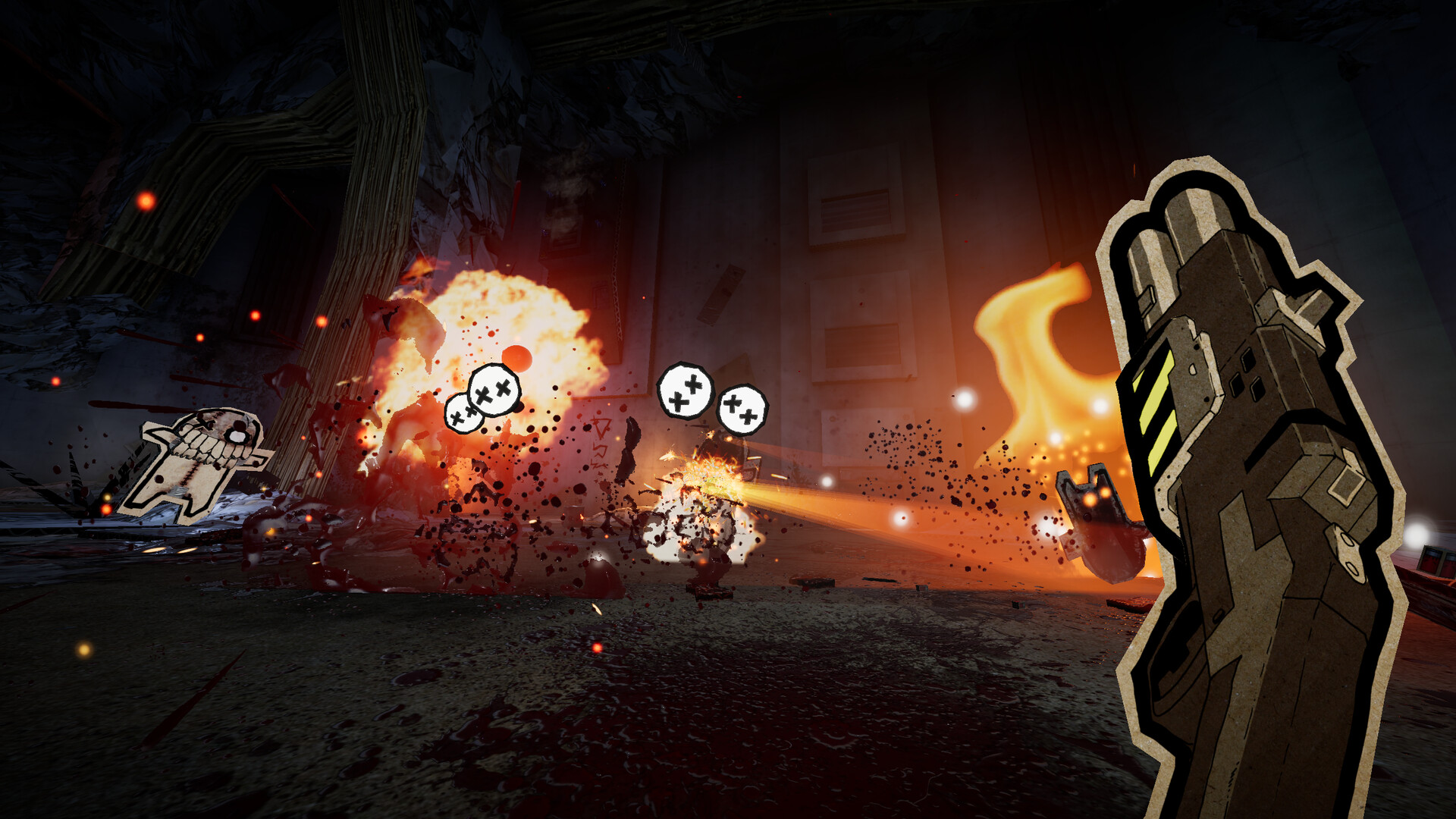
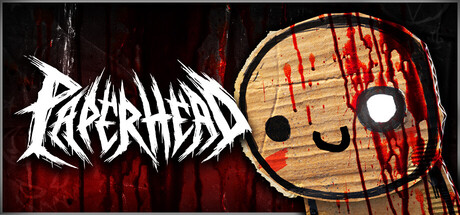
PAPERHEAD is a movement-first boomer shooter wrapped in a cardboard horror story, developed by Paperhead te4m and published by HypeTrain Digital. It launched on Steam October 9, 2026 at $15.99, after years of public development through the free EP.0 prologue and a Steam Next Fest demo. The pitch: an abandoned research facility, a world made of paper that has gone horribly wrong, a shotgun, a magic pencil, and one unanswered question hanging over everything. Why would cardboard bleed?
The combat engine gives you four verbs. You toss enemies into the air, kick exploding barrels through crowds, stomp airborne targets, and blast whatever survives. The pencil redraws rooms: sketch bombs to kick, draw doors through weak walls, vandalize for fun. Levels are arena-shaped, the industrial soundtrack cues wave escalation, and the whole thing moves at Anger Foot speed with a Binding of Isaac amount of hidden lore.
The campaign runs 5-8 hours for a first pass. Reviews landed Very Positive in launch week (101 positive against 4 negative across 105 English reviews), and the release holds a 9/10 flavor across most of them. Performance was the launch-week complaint, with players reporting 1% lows dropping from 240 FPS to 30 on capable hardware; most report it smoothed out within a day. Difficulty is real: a "hardcore" mode exists, launch commentary compares its feel to pre-nerf Viscerafest, and the arenas are tuned assuming you kick barrels instead of camping corridors.
This guide covers the combat loop in depth, the two-currency economy, every upgrade worth buying, boss patterns, secret hunting, the achievement list with unlock rates, character unlocks, and a path to the two hardest achievements in the game.
Getting Started: Your First 30 Minutes
The Weapon Drought Is on Purpose
You do not get your first firearm until roughly stage 3. The opening stretch is boots-only, and this is deliberate. Reviews call it out repeatedly, some love it, some bounce off it, but the design intent is clear: PAPERHEAD wants kick-and-toss to be in your fingers before the shotgun ever arrives. Do not wait for a gun to start fighting. The kick deals real damage, costs nothing, and sets up every environmental kill the game offers.
The Four-Verb Loop
| Verb | Input | What it does | When to use |
|---|---|---|---|
| Kick | F | Boots enemies and barrels across the room | Always. It is free. |
| Toss | F on airborne setup | Throws enemies up for juggling | Open fights, feed stomps |
| Stomp | Q | Slam down onto airborne enemies | Chain off tosses, keeps momentum |
| Blast | LMB | The shotgun. Meaty, loud, expensive | When nothing free applies |
The economy under this loop: barrels and stomps are free, shells are scarce. Every enemy killed with the environment is a shell you still own. Players who lead with the shotgun hit dry strings mid-arena; players who kick first always have ammo for the thing that actually needs shooting.
The kick draws direct lineage from DOOM Eternal's flame-vent/melee economy. The difference is that PAPERHEAD's version is a kill tool, not a resource tool. Kicking a barrel into three enemies is a triple kill that fired zero shots.
Controls Worth Binding First
Keyboard and mouse: WASD moves, Space jumps, Shift slides, F kicks and tosses, Q stomps, LMB shoots, RMB aims, E interacts and draws. Full controller support ships at launch, including DualShock and DualSense, and pad play is genuinely first-class here. One launch bug to know: mixing keyboard and controller input at the same time makes the camera flick. Pick one input per session until a patch lands.
Beginner Mistakes That Cost Runs
- Playing it like a cover shooter. Standing still is death. The game's speed is your armor; slide-jump between every position.
- Hoarding shells. The game restocks through the shop. Dying with 40 shells is waste.
- Ignoring barrels. Every arena places them on purpose. A barrel near a cluster is the room telling you how it wants to be solved.
- Starting on hardcore. Finish a run first. Hardcore re-tunes enemy aggression hard, and the achievement for clearing every level on it is a 1% unlock for a reason.
- Skipping EP.0 habits. The prologue had no shop economy. 1.0 is mechanically a different game. Your EP.0 instincts about clips apply; your instincts about progression do not.
The Two-Currency Economy Explained
Devlog 4 laid this out and the launch build shipped it intact. Two clip colors feed two shops:
| Currency | Source | Spent at | Buys |
|---|---|---|---|
| Regular clips | Common level pickups | Consumable shop | HP refills, ammo, armor, extra weapons, and a huge-dump skill point |
| Golden clips | Secrets | Upgrade tree | Ammo/HP capacity, ability upgrades, weapon upgrades, joke extras |
The split matters because the two currencies answer different failures. Regular clips fix a bad fight after it happens: heal, restock, armor before a boss. Golden clips prevent bad fights from happening: bigger pools, better tools. If you find yourself leaking regular clips every floor, the actual problem is an underfunded golden tree.
Spending Priorities
First golden clips, buy in this order:
- Movement upgrades first. Anything that extends slide, jump, or air control compounds across every remaining fight and every secret you can reach. Prop-jump (jumping off carried physics objects mid-air) changes which secret ledges are landable at all.
- Ammo capacity second. Shell scarcity is the whole resource game; raising the cap converts every pickup into more fights.
- Weapon upgrades third. Damage numbers come after mobility and uptime.
- Joke extras last. They exist. They are funny. They are not combat purchases.
Regular clips:
- Armor before every boss arena. Cheap relative to the damage it eats.
- Keep a 1-heal buffer, spend the rest. Hoarded regular clips do nothing until the skill-point dump threshold, which is a late-game sink, not a starter buy.
- Extra weapons when your loadout has a coverage gap, not on pickup.
Builds
The upgrade tree is young and undocumented in full, but launch play and the developer's own framing (all-in pencil builds and coin-farming runs are named as viable) support three archetypes:
Build 1: Pencil Main
Tree: Every pencil upgrade first. Sketch cost, bomb power, door speed. Regular clips: Hoard for ammo you will not need; pencil bombs replace shotgun crowds work. Playstyle: The room is your weapon. Sketch a bomb, kick it into a cluster, draw doors to skip arenas that bore you, stomp the survivors. Highest skill ceiling, most fun per kill, weakest against large doorway brutes that resist everything but buckshot. Best for: Second playthroughs, score chasing, secret hunting.
Build 2: Boots-Only Speedrunner
Tree: Prop-carry rank 1, then Prop-jump rank 2, then anything that extends the stomp chain. Regular clips: Armor and health only. Never buy ammo. Playstyle: The game is beatable treating firearms as optional. Toss into stomp into kick-cancel into the next room. This is the build the movement system was balanced around, and the one speedrun categories will form around, since the launch audience immediately began calling for leaderboards. Best for: Replay value, PERECT-rank chasing, the Peaceful solution achievement.
Build 3: Shotgun Traditionalist
Tree: Ammo capacity first, then weapon damage, movement last. Regular clips: Ammo restocks every shop visit. Playstyle: Kick barrels because the game prices it free, but solve every arena with the gun. Most forgiving build on hardcore, where the aggression tuning punishes greedy stomp attempts. Best for: First playthroughs, hardcore mode, players coming from DOOM who want the floor to feel safe.
Quick Comparison
| Build | First hours | Hardcore fit | Secret access | Skill floor |
|---|---|---|---|---|
| Pencil Main | Weak, ramps hard | Risky | Best in game | High |
| Boots-Only | Strong immediately | Poor | Good (needs prop-jump) | Medium |
| Shotgun Trad | Strong | Best | Weak | Low |
Step-by-Step Strategies
1. The Arena Opening Routine
Read every arena the same way. Entry: find the barrels before you find the enemies. First action: kick the nearest barrel into the largest cluster. Second: toss the nearest single enemy, stomp it. Third: the music tells you what remains. When the track ramps, a chain wave is entering, so reset to barrel-hunting. Shells are for the exit toll, not the entry tax.
2. The Stomp Chain
Toss does not consume momentum, it converts enemies into platforms. Toss one, stomp it, and the bounce keeps you airborne toward the next. Airborne enemies killed by stomp refund the bounce. Three-enemy clusters become a no-contact clear: kick barrel, toss survivor, stomp, slide-jump out before the second wave spawns. This is the loop behind PERECT ranks, because taking zero hits in a level is the rank's actual gate.
3. The Boss Pattern Read
Every boss in PAPERHEAD follows a three-phase shape: intro telegraph, pattern set, rage phase at a health threshold. The generic counter-play that works on all of them:
- Phase 1: do not spend shells. Barrels and stomps only. Learn the tells while the fight is cheap.
- Phase 2: the arena spawns its own ammo economy. Kick what it gives you.
- Phase 3: rage speed punishes greed. One stomp attempt per opening, then disengage.
- The final boss in particular is the community's keyboard-smashing reference point. Reviews are blunt that underupgraded runs hurt here; if you skipped the golden tree, the rage phase will read as unfair. It is not unfair, it is a skill check on the economy.
4. The Secret-Hunting Lap
Secrets hold the golden clips, and golden clips hold the build. Two passes per floor: clear pass, then secret lap. During the clear pass, mark every blank-looking wall (drawable cardboard takes doors later) and every ledge you cannot reach yet. After the floor's movement upgrade lands, walk the lap. Late floors gate some secrets behind late tools, so full completion requires one full back-track lap once your kit is complete. Budget an hour for the return trip and treat it as the game's true final level.
5. The PERECT Rank Push
The P33 RANK achievement (21% of players) needs one level at PERFECT rank; ULTIMATE P33ING (0.0%) needs every level. The rank demands a no-hit clear plus the level's score threshold, which is where the Aha! achievement's hint applies: level 2's max score requires using every kill type in one run. Practical route: grind level 2 until the max-score route is muscle memory, take the one-level achievement, then attempt full-game no-hit as a dedicated final project with the Boots-Only build, whose lower shell dependency makes no-hit consistency easier.
6. The Hardcore Campaign Plan
Hardcore multiplies enemy aggression and shrinks the forgiveness windows. The plan: Shotgun Traditionalist build, armor purchased before every single arena, barrels treated as mandatory. Skip score chasing entirely, skip secret laps until after the credits. The achievement requires all levels on hardcore, which includes the bosses; the final boss rage phase at hardcore is the single hardest check in the game, and the community's 1% completion rate tells you what to expect. Bring patience and a restocked ammo bar.
Character Unlocks
The character roster is secret-gated, and each character is a full moveset reskin with leaderboard weight:
| Character | Unlock condition | Global unlock rate |
|---|---|---|
| Default Buddy | Start of game | , |
| Jeb The Scientist | Story progression | 9% |
| Drone 0 | Story progression | 9% |
| Super Bandage Boy | Late-game secret | 3% |
| Lost Soul | Hidden encounter | 2% |
| Golden Buddy | Complete the secret questline | 0% |
Two achievements are character-bound runs: Blood Runner requires finishing every level as Jeb, HOTLINE requires every level as Super Bandage Boy. These are the completionist endgame; each is effectively a full second campaign, so pick the character whose handling you like before committing.
Every Achievement and What It Asks
| Achievement | Requirement | Unlock rate | Difficulty |
|---|---|---|---|
| Smiling friend | (Hidden story moment) | 57% | Automatic |
| P33 RANK | First PERFECT level rank | 21% | Medium |
| THE END | Finish the game | 9% | Easy |
| Jeb The Scientist | Unlock Jeb | 9% | Easy |
| Drone 0 | Unlock Drone 0 | 9% | Easy |
| R.I.P. GL | (Memorial achievement) | 8% | Automatic |
| YES THIS IS MADNESS | (Madness reference, hidden) | 8% | Easy |
| World War Paper | Watch full credits | 6% | Easy |
| Episode 0? | (Hidden, EP.0 callback) | 5% | Easy |
| CAREER ADVICE | (Hidden interaction) | 5% | Easy |
| Super Bandage Boy | Unlock character | 3% | Medium |
| Can I Pet the Dog? | Pet the chill boy | 3% | Easy |
| Peaceful solution | (Peace run, hidden) | 2% | Hard |
| Lost Soul | Unlock character | 2% | Medium |
| Thats Just a Theory | Find ALL lore | 2% | Hard |
| Aha! | Max score level 2 | 2% | Medium |
| ANIME 2 WATCH | (Hidden) | 1% | Medium |
| Hardcococococore | All levels on HARDCORE | 1% | Very hard |
| Family Boi | (Hidden story beat) | 0% | Easy |
| MOLLY | (Hidden) | 0% | Easy |
| Blood Runner | All levels as Jeb | 0% | Very hard |
| Golden Fre...Buddy | Unlock Golden Buddy | 0% | Hard |
| Otherworlder | (Hidden, future-past joke) | 0% | Medium |
| HOTLINE | All levels as Super Bandage Boy | 0% | Very hard |
| ULTIMATE P33ING | PERFECT on every level | 0% | Extreme |
The lore achievement deserves its own warning: Thats Just a Theory needs every document, and the community treats the hidden papers as the real story delivery. If the cardboard-bleeds mystery is why you bought the game, the lore hunt is not optional content, it is the payoff.
Advanced Tips
- The music is a mechanic, not mood. Track ramps mark chain-wave spawns. Set your repositioning to the soundtrack and flanks stop happening.
- Kick distance scales with slide speed. Slide-kick sends barrels further than standing kicks. Long-range barrel artillery is a slide-kick tech, not a kick stat.
- Prop-carry is a shield. Carried physics objects eat incoming fire while held. The EP.0 community fought over whether carrying props was a bug or a feature; as a purchasable upgrade it is now officially a feature, and it plays like a mobile cover system.
- Doors are one-way shortcuts. Drawn doors kick down in one direction. Draw from the far side of a room to open an escape lane toward the entrance you came from.
- Reload discipline. Never reload in a doorway. Enemies spawn THROUGH doorways in this game, and screenshots of enemies in door frames are a promise, not a joke.
- The 1% low fix. If framerates crater, cap FPS at 120, drop shadows one step, and disable background apps before touching any other setting. Most launch reports resolved this way within a day.
- Golden clip math. A full secret lap nets roughly one tree tier. If a floor has secrets you cannot reach, the movement upgrade is cheaper than the clips you are leaving behind.
- Controller players: the DualSense support is real and good, but pick one input device per session. Mixed input breaks the camera as of launch.
FAQ: The Things That Get People Killed
Why do my shells keep running out mid-arena? Because the arena solved itself for free and you paid for it. Barrels, stomps, and pencil bombs handle 80% of encounters. Shells exist for brutes and for emergencies, and the game prices them accordingly. Restock at the consumable shop with regular clips when pools dip.
What is the difference between the two shops? The consumable shop (regular clips) sells recovery: health, ammo, armor, weapons. The upgrade tree (golden clips) sells power: capacity, abilities, upgrades. Golden clips only come from secrets, so skipping secret-hunting deletes the entire upgrade system from your run.
Is hardcore worth doing first? No. Two separate reviews describe hardcore as the "real" difficulty the game was tuned around, and the all-levels hardcore achievement sits at 1%. Finish a normal run, buy your tree, then take hardcore as a second campaign.
Where did the secrets I marked go? Some secrets need late-run tools (prop-jump, late doors) to reach. This is the back-tracking design, not a bug. Do the full return lap after the credits if you are completionist; most secrets resolve in one pass with a complete kit.
The final boss feels impossible. What am I missing? The economy. Reviews that smashed keyboards on the final boss self-report skipping upgrades. Rage-phase speed assumes golden-clip movement tiers and an armor purchase from the pre-boss shop. If both boxes are checked, the three-phase read above applies and the fight is a clean, if violent, skill check.
Does the pencil have an ink limit? None is documented, and launch play reports sketching freely. Treat sketches as cheap until a patch says otherwise.
Verdict
PAPERHEAD earns its Very Positive launch. The combat loop is the tightest thing in the sub-$20 shooter space this year, the two-currency economy gives the secret hunting real teeth, and the cardboard horror tone lands because the game commits to both halves of it. The performance wobbles at launch were real but largely self-resolved, the campaign is short but dense, and the achievement mountain gives it a completionist tail measured in tens of hours. Buy it if movement shooters click for you. Buy it for the lore if the question in the trailer got you. And kick the barrel first.
Screenshots