Daily Pick
One deeply researched guide worth reading today.
A practical route through the systems that matter most, written to help new players make confident decisions quickly.
Overview: What Kind of Game Is Kill The Shadow?
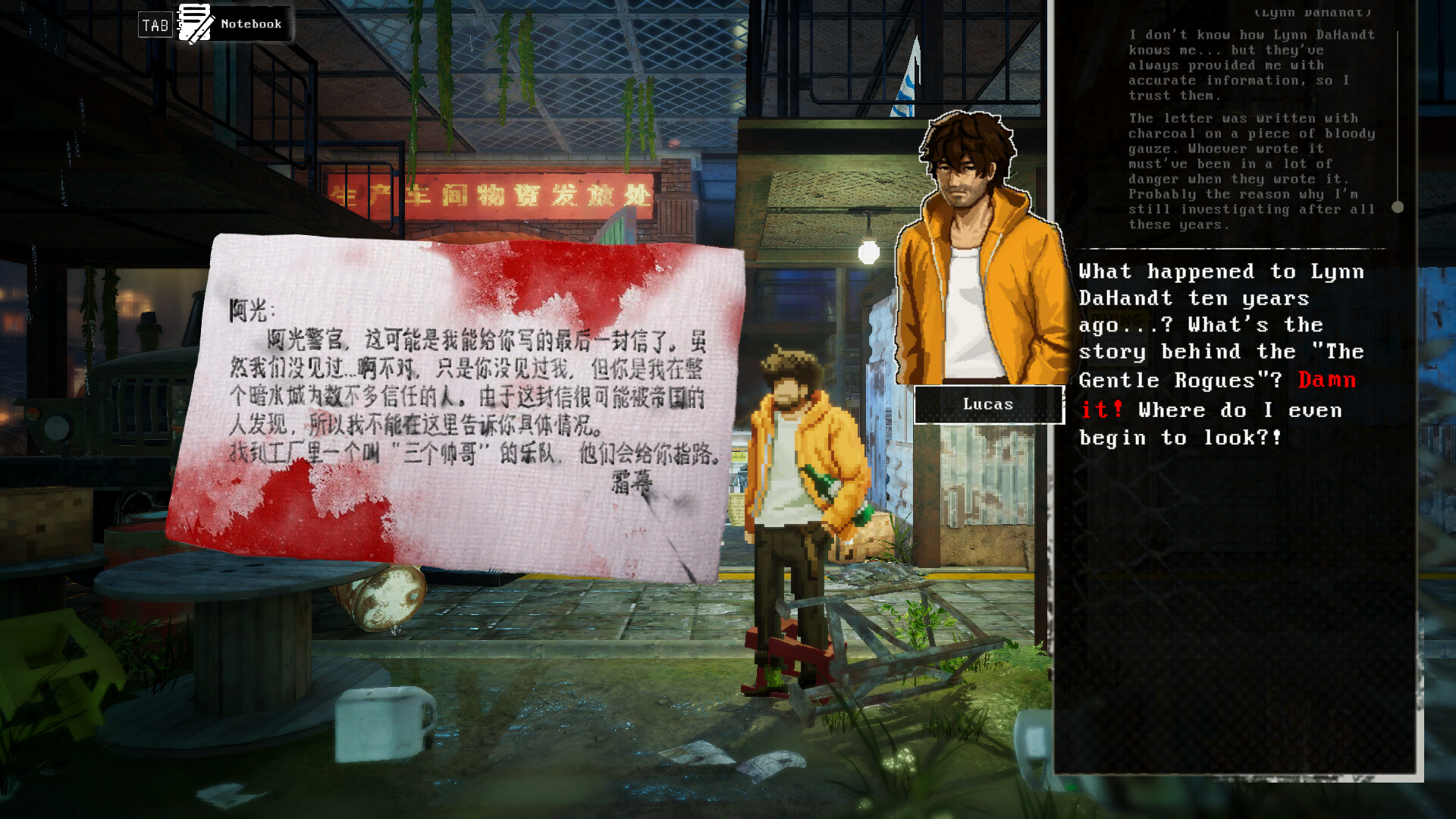
Kill The Shadow is a 2.5D suspense detective RPG from Shanghai studio Shadowlight, published by Phoenix Game. You play Lucas, a former police officer carrying a parasitic creature called the Shadow on his back. The creature reads memories and reconstructs the traces of the dead, which is both the story's hook and the game's core mechanic: you investigate a chain of bizarre murders in Dark Tide City, a metropolis split by a mysterious fracture ten years before the game begins.
The game launched on Steam August 5, 2026 for Windows at $16.99 ($15.29 with the launch discount, 10% off again during the Steam Autumn Sale alongside five themed bundles). It is single-player with 41 achievements, Steam Cloud saves, and full English and Simplified Chinese voice acting. The comparison set is Disco Elysium meets The Rewinder: ability-gated dialogue, a corruption-of-sorts meter, multiple endings, and a Chinese historical melancholy underneath the murder cases.
| Field | Detail |
|---|---|
| Genre | Detective adventure, RPG, suspense |
| Developer | Shadowlight (坞光岚影) |
| Publisher | Phoenix Game |
| Platform | Windows (PS5 and Xbox Series X |
| Price | $16.99, sale price ~$15.29 |
| Length | 15-25 hours first run; 30+ for full completion |
| Achievements | 41 (10 hidden) |
| Steam rating | Very Positive across ~550 reviews (English and Chinese combined) |
| Steam | store.steampowered.com/app/2660230 |
Who this deep dive is for: players past the demo who want the endings mapped, the corruption routing explained, and the achievement list optimized into a two-run plan. The deduction layer of this game is easy; the meta layer (which choices lock which endings, what carries between runs, where the point of no return sits) is where actual difficulty lives, and that layer is barely documented anywhere else.
What the Post-Launch Patches Changed
Four updates landed in the first two months, and they matter for routing:
Stability patch (late September). The team isolated the random crash bug: an older Unity render pipeline version contained a heap-corruption defect, and the triggering code path is disabled. If you bounced off at launch because of crashes, the game runs stably now; two days of zero-crash internal testing preceded the patch.
Content patch: part-time jobs and a new finale conversation. The Old Machinist at Pig Cage Walled City offers additional part-time work, and Wendell Forge plus the Shipwreck Wharf bar now offer jobs too. In the grand finale, players who chose to become Rafe's dad get a new conversation with Rafe's mom on the bridge. Gamepad sprinting now uses stick-magnitude hysteresis (push past threshold to run, drop to walk), and the Y-button sprint binding is gone.
Quality-of-life patch. Quick Save (F5) and Quick Load (F6) landed with UI hints. The 3D clue-search interface got a drag-speed setting. Rewind gained a sensitivity setting, A/D keyboard controls, and an on-screen Q reminder. Part-time jobs complete with repeated clicks instead of long dialogue. You can feed Lucky at the Factory. Save export arrived on the title screen.
Fix patch. Ethan's achievement now unlocks on viewing the photo. F5/F6 icons display correctly. The Master Reed deduction clue color was adjusted for readability. A water-system crash and several softlocks got fixed.
The patch pattern tells you something useful: the developer treats routing aids (quick save, save export, rewind tuning) as first-class features. Use them aggressively; the game is built to reward save-scumming explorers, not punish them.
Getting Started: Your First 30 Minutes
- Set audio to Chinese with subtitles if you read them. The English dub is the game's most common criticism; the Chinese cast (29 actors, 100+ characters, 2,000+ lines) carries the intended tone. This choice shapes 20+ hours of experience.
- Turn on quick save (F5) and use it before every conversation. Autosaves are frequent, but an anchor before each dialogue tree lets you explore branches without weight.
- Play the tutorial mystery fully and slowly. The habits that carry through the whole game are built in the first case: sweep the scene, interview everyone, connect on the board, confront once, rewind, try again.
- Commit to one ability at creation. Strength, Spirit, or Charm. Balanced builds sound safe and unlock nothing reliable; every check gates on a threshold you either clear or do not.
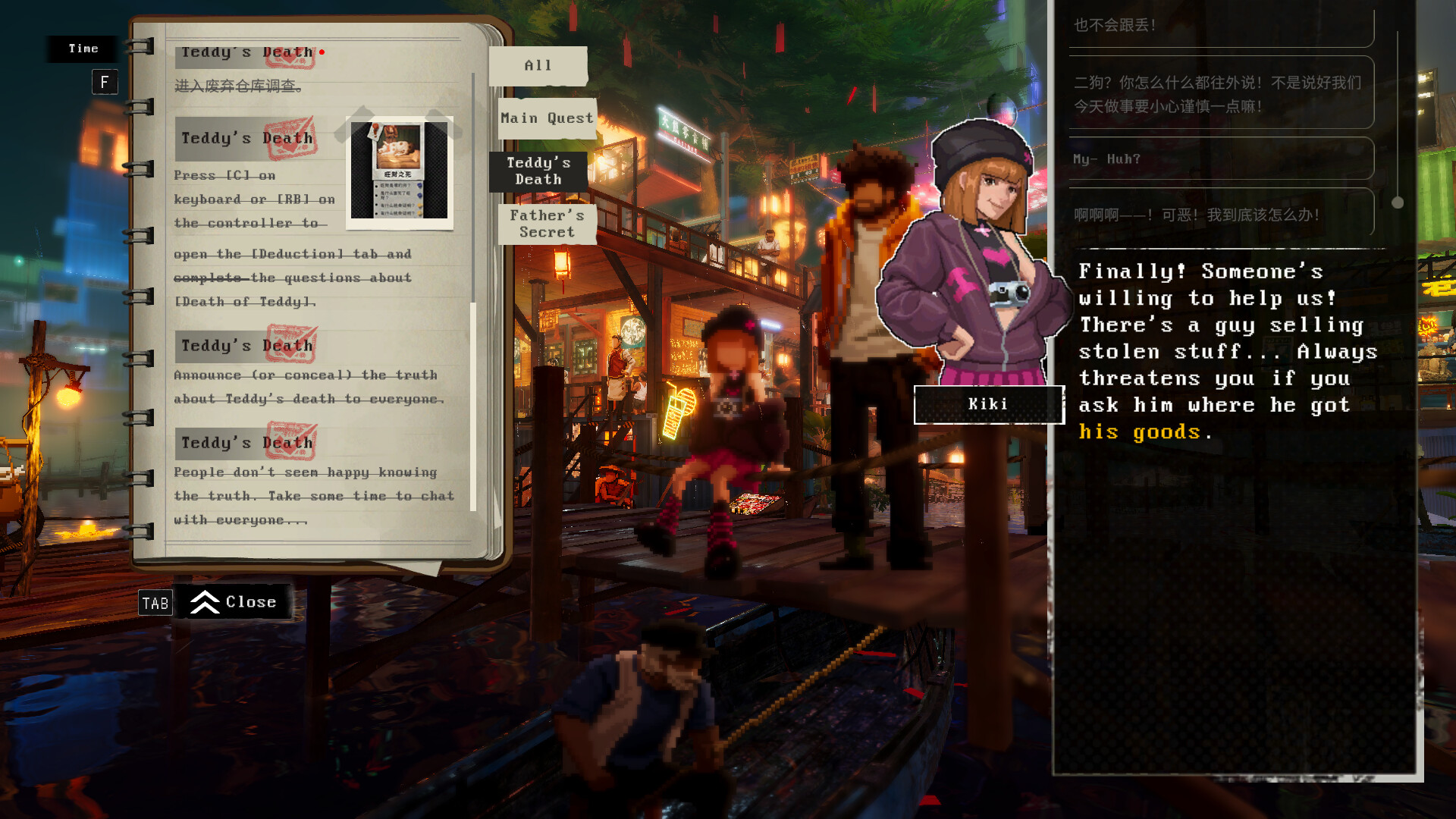
- Read every note and newspaper. The prison writings and temple-fair reports are flagged case content. The game hides routing information in documents, not just flavor.
Beginner Mistakes to Avoid
| Mistake | Why It Hurts | Fix |
|---|---|---|
| Playing with English audio only | The best writing is in the Chinese dub | Switch audio, keep subtitles |
| Hoarding clues in your head | The deduction board is where cases advance | Connect every clue the moment it lands |
| Ignoring the corruption meter | It silently gates ending branches | Decide early which run type you want |
| Skipping part-time jobs | Money funds bribes, which are S-tier approaches | Do every job once; they are click-through now |
| Selling gifted books | Books boost attributes permanently | Track gifts; claim them every chapter |
| Walking everywhere pre-sprint | Sprint unlocks only after the first playthrough | Plan investigation routes around districts |
| Treating rewind as failure | Rewind is the intended exploration tool | Rewind in every major conversation |
Core Mechanics Explained
The Rewind System: Knowledge Persists, Consequences Do Not
Rewind lets you revisit any conversation or moment and choose differently. The load-bearing detail, and the one most players miss: the game remembers what you learned even after you rewind. Lucas keeps his knowledge; the world resets to the branch point. This makes rewind an information-gathering tool, not an undo.
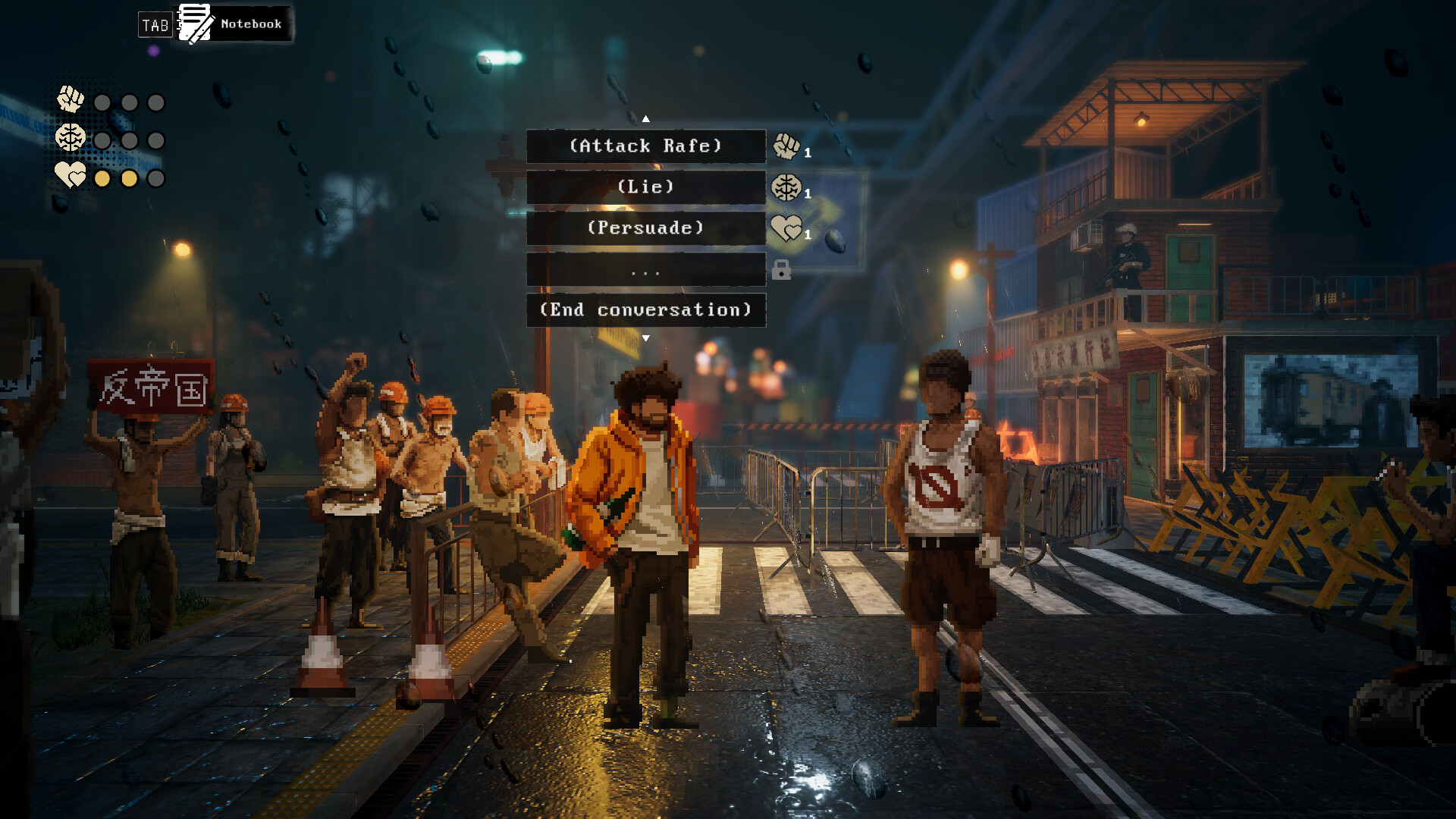
The strategic consequence is enormous. Every conversation is a chest with multiple drawers. Open each drawer: pick the aggressive option, watch the reaction, rewind, pick the passive one, rewind again. You keep everything you learned from all three attempts and then commit to the path that yields the most. The game's own dialog trees are designed around this; characters reveal different facets depending on approach, and several leads only appear after you have tried and failed an approach once.
Routing rules for rewind:
- Map before you commit. In any conversation with three or more options, try all branches before locking in. The cost is seconds.
- Failure is data. A failed intimidation check tells you the target's threshold. Rewind and come back with Charm or money; the knowledge of what does not work is progress.
- Rewind does not cross chapter ends. Chapter-finale decisions lock in; use quick save before them, because rewind will not carry you back past the credits of a chapter.
- Tune the scrub. The sensitivity setting added post-launch matters for long rewinds across long conversations. Set it once at the start of Chapter 1.
The Deduction Board and the Evidence Economy
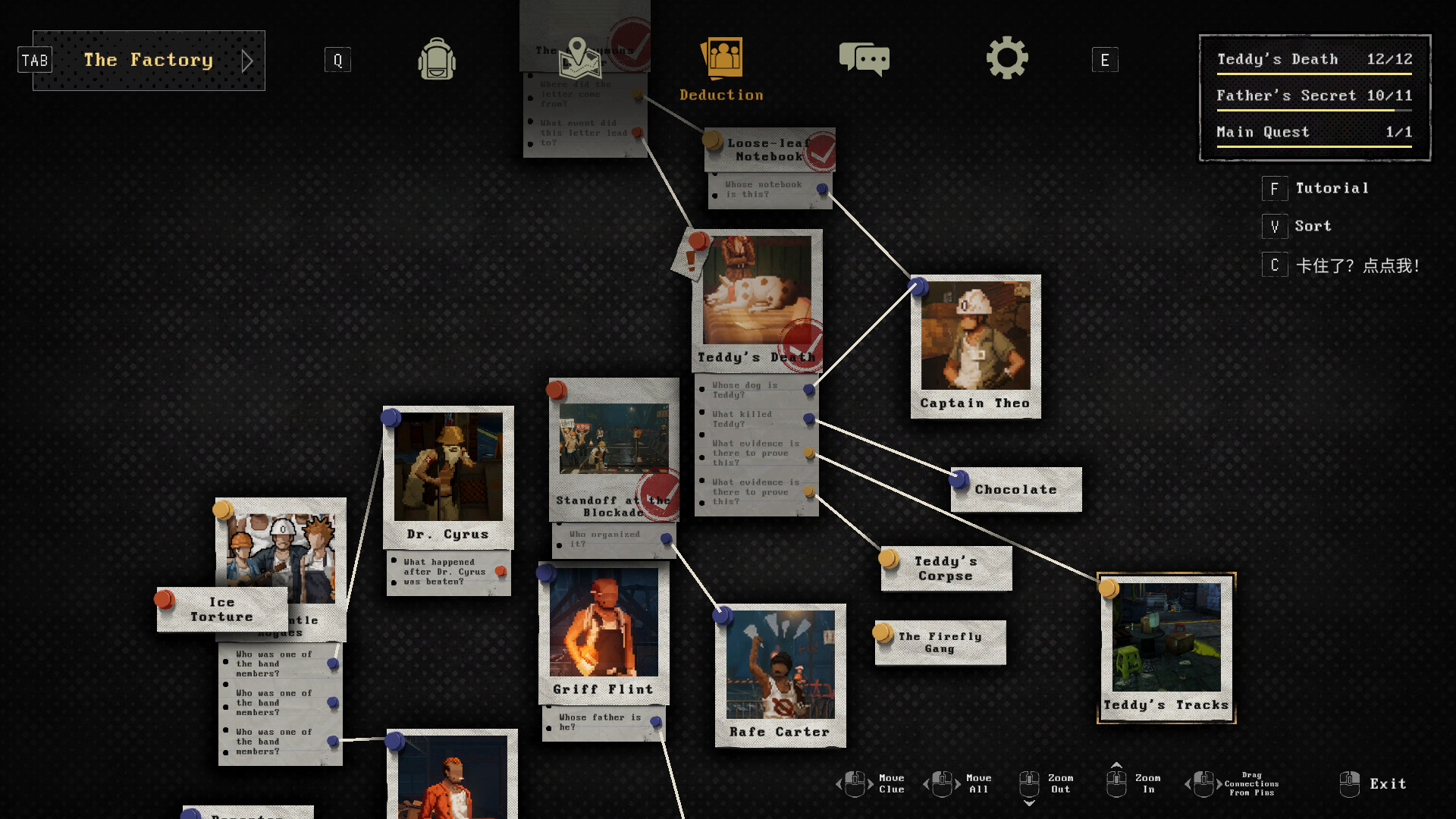
Cases advance through a photo-pin-string board. The five-step loop is explore, gather, analyze, connect, conclude. Two mechanics hide inside the loop:
Wrong connections are free. The board lets you link clues incorrectly, watch the game reject the theory, and unlink without penalty. There is no resource spent on failed deductions. Experiment violently; the board rewards it.
The clue bar zoom trap. Scrolling the left evidence bar with the mouse wheel also zooms the entire board. It is a UI quirk, not a bug in your input. Work from the board itself and treat the side bar as a list, not a scroll target.
Crime-Scene Reconstruction
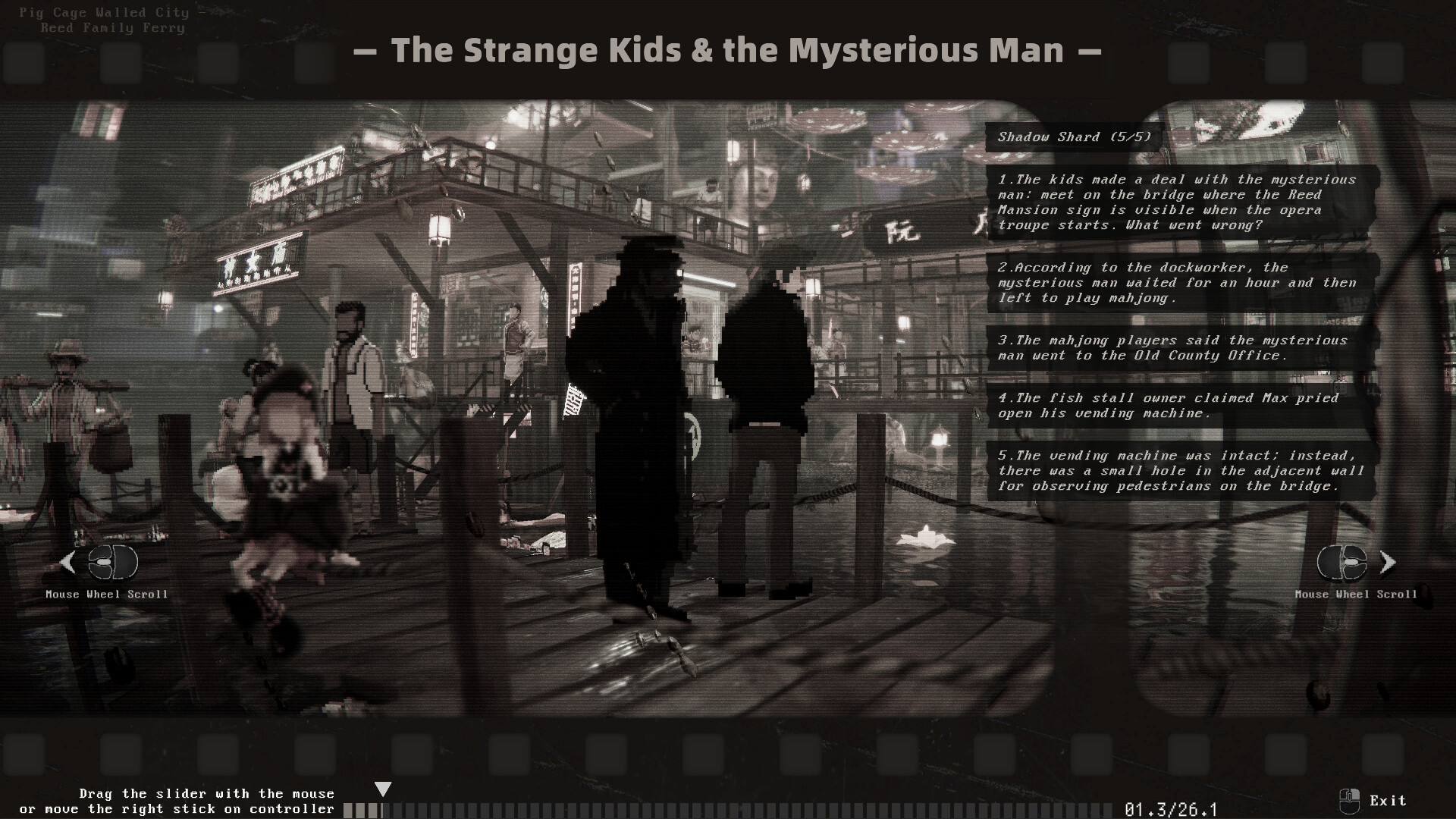
The Shadow reconstructs final moments of the dead as 3D micro-scenes you rotate and inspect. The design philosophy is explicit: no arrows, no hand-holding, clues hidden in depth. The discipline that pays:
- Rotate the full camera sphere before leaving any reconstruction. Clues sit behind objects and under surfaces.
- Compare the reconstruction against the physical scene in the present. The killer staged something; the difference between the past and the present is the evidence.
- Watch for the tell: an object in the present that the reconstructed past cannot explain, or a body position that contradicts the claimed cause of death.
- Re-run reconstructions after major reveals. Post-patch, new details appear in old scenes once the story gives you context.
Strength, Spirit, Charm: The Routing Triangle
| Ability | What It Opens | Corruption Interaction |
|---|---|---|
| Strength | Intimidation, forced answers, brute-force paths | Pushes the meter up faster on dark choices |
| Charm | Persuasion, manipulation, bribery, social doors | Neutral; bribes spend money, not morality |
| Spirit | Deeper reconstruction, better rewind, insight checks | Neutral; makes evidence work stronger |
The triangle matters because check gates are hard. A failed check is a wall, not a penalty, so your primary stat decides which routes exist for you at all. Charm is the meta pick for a first run: money-based approaches are stat-cheap, universally available, and do not move the corruption meter. Spirit is the second-run pick for players who want the detective fantasy at maximum resolution. Strength is the roleplay pick; it closes more doors than it opens but has the most character in its scenes.
The Corruption Meter: The Game's Real Difficulty Setting
Dark choices push a hidden-ish corruption meter higher, and the meter is tied to which endings can branch at the finale. This is the mechanic that determines whether your two runs are different games or the same game twice. Three postures:
- Low-corruption run (first run recommended). Take the protective, empathetic options. Unlocks the Perfect Ending path (13.9% of players) and Rafe-family endings.
- High-corruption run (second run). Take the selfish, brutal options. Unlocks The Lynching, money endings, and the darkest branches.
- Mixed run (completionist). Deliberately oscillate to catch branch-specific achievements like Money above All Else (17%) and Tomb Raider (35%) without committing the whole run to darkness.
The meter's structure means achievement hunting without an ending plan wastes runs. Decide the run's corruption posture before Chapter 1 ends.
Progression Strategy
Ability Point Priority
- Primary stat to the early-case threshold first. Every Chapter 1-2 check is clearable with a focused build and impossible for a balanced one.
- Secondary stat to the mid-game floor. Two viable approaches cover roughly 90% of checks.
- Spirit third for every build. Reconstruction depth and rewind quality pay into all approaches; Spirit is the only stat that improves your information, which is the real currency of a detective game.
- Books fill gaps. Shawn's gifted books and purchasable titles add flat attributes. The first patch raised the gifted-book cap and bonuses, so gifts are now a meaningful stat line. Claim every gift every chapter.
What to Unlock First
- Fishing rod (early). The Intermediate Fishing Rod got a price cut in the first patch, a strong signal fishing is real content. Fishing Master (30 fish, ~28% unlock) is the rarest non-ending achievement in the common band, and fish sell well.
- Part-time jobs (immediately). Three job sources post-patch: the Old Machinist, Wendell Forge, and the Shipwreck Wharf bar. They now complete with quick clicks. Money funds the bribery approaches that make Charm runs flow.
- Save export (title screen). Backs up runs before finale decisions. This is the achievement hunter's best friend; nothing else in the game approaches its routing value.
- District map knowledge. The Factory leads to Shipwreck Wharf; Old Town connects to Pig Cage Walled City. Sprint does not exist in a first playthrough (a common complaint among Chinese reviewers), so learn the district adjacencies and plan loops that minimize backtracking.
The Two-Run Plan
The achievements and endings are structured for two runs, and the optimal split is asymmetric:
Run 1: The Natural Detective. Chinese audio, Charm primary, Spirit secondary, low-corruption choices, all side systems touched, no wiki lookups. Target: Perfect Ending, the Rafe-family achievements (Master Negotiator, The Stepfather), Master Machinist, Newspaper Boy, and 30 fish. This run banks 60-70% of the list while giving you the story at full impact.
Run 2: The System Player. Spirit primary, high-corruption routing, save-export anchors before every finale, target the hidden endings (The Lynching, Escape, The Butterfly's Dream, The Reckoning), the bribe-and-theft achievements (Money above All Else, Master Thief, Tomb Raider), and Choices Matter. Dialogue trees are already mapped from run 1, so rewind exploration is fast.
Completionist (3.3%) is a third light pass on top: mop-up achievements like The Foodie (7.7%), Hymn of Courage, and I See What You Did There.
Builds and Approach Tier List
| Build | Primary | Secondary | Best For |
|---|---|---|---|
| The Negotiator | Charm | Spirit | First run; clean non-violent solutions; money approaches |
| The Insight | Spirit | Charm | Second run; maximum deduction depth; achievement cleanup |
| The Enforcer | Strength | Spirit | Roleplay; the direct route; darkest branches |
| The Fixer | Charm | Strength | Mixed corruption runs; maximum per-case flexibility |
Approach tier list (how you solve cases, not character builds):
| Tier | Approach | Why |
|---|---|---|
| S | Mind games | Rewind makes psychological plays risk-free; feeding false information exposes suspects' tells |
| S | Bribery | Money is universal, stat-cheap, and does not move the corruption meter |
| A | Spirit insight | Better reconstruction and rewind pays into every case |
| B | Intimidation | Closes doors permanently in some branches; several targets are authority-proof |
Mind games and bribery share the S tier because both are rewind-compatible and corruption-neutral. Intimidation is deliberately priced worse by the design: it works, and then the world remembers.
Step-by-Step Strategy: Five Sequences
Sequence 1: The Case Loop (Run on Every Case)
- Sweep the scene fully before any dialogue. Rotate reconstructions through the entire camera sphere.
- Interview every named character in the district. Note contradictions between witnesses, not just against evidence.
- Collect every document. Newspapers and notes are clue cards, not set dressing.
- Connect everything on the board, including wrong theories. Rejections are free information.
- Choose the approach your build supports. On failure, rewind and switch approach type, not the same approach harder.
- Quick save before any choice flagged as a decision. Read the chapter summary screen; it lists what remains open.
Sequence 2: The Dialogue Tree Map
- F5 before the conversation starts.
- Pick the most aggressive option. Watch the reaction. F6, pick the most passive. Compare.
- Rewind, pick the middle option. Characters' preferred tones usually sit at one extreme, and the extremes reveal which.
- Commit to the highest-information path, then explore its downstream branches the same way.
- Note the character's preferred approach in your head (or on paper): Theo folds to authority, Rafe opens to patience, Chiffon responds to everything. Later chapters reuse these personalities.
Sequence 3: Early-Game Case Order
- Teddy the puppy first. Short, teaches the loop, and feeds Who's a Good Boy? (54% of players have it; the dog matters).
- Master Reed's disappearance second. Densest early plot; connects the elite thread.
- Shipwreck Wharf grudges third. Motive central; sets up the southern arc.
- Prison writings in parallel, always. The newspapers and notes are the spine of the decade-old mystery.
- Chapter 1 finale choice last, after every side thread is closed. The choice ripples into Chapter 2 and locks your corruption posture; take it with full information.
Sequence 4: The Money Engine (Side Systems Run)
- Buy the Intermediate Fishing Rod the day you can afford it.
- Fish between case beats at every body of water; spots are easy to miss in the semi-open districts.
- Run all three part-time job sources each chapter (Machinist, Wendell Forge, Wharf bar). Post-patch they are click-through, about a minute each.
- Sell duplicate fish, keep gifts, buy books that patch your secondary stat floor.
- Fund result: by mid-game you can afford every bribe the S-tier approach requires, without touching the corruption meter.
Sequence 5: The Endings Campaign
- Finish run 1 naturally. The credits unlock the branch diagram.
- Read the diagram. Identify which of the eight endings you missed and which chapter decisions gate them.
- Use save export from before each finale to reach alternate endings without replaying chapters.
- Route run 2 through high corruption: accept the butler's bribe, take Rafe's corpse money, let the Firefly Gang purge the Walled City.
- Target one hidden ending per loaded save: The Lynching, The Butterfly's Dream, The Reckoning, Escape.
- Final pass: mop up The Foodie, Hymn of Courage, I See What You Did There, and Choices Matter, then Completionist.
Advanced Tips
- Revisit scenes after reveals. Old districts change dialogue once the story moves. The game updates NPC lines silently; a ten-minute loop through previous districts after each chapter end catches new clues, new jobs, and gift NPCs.
- The two-column contradiction note. Keep a running list: what witnesses say versus what reconstructions show. Every case is solved at the seam between the two columns, and writing it down beats holding five testimonies in working memory.
- Feeding Lucky is a real system. The Factory dog can be fed post-patch; Who's a Good Boy? sits at 54% but requires sustained attention. Feed him something in every Factory visit.
- The Ethan photo achievement now unlocks on viewing. Pre-patch it required extra steps; if you played at launch and missed it, view the photo on your current save.
- Chinese audio changes puzzle perception too. Voice-acted emphasis marks which dialogue lines carry case weight. Subtitle-only players miss tone cues that flag lies.
- Quick save before the Master Reed deduction specifically. The clue color adjustment patch made the case fairer, but its deduction has the most failure states of the early game.
- The bar at Shipwreck Wharf is a job, a clue source, and an achievement feeder. Wendell Forge and Auntie Bass's reunion (The Middle-aged Love Story, 38.9%) routes through scenes there; do not rush the district.
- Rafe's arc branches harder than any other early character. Master Negotiator (41%) for talking him down, Tomb Raider (35%) for looting his corpse, The Stepfather (11.7%) for the long route. All three need different corruption postures; they are the model for how the whole game handles choice.
- Sprint arriving after the first playthrough is a design statement. The first run is meant to be walked; use the walk time to listen to ambient dialogue, which is where several optional clues hide.
- Do not buy the game at full price twice. The Autumn Sale bundles (Dark Narrative with Cyber Manhunt, Pixel Mystery with Tales of the Neon Sea, and three others) give an extra 10% off if you own one game in the bundle. For completionists, the bundle-mates are all in the same genre neighborhood.
Achievements Routing: The Numbers That Matter
Current unlock rates from Steam tracking, re-verified this month:
| Band | Achievement | Rate | Note |
|---|---|---|---|
| Common | Goodbye, North! | 70.5% | Story-unlockable |
| Common | Senior Machinist | 69.3% | Trade the Relief Meal early |
| Common | Who's a Good Boy? | 58.7% | Feed Lucky consistently |
| Common | Detective Lucas | 54.2% | Story-unlockable |
| Uncommon | The Newspaper Boy | 48.6% | Deliver to everyone; missable |
| Uncommon | Master Negotiator | 46.9% | Rafe talked down; low-corruption |
| Uncommon | Tomb Raider | 41.2% | Rafe's corpse; high-corruption |
| Uncommon | Major Ending: The Buried Truth | 39.0% | Dorian's trial full truth |
| Uncommon | Perfect Ending | 30.4% | Freed the North |
| Uncommon | The Fishing Master | 19.3% | 30 fish |
| Rare | Ending: Escape | 18.0% | Hidden |
| Rare | Major Ending: The Lynching | 20.3% | Hidden; high corruption |
| Rare | The Foodie | 17.0% | Reed Mansion dish |
| Rare | Choices Matter | 15.5% | Hidden |
| Rare | Major Ending: The Butterfly's Dream | 12.0% | Hidden |
| Rare | Ending: The Stepfather | 11.7% | Rafe's mom route |
| Rare | Major Ending: The Reckoning | 11.3% | Firefly Gang purge |
| Ultra-rare | Completionist | 3.3% | Everything above |
The rate distribution tells you where the routing cost lives: the common band is automatic, the endings cluster under 21%, and only one achievement in three hundred players reaches Completionist. A two-run plan with save exports turns the rare band into routine work.
Known Issues and Troubleshooting
| Issue | Status | Workaround |
|---|---|---|
| Random crashes (launch window) | Fixed in the late-September patch (Unity pipeline heap corruption) | Update to current build |
| English dub quality | Ongoing; the most common criticism | Chinese audio + English subtitles |
| Controller menus | Partial support; some menus expect mouse | Keep mouse handy; DualSense works in-game |
| Sprint only after first clear | By design | Plan walk routes; audio clues reward the pace |
| Long dialogue stretches | Pacing criticism in later chapters | Part-time jobs and fishing between beats |
| Cross-language text overlap | Rare reports on Italian/Japanese text | Restart chapter; autosave is frequent |
System Requirements and Platforms
| Component | Minimum | Recommended |
|---|---|---|
| OS | Windows 10 64-bit | Windows 11 64-bit |
| CPU | i5-6400 / Ryzen 5 1400 | i5-12600K / Ryzen 5 7600X |
| RAM | 8 GB | 16 GB |
| GPU | GTX 960 / RX 580 | RTX 3060 / RX 6600 XT |
| Storage | 4 GB | 4 GB SSD preferred |
Console versions arrived August 12, 2026 on PS5 and Xbox Series X|S. Steam Deck is unverified; the 2.5D Unity build generally runs under Proton, but test the free demo first and check ProtonDB reports before buying on Deck.
FAQ / Common Mistakes
How many endings are there, really? Eight named endings: Perfect Ending, Major Ending: The Buried Truth, The Lynching, The Butterfly's Dream, The Reckoning, Ending: Escape, Ending: The Stepfather, and Ending: To Die for Justice. The official copy summarizes the finale choice space as "Kill. Judge. Or perhaps... kiss(?) the mastermind."
Does rewind erase my progress? World state, yes; knowledge, no. The game remembers what Lucas learned even after a rewind, which is why rewinding through every dialogue branch before committing is the optimal play and not an exploit.
What is the single best build for a first run? Charm primary with Spirit secondary. Money approaches are corruption-neutral and stat-cheap, and Spirit improves the reconstruction and rewind quality that every case uses. Save Strength builds for a deliberate dark second run.
Why is sprint locked until the second playthrough? It is a design choice, and a divisive one among Chinese reviewers. The first run is meant to be walked: ambient dialogue, district audio, and several optional clues reward the slower pace. Plan investigation loops district by district to minimize backtracking.
Is the deduction difficulty actually easy? Yes, and reviews agree across languages. The game hides clues generously and rarely demands inference leaps. The difficulty lives in routing: which endings, which achievements, which corruption posture. If you want brutal logic, adjust expectations and enjoy the story.
Which choices are missable? Gifted books (per chapter), The Newspaper Boy deliveries, feeding Lucky, and several district dialogue scenes that change after chapter ends. Quick save at the start of each chapter and sweep previous districts once before moving on.
Is the Chinese story ending worth the spoilers? Reviews split on the finale. The common praise: art, atmosphere, deduction pacing, and the weave of late-Qing history into the city's factions. The common criticism: the last act leans hard into moralizing and one plot twist divides players sharply. The Perfect Ending adds content the other endings do not show, which is why the 30.4% who reached it argue it is the intended way to finish.
Do console versions have the same patches? The PS5 and Xbox builds launched after the PC patch cycle started, so they ship with the stability fixes and QoL features (quick save, rewind tuning, part-time job clicks) day one. The Rafe-mom bridge conversation was added to PC post-console-launch and should follow on consoles.
Is the demo worth playing first? The free demo (Steam app 2947640, 10 achievements of its own) covers the opening and lets you test performance and language options before buying. Demo saves do not transfer; treat it as a trial, not a head start.