Daily Pick
One deeply researched guide worth reading today.
A practical route through the systems that matter most, written to help new players make confident decisions quickly.
Overview: What Kind of Game Is Slayblade?
Slayblade is a run-based battle-tops roguelite from Henry's House, the studio behind Nanomon Virtual Pet, Kardboard Kings, and Desert Child. You build a battle-top ("blade"), fight street battles for cash, spend winnings on new parts, and merge their powers to dominate a miniature PS1-inspired Y2K city. It released on Steam August 20, 2026 for $4.99.
The core pitch: Beyblade-style top battles with a chill roguelite loop. Each run you collect parts, win money, and push further up the street-battle ladder. The official description jokes "if you Die in the game, you Die in real life"; the actual tone is playful, lo-fi, and snackable. The whole game runs on a mouse and left-click.
What separates Slayblade from a toy-simulator is the merge system. Parts do not just stack stats; they combine powers, and finding insane combos is the stated endgame. The 60+ part collection, the run structure, and the Y2K setting (hand-drawn character art, street-corner battles, a miniature city to skate around) give it the "chill roguelite" feel the Steam page advertises.
Who is this for? Players who enjoyed Beyblade as kids, roguelite deck-builders that reward combo discovery, or Oscar Brittain's earlier games (Kardboard Kings' shop-management loop, Desert Child's hoverbike races, Nanomon's pet-raising). If you want a deep story mode or multiplayer competition, Slayblade explicitly does not have those; the game is built around short, satisfying battle loops and customization.
| Field | Detail |
|---|---|
| Genre | Action roguelite / battle-tops |
| Developer | Henry's House, Oscar Brittain |
| Publisher | Henry's House |
| Platform | Windows (Steam) only |
| Price | $4.99 USD |
| Players | Single-player |
| Release | August 20, 2026 |
| Input | Mouse only (left-click); partial controller support |
| Parts | 60+ collectible blade parts |
| Episodes | 18 modifier episodes + tournament finale |
| Achievements | 50 |
| Steam Deck | Playable (community-verified, mouse recommended) |
| Steam | store.steampowered.com/app/4117730 |
| Website | henryshouse.com.au |
The Battle-Tops Loop
Slayblade's loop is three beats repeated across every run:
- Battle. Fight street battles with your blade. The controls are simple and satisfying by design; the Steam page promises "SUPREMELY SATISFYING controls" with the whole game playable via mouse and left-click.
- Spend. Take the cash you won and buy NEW parts.
- Merge. Find insane combos with the parts you unlock.
The run structure makes each session self-contained: collect parts, win cash, upgrade, push further. Death ends the run and sends you back with whatever progression the roguelite keeps.
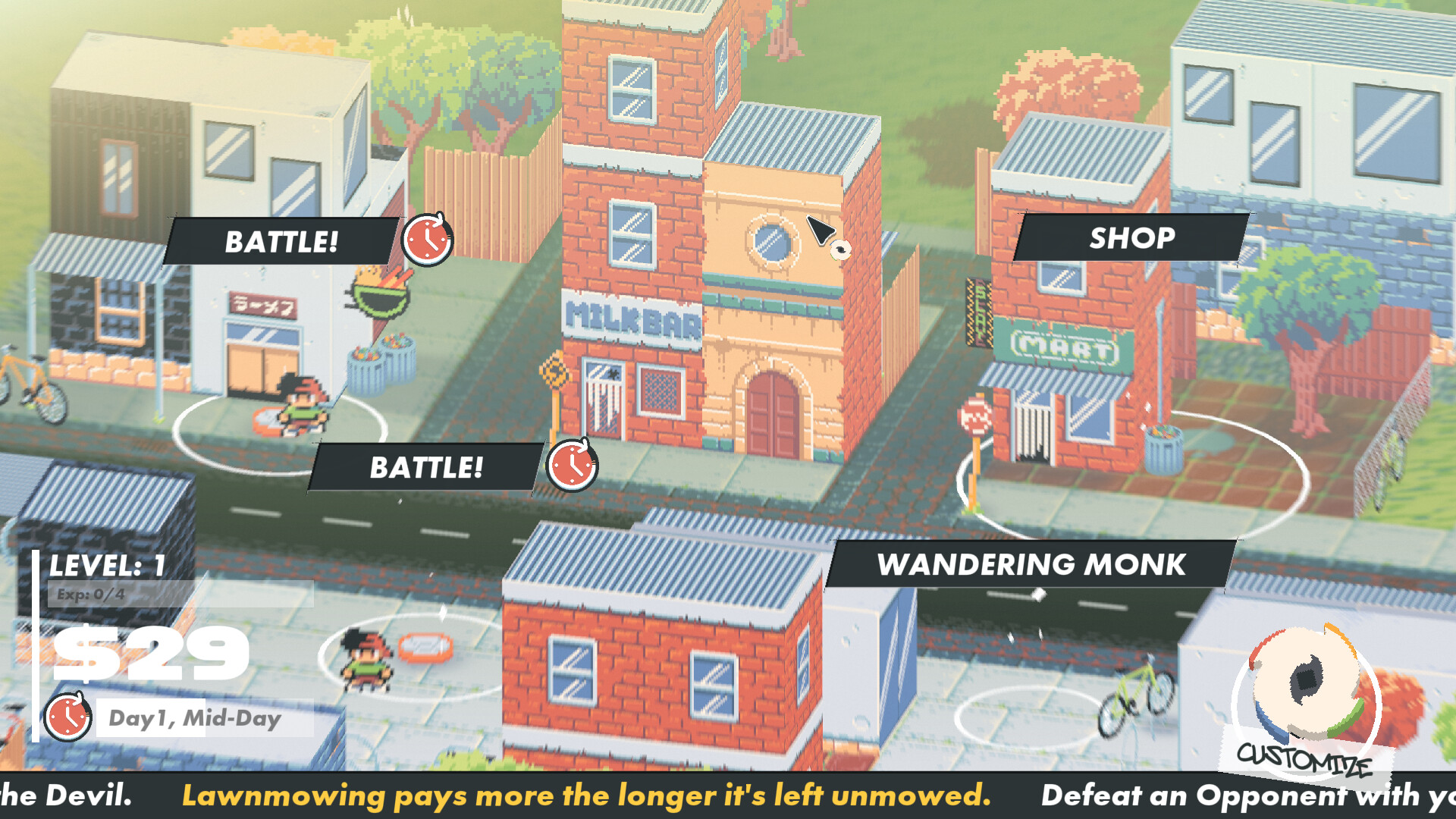
The Y2K city is the run's stage. You skate around a miniature PS1 city, winning Cash and Upgrades on your way to the top. Street corners host the battles; the city's districts hold part shops and challenges.
What Slayblade IS and IS NOT
The developer is unusually blunt about scope. From the Steam page:
What it IS:
- A snappy experience: colorful lo-fi visuals, simple/satisfying battles, fun customization
- Intuitive gameplay: whole game playable with mouse and left-click
- 2000s vibes: street-corner battles, hand-drawn character art, amazing music
- Lots of replay value: over 60+ Blade Parts to collect, and loads more unlockables
What it is NOT:
- No big story mode, just a brief intro + outro cutscene
- Not a multiplayer game
That honesty matters for expectations. Slayblade is a single-player, session-based battle game, not a live-service or narrative RPG. The "Save the city from a rich loser" plot is frame, not a 20-hour campaign. Launch reception split exactly along this line: the game sits at Mixed overall on Steam (65% of 351 reviews) mostly because players expected more content for the run structure, while the recent review trend sits at 75% positive as patches land.
Getting Started: Your First Run
Your first session, in order:
- Build your first blade. Start with the default parts. Do not overthink the first build; the game wants you to feel the battle controls before it asks for optimization.
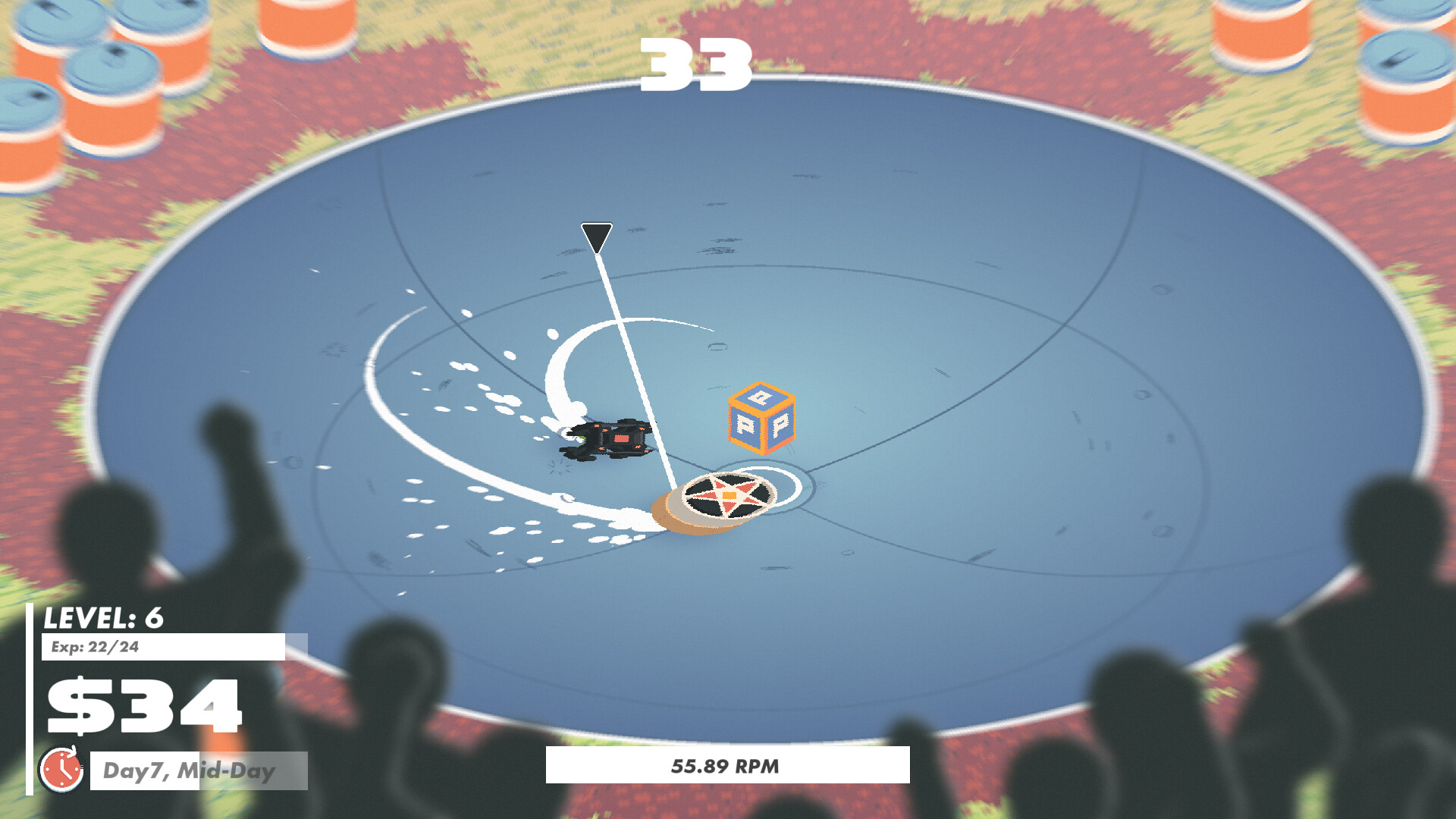
- Fight your first street battle. Left-click to engage. You launch your top into the bowl with a launcher, then steer it with the mouse, circling the arena to keep your RPM up while you collide with the opponent.
- Spend cash on parts. After the first win, buy a new part. The shop is where the roguelite economy begins. Read what each part does.
- Check part powers. Parts do not just add stats; they merge powers. Read each description before stacking.
- Push to the next district. The Y2K city opens up as you win. Each district has stronger opponents and better parts.
- Test in a low-stakes fight. If a part references an aura, a field effect, or a resource-scaling power, try it in a safe fight before you build around it.
Beginner mistakes to avoid:
| Mistake | Why It Hurts | Fix |
|---|---|---|
| Hoarding cash | Cash does not earn interest; unspent money is dead progression (except money-scaling builds) | Buy a part after every win that offers one |
| Ignoring part powers | Merging is the stated endgame; raw stat stacking misses combos | Read part descriptions and test merges |
| Ignoring the power cube | Whoever grabs the mid-battle cube usually wins the fight | Circle near the center so you reach it first |
| Letting gacha auto-equip parts | New parts auto-equip with no way to disable it | Re-check your blade after every gacha roll |
| Trusting autobattle | The AI ignores your build and often circles or self-KOs | Watch the fight; restart if it stalls |
| Pushing districts too fast | Stronger opponents wipe an un-upgraded blade and waste a run | Grind until your blade consistently wins, then move up |
Controls & Input
Slayblade is designed around a single input: left-click. The Steam page lists a "Mouse Only Option" and the game is "Playable without Timed Input," meaning no quick-time prompts or reaction checks gate progress. Partial controller support exists for players who prefer a gamepad, but the mouse is the intended path.
| Action | Input |
|---|---|
| Navigate menus / select parts | Left-click |
| Launch blade into battle | Left-click |
| Steer your spinning top | Mouse movement (circle the arena to maintain RPM) |
| Advance dialogue | Left-click |
| Controller (optional) | Partial support, varies by menu |
There is no keyboard requirement. The tutorial is thin; the two facts it undersells are the ability trigger order and the cube priority, both covered below.
Core Mechanics Deep Dive
Battle System: RPM Is Everything
Battles are the heart of Slayblade. Battle-tops collide in street-corner arenas, and your blade's parts determine its behavior: speed, power, durability, and special effects from merged powers. You steer your top with the mouse inside a shallow bowl, trading knockback and spin damage until one blade runs out of RPM. Knocking an opponent out of the arena entirely also wins (the "Hit for Six" achievement, 68% of players).
The battle feel is the product's main selling point. One player described the collision weight as anime-like. Circles matter: circling the bowl keeps your spin speed up, and a stalled blade in the center is a blade that loses. The physics are floaty by design, which reads as sloppiness in the autobattle and as skill expression when you drive.
The win condition, stated plainly: make the opponent's RPM hit zero before yours does. Everything else (knockbacks, bombs, stomps, cube effects) is a means to drain spin.
The Ability Trigger Order: Head → Mid → Tip
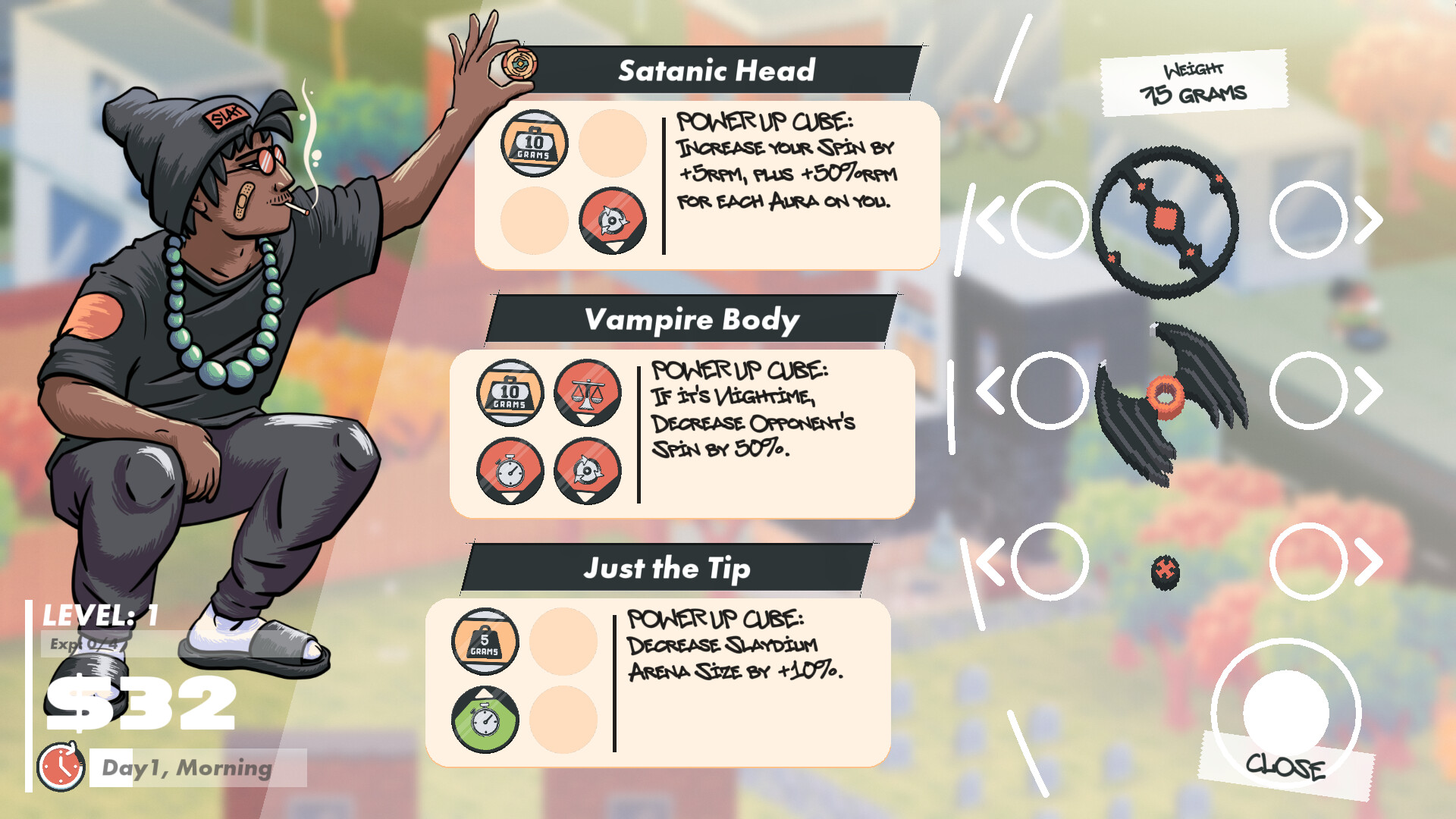
Part abilities activate in a fixed sequence: head first, then mid, then tip. All parts fire on the same frame within their slot, which produces real interactions. The verified example: holding both the "$$$ Bod" (gain cash equal to your opponent's level) and the "IAP Tip" (lose all current cash, gain a level) resolves the loss before the gain, so the pair nets positive cash instead of canceling to zero. When you stack effects, order them in your head with that sequence and you can predict most outcomes.
The Power Cube Decides Most Fights
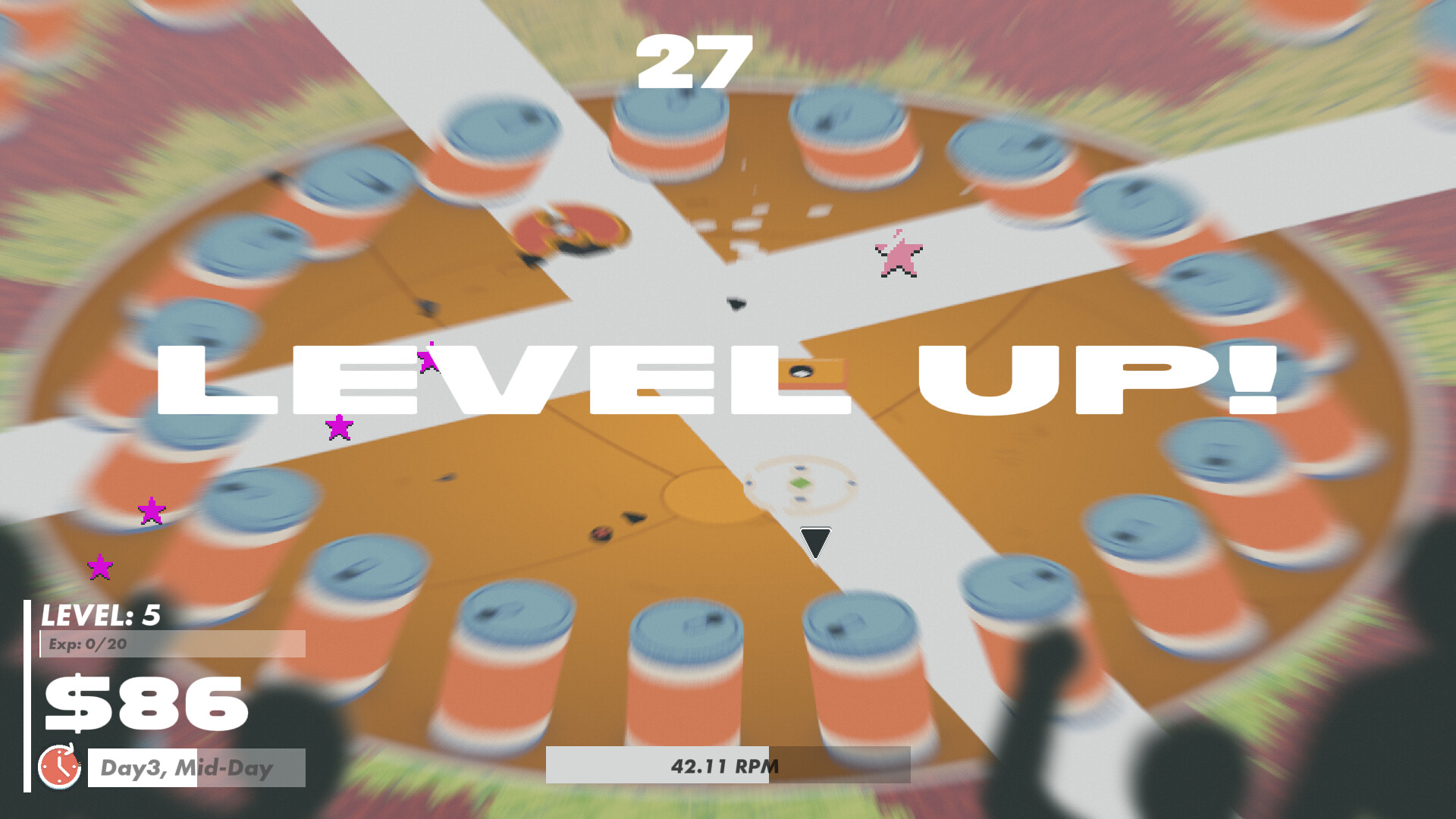
Mid-battle, a power cube drops into the arena. Picking it up grants a major effect: spin boost, opponent spin drain, or scaling effects tied to parts and wallet size. The uncomfortable truth of the launch meta is that whichever blade grabs the cube usually wins. The cube often spawns in the final 3-5 seconds, so:
- Pre-position. Circle the stadium's mid-ring as the timer drops so you are never far from the spawn.
- Bank speed. Do not commit to a far-edge chase in the last seconds; a stalled blade cannot reach the cube.
- Pre-damage first. Cube damage alone will not finish a healthy mid-game opponent. Land hits before the cube so its drain closes the deal.
Patch 1 fixed the "Collect 4" achievement so opponent cubes no longer count against it. Four cubes in a single battle is the target (57% of players have it).
Part Collection (60+ Parts) and the Merge System
Over 60 blade parts drop from battles, shops, and gacha. Parts combine through the merge system: the "INSANE combos" the Steam page promises come from reading two powers and finding the interaction. The roguelite framing means merges are discovered over runs, not just bought.
Pro parts are the recognizable set: green parts with "Pro" in their names, generally boosting spin. Winning a battle with an all-Pro build is the "Amateur" achievement (2.4%).
Cash & the Money Economy
Cash is the backbone: win it in battles and bets, spend it on parts. Two economy rules:
- Cash scales certain powers. Money-linked parts (the "$$$" family) tie cube strength or effects to your wallet size.
- Cash does not reinvest itself. Unspent cash is dead progression unless your build scales with it. Cycle it into parts, or deliberately bank it as a weapon if you run the money build.
Betting adds a second layer: before certain fights you place a bet, and winning doubles it. "Big Boy" (win a $20+ bet, 85%) and "Bigger Boy" ($50+) reward over-betting a fight you have already solved. Keep the Tip (halve your money, double your bet) doubles championship payouts too, which matters in the endgame episodes.
Auras, Modifiers, and the Day Cycle
Auras are field effects around your blade that modify spin, knockback, or defense while active. Patch 1 fixed the crashes they caused, but the explanation is still thin; treat every aura part as a test target. In timed episodes auras underperform because the cube spawns too late for field effects to matter; in long fights they accumulate.
Episodes layer modifiers over the standard loop: big-head blades, surrounding bomb rings, 2-versus-1, autobattle-only, small bladder, shrunk bowls, inverted time, no-exp rules, and more. Each has its own achievement, and the full list forms the postgame.
The city runs a day cycle: mornings bring new fights and shop stock, nights host championship matches. Cutting grass, collecting ground coins, and the pokies minigame pad your income between fights.
The Y2K City & Districts
The city gives the run its geography: districts, street corners, shops, and opponents spread across a miniature PS1-inspired environment. Stronger opponents cluster in farther districts. Criminals are the elite tier (20-30 RPM); beating one is the "Manbat" achievement (22.9%). The tournament is the run's finale and the source of the "Who's your Daddy?" achievement (49.9%).
Step-by-Step Strategy: Climbing the Ladder
Here is a repeatable path through a single run, built from how the economy and districts actually behave.
- Open with a balanced blade. Start even; learn the current district's opponents before you commit to an archetype.
- Win your first two street battles. Bank the cash. Early opponents have low RPM and fall to basic contact.
- Visit the shop and buy one part that changes how you fight, not a marginal stat bump. Prioritize parts that reference cash scaling, RPM drain, or knockback, since those feed merges.
- Test the new part in a low-stakes fight. Confirm the power does what you expect before you spend more.
- Grind the current district until you win consistently. Do not rush up with an un-upgraded blade.
- Bank for the next tier before moving up. Save exactly enough for one high-value shop item in the next district, then push.
- Merge aggressively once you have two synergistic parts. Read both powers and try them together; a broken combo beats a pile of high numbers.
- Play the cube, not the opponent, in close fights. From mid-game on, position for the cube spawn and pre-damage so the cube's drain finishes opponents.
- Bet big only on solved matchups. Double-or-nothing on a fight you win reliably is free progression toward the $50 bet achievement.
- Take the tournament when you can win it. The finale pays the biggest purse and resets your district momentum; enter it the evening your blade first two-shots district opponents.
- Repeat the cycle until the Final Battle. The climax is save-the-city versus "a rich loser."
Episode Walkthrough: The Postgame Structure
The full game ships 18 modifier episodes, each with its own achievement and completion reward. They are the content backbone after the credits, and the achievement spread shows exactly where players stop:
| Episode | Achievement unlock rate | Modifier gimmick |
|---|---|---|
| Get In The Slayblade | 9.8% | The tutorial-plus episode |
| Independence Slay | 5.8% | Early modifier run |
| 28 Slays Later | 5.8% | Survival-flavored run |
| A Bug's Death | 5.4% | Insect opponents |
| Two Stroke Heroes | 2.4% | Two-episode combo run |
| Slasyphus | 2.3% | The boulder-grind homage |
| Honey, I Shrunk The Bowl | 2.3% | Tiny arena, more ring-outs |
| Biosphere | 1.8% | Environmental hazards |
| Groundhog Slay | 1.2% | Looping-day structure |
| Uncut Blades | 1.1% | Grass gimmick run |
| There Will Be Blades | 1.0% | Late-game gauntlet |
| A Day At The Pokies | 0.9% | Gambling minigame episode |
| Slayotic Neutral | 0.9% | Balanced constraints |
| Leaving Slay Vegas | 0.8% | Betting-focused |
| Slaydog Millionaire | 0.6% | Cash targets |
| Zlaylander | 0.5% | Autobattle-centric |
| The Slay Of All Fears | 0.3% | The final exam, detailed below |
| Beach episode when? | 0.3% | Completing all episodes |
Autobattle-centered episodes (Zlaylander, plus the Handfree and Traditional achievements) are the community's least favorite: the AI ignores your build, sometimes circles forever, and occasionally launches itself out of the ring. Patch 1 stopped the worst of the circling. Watch any mandatory autobattle and restart the moment your top stalls without contact.
Episode Guide: The Slay Of All Fears (0.3% Club)
The rarest episode is a five-day gauntlet that inverts every habit the game teaches. Battles last 10 seconds. Money resets each morning. Enemies out-RPM you from day 2 onward. This is the mode where the community's accumulated knowledge concentrates:
Structure facts:
- You play days 1-5 only, one championship match per night.
- After day 1, your RPM is too low to win fair fights; every win routes through a power cube.
- The 10-second limit means some spawns produce zero cubes. That run is dead; restart.
Day 1 (the reset day): This is the only day you can win fights without cubes, because enemy RPM is still close to yours. Bait opponents into the edge bombs. Before fighting, reroll the shop until you see one of these:
| Part | Why it carries the run |
|---|---|
| Keep the Tip | Halves your money, doubles your bet. Doubles championship payouts, which funds everything |
| Devil's Blade | Level punishment barely matters when levels reset nightly; just avoid contact and chase cubes |
| Rival parts | Flat -RPM effects that stay relevant all five days |
| Body Check Tip | 55g for -13 RPM damage per hit; scales all run |
Win the highest-paying fight you can. If you lose, restart; the mode does not forgive a broke day 1. If the shop gives you Keep the Tip, you can attempt the Quarter Finals on night 1.
Fail checkpoints: if you are not in Quarter Finals by day 3 or Semi Finals by day 4, restart the run. Fighting criminals (20-30 RPM) is realistic only on day 1.
Day 2: Enemies sit around 40 RPM. You need at least one Rival part plus a bomb bait, or a cube plus pre-damage, to win. Pre-hit opponents before the cube lands; cube drain alone will not finish them, and the cube often spawns with 3 seconds left. Night income does not carry, so spend the evening cutting grass: aim one experience point below your next level, or park at 0-2 total EXP to keep the Accountant's Blade lethal the next morning.
Days 3-5: Without a Devil's Blade, an Accountant's Blade with good EXP luck, or multiple RPM-drain parts, you cannot win. Missing the RPM-damage purchase by day 3 softlocks the run: no wins, no cash, no purchases. Do not fight criminals anymore; they steer too well. Pre-damage with your low-RPM blade even at the risk of trade hits, because timeout losses give nothing.
Part verdicts for this mode:
- Accountant's Blade: strong; the no-EXP modifier still leaks battle EXP, which feeds its instakill scaling.
- Aura Stealer Bods: buff your passive stats and offset the Devil's Blade's nerfs.
- Pro/Healing Bods: passable stat sticks; the extra RPM helps finish drained opponents.
- Skip: aura effects (cube spawns too late to proc them), money-scaling parts (wallet resets daily), flat damage parts (your level never grows), and time-invert parts (gains seconds, wins nothing).
The episode is beatable in a handful of patient restarts. The skill ceiling is low; the discipline ceiling is the whole game.
Advanced Strategies
The Merge-First Doctrine
Do not treat parts as stat sticks. The game's endgame is combo discovery, so read every part's power description and actively test merges. A part that looks weak alone can be the linchpin of a broken combo. Buy for synergy, not for the highest number. Remember the trigger order (head, then mid, then tip) when you stack: a gain-then-lose sequence resolves differently from lose-then-gain, and the same-frame rule means both effects of a slot resolve before the next slot reads the result.
The Cube-Camping Meta
From the mid-game on, fights resolve around the cube. Three habits convert that from RNG into routine: hold the mid-ring as the clock dips, keep your blade's speed banked so you can burst to either half of the arena, and pre-damage your opponent so the cube's drain is a finisher instead of a poke. Players who chase edge contact in the final seconds lose the cube and then the fight.
The Money Build (Post-Patch)
The demo's infamous wallet build survived launch in a weaker form. The "$$$" part family (Devil's Head among them) ties effects to cash, and the Devil's Head alone (restore 100% of your spin, cut the opponent by 90% when you grab a powerup) has carried players through the entire championship with no other customization. Patch 1 tagged these parts "Rare," which thins them out of shop and gacha pools, and the developers have said a real nerf is on the table. The practical read: when you see one, buy it immediately, because pool-thinning makes them scarce. Until the nerf lands, a money-parts blade with a fat wallet is the closest thing the game has to an easy mode.
Auto-Equip Vigilance
Gacha rolls auto-equip their parts, and there is no setting to disable it. A lucky roll can silently disassemble a tuned blade between fights. After every gacha pull, open the customize screen and rebuild your intended loadout before the next fight. The community has requested a toggle; until it ships, the discipline is on you.
Betting as a Progression Lever
Bets are the only mechanic that multiplies cash without parts. Big Boy ($20) and Bigger Boy ($50) sit at 85% and 55% unlock rates because players under-bet. Once a matchup is solved, escalate the stake. Keep the Tip doubles stakes again. The risk profile only works on fights you win consistently, which is the same discipline as district pacing.
District Pacing
Do not rush the city's ladder. Each district has stronger opponents, and pushing up with an un-upgraded blade wastes runs. Grind the current district until your blade consistently wins, then move up with cash banked for the next tier of parts. Watch the day cycle: spend decisively and do not idle, because the evenings host the championship fights that pay the most.
Archetype Building
Build toward an archetype rather than a grab-bag. Speed blades and power blades play differently; committing to one identity makes part choices obvious and merges more powerful. The 60+ part pool supports multiple archetypes, so pick one per run and commit. Do not hybridize until you know the meta.
The Mini-Game Economy
Three income sources hide outside battles. Lawn mowing pays cash and doubles as the Clean Shave achievement (mow every blade of grass, 26.9%); ground coins spawn around the map and Pie in the Sky wants 50 of them (13.2%); the pokies slot runs on spare change. None replace battles, but together they fund the first shop visit of every run, which is when the shop's best rolls matter most.
Builds & Tier List: The Post-Patch Meta
Demo players found combos fast, and the launch balance moved. Patch 1 added "Rare" tags to the dominant parts, thinning them from shops and gacha. The archetypes below reflect the post-patch reality, with the demo's lessons where they still apply:
| Tier | Build | Core parts | Why |
|---|---|---|---|
| S | Money / Devil's Head | "$$$" heads, Devil's Head, Keep the Tip | Cube pickups scale off wallet; Devil's Head's powerup effect (full spin restore + 90% opponent cut) wins championships solo. Now Rare-tagged, so buy on sight |
| A | RPM Drain | Rival parts, Body Check Tip | Flat -RPM effects win the fights cubes don't; the backbone of late episodes |
| A | Cube Control | Speed tips, mid-ring parts | The cube decides fights; a blade built to reach it first converts RNG into wins |
| B | Power | High-damage heads, heavy tips (Sumo builds) | Straightforward and reliable; heavy blades also bank the Sumo achievement (76%) |
| B | Aura | Aura-tagged parts | Field effects stack in long fights; too slow for 10-second episodes |
| C | Defense | High-durability parts | Surviving pays nothing; timeout losses award zero |
| Situational | Accountant's Blade | EXP-scaling instakill | Useless in normal runs, elite in The Slay Of All Fears |
Two structural notes on the list: first, the game's own balance is uneven enough that patch 1 exists, so expect tiers to shift again when the promised full balance pass lands. Second, the tier list matters less than merge literacy; the players who read part powers and test combinations will beat the players who copy builds, because the shop inventory changes every run.
Steam Achievements: The 50, Mapped
The achievement list doubles as a completion checklist. The spread is unusual: most players clear the basics (97.4% win a battle, 89.8% win within the first 10 seconds) but fall off a cliff at the episodes (9.8% finish the first, 0.3% finish all 18).
The natural progression:
| Achievement | Requirement | Unlock rate |
|---|---|---|
| Participation Award | Win a battle | 97.4% |
| You'll go blind! | Battle 3 times in one day | 93.1% |
| I got places to be | Win within the first 10 seconds | 89.8% |
| Level 5 / 10 / 20 | Reach levels in a run | 85% / 60% / 19% |
| Big Boy / Bigger Boy | Win $20 / $50 bets | 85% / 55% |
| Slayblade of Theseus | Replace every starter part | 82.1% |
| Sumo | Win with a heavy blade | 76.2% |
| Hit for Six | Knock an opponent out of the arena | 68.3% |
| Collect 4 | Grab 4 power cubes in one battle | 57.4% |
| Who's your Daddy? | Win the tournament | 49.9% |
| Clean Shave | Mow all the grass | 26.9% |
| Manbat | Beat a criminal | 22.9% |
| Gotta Nuke Something | Blow up an opponent with a nuke | 13.6% |
| Multi-Tasking | Gain money during a battle (money parts) | 17.5% |
| Got your Money's Worth | Win 100 battles | 7.8% |
| The episode arc | Finish episodes 1-18 | 9.8% → 0.3% |
| Rank 5 / 10 / 30 | Climb the rank ladder | 26% / 9% / 1.3% |
The five stubborn ones: Traditional (win with autobattle, 3.7%), Handfree (win a run with the autobattle modifier, 1.2%), Amateur (win with all-Pro parts, 2.4%), Two-Timing (2v1 modifier, 2.6%), and The Slay Of All Fears itself (0.3%). All five route through the episode guide above. For Amateur: green parts with "Pro" in the name are the target set; they lean spin-positive, so the build plays itself once assembled.
System Requirements & Performance
Slayblade is a light game, and the official numbers overstate what it needs (the recommended RTX 4070 Ti listing is a running joke among reviewers; the game is a low-poly arena with a CRT filter).
| Minimum | Recommended | |
|---|---|---|
| OS | Windows 10 | Windows 11 |
| Memory | 8 GB RAM | 16 GB RAM |
| Graphics | GTX 1080 | RTX 4070 Ti (listed; not real) |
| Storage | 500 MB | 500 MB |
The modest footprint and simple 3D arena make it playable on modest hardware. Windows is the only supported platform; there is no macOS or Linux build. Custom volume controls and Steam Cloud are supported, so parts and unlocks sync across machines.
Steam Deck / Linux Note
There is no native Linux or macOS build, but the game runs through Proton and community testing rates it Playable on Steam Deck. The entire game runs on a mouse and left-click, which is the friction point in handheld mode; docked with a mouse is the comfortable path, and the partial controller support handles most menus. Expect to fight the cursor occasionally in the customize screen on the trackpad.
Known Issues & Troubleshooting
- The stomp. The dog opponent's stomp attack has a near-instant animation that players describe as undodgeable. Keep distance when the dog winds up, or cap your framerate; the attack's window reads better at 30-60 fps.
- Autobattle stalls. The AI can circle without engaging or throw itself out of the ring. Patch 1 reduced the circling. Watch every mandatory-autobattle fight and restart on a stall.
- Auto-equip after gacha. No setting exists. Rebuild your blade manually after every roll.
- Cube droughts in timed modes. The 10-second episodes can spawn zero cubes. That is the run, not a bug; restart.
- Win-loses-a-fight confusion. Contact damage trades can drain your RPM below the opponent's even as you deal knockback; check the RPM bars, not the hit sparks, to understand a loss.
- "Devils head... broken?" Yes, by design so far. The developers acknowledged it in their own forum and tagged it Rare in patch 1; a nerf is on the table.
Developer Background
Henry's House is the studio of Oscar Brittain, an indie developer known for Nanomon Virtual Pet, Kardboard Kings, and Desert Child. The through-line: tactile loops, lo-fi visuals, and games that respect short sessions. Slayblade continues that pattern with the battle-tops concept, and the dev team (Oscar and Rob) runs an active Discord where they have answered player feedback since Next Fest, including a personal reply on the Devil's Head nerf question. A community modding toolkit (built by a player, endorsed by the studio) lives in the Discord, and the soundtrack is on Bandcamp and Steam.
Comparison With Similar Games
| Game | How it compares |
|---|---|
| Beyblade (toy line / anime) | The conceptual ancestor. Slayblade keeps the spinning-top battles but adds the roguelite run structure, part merging, and the Y2K city you skate between fights. |
| Beyblade video games (GBA era) | The nostalgia target. Reviews explicitly compare Slayblade to the Game Boy Advance Beyblade games, with modern run structure layered on. |
| Kardboard Kings | Same developer's shop-management loop. Slayblade trades cards for tops but keeps the buy-sell-upgrade rhythm and tactile feel. |
| Desert Child | Same developer's hoverbike racing RPG. Same lo-fi presentation, same short-session design, different combat loop. |
| Roguelite deck-builders (Slay the Spire lineage) | Same "discover combos over runs" loop, but real-time instead of card-based. If you like finding broken synergies, Slayblade scratches that itch with spin physics. |
Update History & Roadmap
| Date | What happened |
|---|---|
| Jun 2026 | Steam Next Fest demo released (app 4682290). "Very Positive" rating (162/26). |
| Jul 2026 | Developers confirm all Next Fest feedback is being addressed; direct players to Discord. |
| Aug 6, 2026 | Release date announced: August 21 (August 20 in most timezones). Content doubled from demo. |
| Aug 20, 2026 | Full release on Steam (Windows), $4.99. |
| Aug 27, 2026 | Patch 1: "Rare" tags on dominant parts (thinner shop/gacha pools), autobattle AI stops endless circling, aura-part crash fix, Collect 4 achievement fix, post-battle gold/exp object crash fix, localization fixes. Community modding toolkit released. Soundtrack launches on Bandcamp and Steam DLC. |
| Roadmap | Devs committed to: more content (the top complaint), new modes for replayability, and a full balance pass on all parts (delayed from patch 1 for testing). |
FAQ
How much does Slayblade cost? $4.99 USD. The soundtrack DLC is separate.
Is Slayblade multiplayer? No. It is explicitly single-player, with no multiplayer features.
Does Slayblade have a story mode? No big story mode, just a brief intro and outro cutscene. The plot frame is "save the city from a rich loser."
What are the controls? The whole game can be played with a mouse and left-click. Partial controller support is available.
How many parts are there? Over 60 collectible blade parts, plus more unlockables and a soundtrack DLC.
Is there a demo? Yes, Slayblade Demo (app 4682290) is free on Steam, and progress carries over to the full game. The demo holds a Very Positive rating while the full game sits at Mixed, largely on content depth.
What platforms is Slayblade on? Windows via Steam only. No macOS or Linux build. It runs on Steam Deck through Proton (community-verified as Playable).
Is Slayblade like Beyblade? Conceptually yes, battle-tops in street arenas, but the roguelite run structure, part merging, and Y2K city setting make it its own game.
Does the demo's broken Money-Parts build still work? Yes, in weakened form. The "$$$" parts survived to launch and the Devil's Head is still the strongest single part, but patch 1 tagged them Rare so they appear less in shops and gacha. A deeper nerf is promised.
How long is the game? One to three hours for the main ladder and tournament, plus 18 modifier episodes in the postgame. 100%-ing the achievement list is a 10-20 hour project on the current content, with more promised.
Why do I keep losing fights I "should" win? Check two things: the RPM bars (contact trades drain spin even when you deal knockback) and the power cube (whoever grabs it usually wins). The win condition is opponent-RPM-zero, not damage dealt.
Final Tips
Buy for merges, not stats. Read part powers, test combinations, and let the trigger order (head, mid, tip) shape your stacks. Play the cube: mid-ring positioning and pre-damage convert the game's biggest RNG swing into routine. Bet on solved matchups, re-check your blade after every gacha roll, and treat the 18 episodes as the real game; the ladder is the tutorial for them. When The Slay Of All Fears walls you, reread the episode guide and restart until day 1 gives you Keep the Tip.
Verdict: 4/5 for the target audience. A satisfying, snackable battle-tops roguelite with real combo depth and a charming Y2K setting. Buy it if you want short, tactile battle sessions with deep customization; skip it if you need multiplayer or a story campaign.
Last reviewed by Game How To Editorial. We play each game, verify controls against official sources, and update guides when game mechanics change.